Encryption – Data encryption is the process of converting plain text data into an unreadable, encoded representation. After encrypted data has been decrypted, users and processes can read and process it.
- Encryption converts the data into an unusable form due to this there’s less chance of hacking and data theft.
- Plain text is scrambled by data encryption techniques so that only the person with the decryption key can read it.
- Personal Data or information that users receive, send, and save on mobile devices, is protected using the Data Encryption technique.
Types of Data Encryption
- There are 2 types of data encryption: Symmetric and Asymmetric encryption.
Symmetric Encryption- in this encryption a single, private password encrypts and decrypts data.
Asymmetric Encryption- also known as public-key encryption or public-key cryptography. In this encryption data is encrypted using a shared Public Key and data is decrypted using a private (non shared) key and that must be kept secret.
- Encryption and safe data handling can be done in a variety of ways. AES256 encryption is one of the most prevalent data security encryption algorithms.
How to Work with AES256
Encrypt Mechanism
- To encrypt and decode data on iOS, we can utilize the CommonCrypto library.
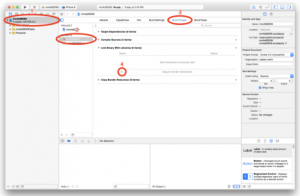
Step 1 – Add framework into the project.
Step 2 – Add Objective-C bridging header file.

Step 3 – Under the hood, this is a simple Crypter Struct that works with CommonCrypto.
protocol Randomizer {

static func randomIv() -> Data

static func randomSalt() -> Data

static func randomData(length: Int) -> Data

}
protocol Crypter {

func encrypt(_ digest: Data) throws -> Data

func decrypt(_ encrypted: Data) throws -> Data

}
struct AES256Crypter {

private var key: Data

private var iv: Data

public init(key: Data, iv: Data) throws {

guard key.count == kCCKeySizeAES256 else {

throw Error.badKeyLength

}
guard iv.count == kCCBlockSizeAES128 else {

throw Error.badInputVectorLength

}

self.key = key

self.iv = iv

}
enum Error: Swift.Error {

case keyGeneration(status: Int)

case cryptoFailed(status: CCCryptorStatus)

case badKeyLength

case badInputVectorLength

}
private func crypt(input: Data, operation: CCOperation) throws -> Data { var outLength = Int(0)

var outBytes = [UInt8](repeating: 0, count: input.count + kCCBlockSizeAES128) var status: CCCryptorStatus = CCCryptorStatus(kCCSuccess)

input.withUnsafeBytes { (encryptedBytes: UnsafePointer<UInt8>!) -> () in iv.withUnsafeBytes { (ivBytes: UnsafePointer<UInt8>!) in

key.withUnsafeBytes { (keyBytes: UnsafePointer<UInt8>!) -> () in status = CCCrypt(operation,

CCAlgorithm(kCCAlgorithmAES128), // algorithm

CCOptions(kCCOptionPKCS7Padding), // options

keyBytes, // key

key.count, // keylength

ivBytes, // iv

encryptedBytes, // dataIn

input.count, // dataInLength

&outBytes, // dataOut

outBytes.count, // dataOutAvailable

&outLength) // dataOutMoved

}

}

}
guard status == kCCSuccess else {

throw Error.cryptoFailed(status: status)

}

return Data(bytes: UnsafePointer<UInt8>(outBytes), count: outLength) }

static func createKey(password: Data, salt: Data) throws -> Data { let length = kCCKeySizeAES256

var status = Int32(0)

var derivedBytes = [UInt8](repeating: 0, count: length)

password.withUnsafeBytes { (passwordBytes: UnsafePointer<Int8>!) in salt.withUnsafeBytes { (saltBytes: UnsafePointer<UInt8>!) in

status = CCKeyDerivationPBKDF(CCPBKDFAlgorithm(kCCPBKDF2), // algorithm

passwordBytes, // password

password.count, // passwordLen

saltBytes, // salt

salt.count, // saltLen

CCPseudoRandomAlgorithm(kCCPRFHmacAlgSHA1), // prf 10000, // rounds

&derivedBytes, // derivedKey

length) // derivedKeyLen

}

}
guard status == 0 else {

throw Error.keyGeneration(status: Int(status))

}
return Data(bytes: UnsafePointer<UInt8>(derivedBytes), count: length) }

}

extension AES256Crypter: Crypter {

func encrypt(_ digest: Data) throws -> Data {

return try crypt(input: digest, operation: CCOperation(kCCEncrypt)) }

func decrypt(_ encrypted: Data) throws -> Data {

return try crypt(input: encrypted, operation: CCOperation(kCCDecrypt)) }

}

extension AES256Crypter: Randomizer {

static func randomIv() -> Data {

return randomData(length: kCCBlockSizeAES128)

}

static func randomSalt() -> Data {

return randomData(length: 8)

}

static func randomData(length: Int) -> Data {

var data = Data(count: length)

let status = data.withUnsafeMutableBytes { mutableBytes in

SecRandomCopyBytes(kSecRandomDefault, length, mutableBytes) }

assert(status == Int32(0))

return data

}

}
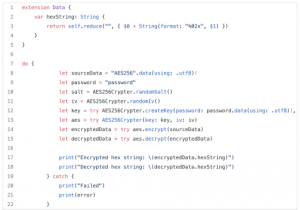
Step 4 – Use crypter where it’s needed.