

Artificial Intelligence is no longer a cutting-edge concept in the healthcare industry. It’s now a key driver of diagnostics, operations, and patient care activities. Still, one question that hinders the AI adoption by C-suite executives is: What is the implementation cost of AI in healthcare industry? This guide breaks down the full cost scenario, right from model selection and data readiness to compliance, integration, and long-term maintenance. Apart from that, we have also outlined expected return on investment for Hospital CEOs, CFOs, CIOs, CMIOs, digital transformation heads, and investors evaluating AI-driven healthcare efficiency.
In short, this guide empowers decision-makers with a clear, practical understanding of AI pricing, ROI timelines, regulatory obligations, and the smartest ways to invest in AI implementation for the healthcare industry. So, let’s know how much you need to spend on your next AI project to deliver measurable business impact instead of surprises.
Why Adopting AI in Healthcare is an Economic Necessity?
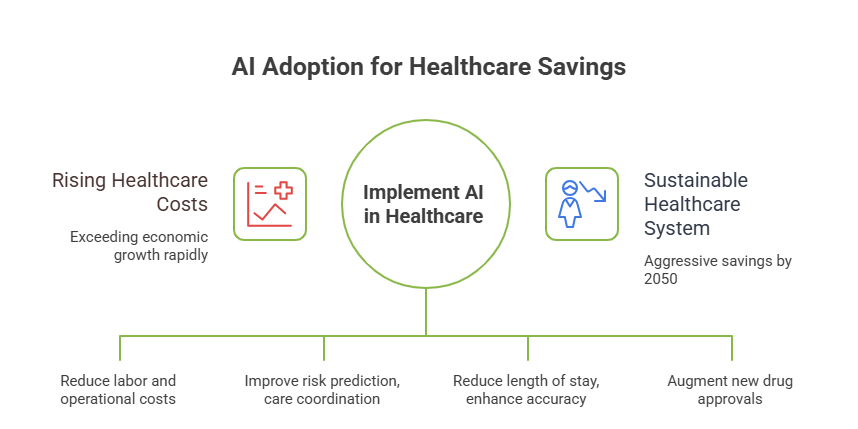
Healthcare costs are increasing at a very fast pace these days, exceeding economic growth in many countries. Just to let you know, the U.S. healthcare expense reached $4.9 trillion in 2023, demonstrating a growth rate of 7.5%. That’s not all, the total health expenditure of the U.S. is expected to rise to 8.5 trillion U.S. dollars by the end of 2033.
Therefore, it is extremely necessary to boost annual savings aggressively in the next 25 years to keep the economy and your organization sustainable in the long run. And to achieve that goal, all you need to do is learn the implementation cost of artificial intelligence in healthcare and adopt it immediately to achieve savings at a large scale. Also, what you need to know is that:
1. AI Reduces Cost Pressure
Hospitals operate on very thin margins, which makes it difficult to deal with increasing labor and operational costs. To resolve this issue, it makes sense to adopt AI in the healthcare industry for staffing optimization, predictive scheduling, and supply chain automation. By doing this, you can reduce hospital operating costs by 10–20%, making it easy to accomplish substantial savings by 2050.
2. AI Focuses on Value-Based Care
As reimbursement shifts from fee-for-service to value-based models, performance metrics like readmissions, length of stay, and outcomes directly impact the overall revenue generation. AI plays a significant role in improving risk prediction, care coordination, and clinical decision support, increasing quality scores and reimbursement rates to a great extent.
For the unversed, fee-for-service reimbursement refers to an old-fashioned healthcare payment model where service providers are paid a fixed amount for every service (like a visit, test, or procedure) instead of a bundled payment. On the other hand, value-based models refer to the approach where the reimbursement is done based on the perceived value or outcomes delivered to the patient instead of the total number of services provided.
3. AI Impacts Revenue & Length of Stay
Using AI in healthcare also helps in accelerating throughput and revenue by:
- Reducing length of stay (AI-driven drug discovery shortens hospital stays by 11 to 16%)
- Enhancing clinical documentation and coding accuracy
- Minimizing claim denials and speeding up reimbursement
Even marginal improvements in LOS (Length of Stay) or coding accuracy result in huge revenue increments for hospitals annually.
4. AI-Powered Drug Discovery Minimizes Systemwide Costs
Even though the cost of implementing AI in healthcare is massive, this cutting-edge technology augments the rate of new drug approvals by 10 to 40%. Resultantly, the reduction in clinical care costs could save billions by the end of 2050.
Thus, everything boils down to the point that AI is not just a technology upgrade but the most effective strategy to keep medical services economically sustainable. Businesses that adopt AI early will notice solid gains in cost structure, reimbursement performance, and systemwide efficiency, while those who don’t will face growing financial pressure.
What Drives the Cost of Implementing AI in the Healthcare Industry?
AI is transforming the whole medical industry by enabling early disease detection and precision surgeries. But turning these innovations into realities requires tremendous investment. The cost of implementing AI in healthcare extends far beyond standard software development. It includes everything, right from data infrastructure and compliance to training, maintenance, and long-term operational needs.
So, here we have compiled a list of the top 8 factors that impact the overall cost of AI implementation in healthcare:
1. Development & Customization Requirements
Creating an AI-powered healthcare solution requires extensive research, clinical expertise, and continuous model enhancement. Hence:
- Simple AI automation tools cost $50,000 to $500,000
- Advanced diagnostic or robotic AI systems demand $10 million or more
- Custom AI models need 30% to 40% more investment than off-the-shelf solutions
Not just that, higher complexity, specialized medical applications, and domain-specific training surge development budgets significantly.
2. Infrastructure & System Integration
AI requires robust technological foundations, such as high-performance computing, secure cloud environments, and smooth connectivity with current healthcare systems. To make this possible:
- Cloud storage & compute cost $100,000 to $1 million per year
- Legacy systems upgrade for AI compatibility increases the cost of implementing artificial intelligence by 20 to 30%
Keep in mind that integrating AI with electronic health records, medical devices, and hospital workflows is often one of the most expensive and time-consuming tasks.
3. Regulatory Compliance & Data Protection
Healthcare operates under strict rules such as HIPAA, GDPR, and country-specific medical data regulations. Ensuring compliance adds ongoing expenses, like:
- Compliance audits cost $20,000 to $200,000 annually
- Combined regulatory and security costs up to $1 million per year
- Non-compliance penalties go over $1.5 million per violation per year
So, security, encryption, and risk assessments are constant drivers of the cost of AI in healthcare because of sensitive patient data.
4. Operational Maintenance & Continuous Updates
AI doesn’t align with a one-time installation approach as it needs continuous refinement to stay safe and accurate in the long run. For instance:
- Annual maintenance covers 15% to 25% of the original development cost
- Compliance & security costs 30% to 50% of the original development cost each year
- Cybersecurity costs $50,000 to $250,000 per year
Hence, continuous monitoring, retraining models, patching vulnerabilities, and adapting to new medical guidelines all add to the long-term cost of implementing AI in the medical ecosystem.
5. Workforce Training & Change Management
AI adoption succeeds only when medical professionals know how to use it effectively. For that reason, you need to put your money on:
- Training programs: $5,000 – $10,000 per employee
- Bias mitigation & model refinement: 10% – 20% of the AI budget
Thus, to run your AI-powered patient care business successfully, you need to invest in training programs and easy-to-use tools. This way, doctors and nurses will feel comfortable using new AI systems, and they will not resist adopting them.
6. Hidden Costs That Many Organizations Overlook
Besides the direct investments, several hidden factors influence the cost of artificial intelligence in healthcare, such as:
- Data privacy & security challenges
- Bias correction & ethical oversight
- Legal safeguards & malpractice liability
- System downtime & transition support
- Patient & provider adoption programs
These hidden costs can account for 30 to 50% of the total cost of AI implementation in healthcare.
7. Costs Vary Significantly by AI Application
Different AI use cases come with different price tags, which are affected by various factors, for example:
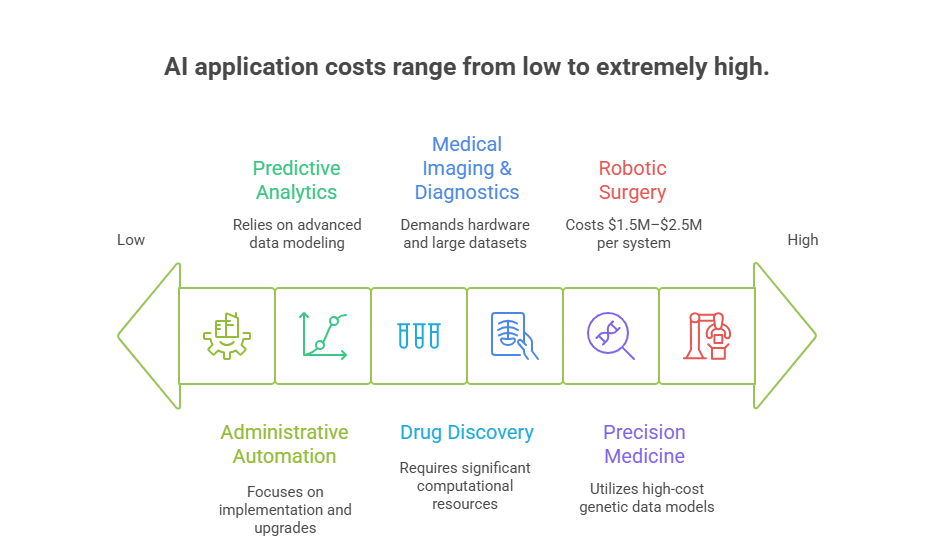
Bear in mind, high-end AI technologies, such as robotic systems, require a large upfront investment, while administrative automation is more cost-efficient.
8. Factors That Influence Total Cost
Multiple factors influence the final cost of implementing artificial intelligence in the medical industry, such as:
- Model type & complexity
- Data volume, quality, and labeling
- Regional compliance requirements
- Integration with legacy IT systems
- Scalability needs & ongoing support
To get a rough idea, you can note that the basic AI-powered solutions start from $50,000, whereas enterprise-grade AI systems surpass $10 million, depending on the aforementioned factors.
Now, if you are thinking whether investing in AI implementation is worth it or not, we must let you know that the global AI in healthcare market size is valued at USD 36.96 billion in 2025 and is expected to hit the USD 613.81 billion mark by 2034. It means this sector is growing, and if you want to minimize long-term healthcare costs by 30% to 50% in areas like diagnostics, patient management, and administrative workflows, AI is the way to go.
AI in Healthcare: Use Cases and Their Cost Ranges (2025–2030)
The cost of implementing AI in healthcare differs widely depending on the functionality, complexity, and data requirements for every solution. Here is a table showing common types of AI solutions, their use case in the healthcare field, and estimated development time & cost:
| AI Solution | Use Case in Healthcare | Development Time | Expected Cost |
| Machine learning algorithms | Predictive analytics, risk scoring, and data classification | 3 – 6 months | $150,000 – $200,000 |
| Generative AI (powering LLM models) | Clinical documentation and healthcare chatbots | 6 – 12+ months | $250,000 – $500,000+ |
| Neural networks | Complicated pattern recognition and diagnostic tools | 6 – 9+ months | $200,000 – $300,000+ |
| AI-powered robotic process automation (RPA) | Automating admin tasks, like billing, patient intake, etc. | 3 – 6 months | $100,000 – $250,000 |
| Computer vision | Image/video diagnostics facilitating radiology and pathology | 6 – 12 months | $180,000 – $400,000+ |
| Overall cost range | Specialized application in hospitals and clinics | 3 – 12+ months | $100,000 – $500,000+ |
End-to-End Framework for Cost of Implementing AI in Healthcare: From Ideation to Deployment
Implementing AI in healthcare is not just a tech change, but a complete transformation that covers infrastructure, clinical workflows, regulatory oversight, and long-term operational administration. It requires capital, compliance, and deep expertise for seamless execution. And for most companies out there, the biggest risk isn’t AI failure, but underestimating the true cost of implementing artificial intelligence in the medical industry and the complexity required to achieve FDA-level deployment.
Here is a clear, end-to-end cost framework that shows what C-suite executives in the healthcare field must plan for when moving from use-case ideation to complete regulatory approval and monetization.
1. Infrastructure: Hardware, Cloud & Edge Compute
Estimated Cost: $50,000 – $1M+
Infrastructure is the foundation of AI-powered solutions, which is often the first major investment for leaders in the healthcare industry. It includes:
- Cloud Computing: It is quite flexible but can become costly with high-volume clinical inference. LLM-driven systems, like clinical summarization, can cost $0.001 – $0.02 per token, increasing the overall amount across thousands of daily interactions. For the uninitiated, inference refers to a pre-trained AI model that analyzes new data and generates real-life predictions, decisions, or insights.
- Edge Devices: Wearable-integrated edge AI chips or hospital machines equipped with local inference engines can set you back by $5,000 – $25,000 per device, depending on features and manufacturer partnerships.
- GPU Clusters: Patient care facilities availing on-premises control pay somewhere between $250,000 and $500,000 to train hardware.
Your choice between cloud, on-premises, or hybrid architectures depends on HIPAA constraints, latency tolerance, and long-term scalability. Similar considerations are important when designing telecom AI solutions, particularly for applications that require real-time analytics, edge computing, and high-volume data processing.
2. Data Preparation: Cleaning, Labeling & Compliance
Estimated Cost: $50,000 – $500,000+
The performance of AI models is mainly dependent on the data that developers feed them. And in the healthcare sector, data is messy, fragmented, and highly sensitive, which makes it difficult to prepare it for the model training due to high labor and cost requirements. Consequently, the cost of implementing artificial intelligence in the medical field looks like:
- Annotation: Medical imaging labeling by certified radiologists can cost $100,000 to $200,000 per 10,000 scans.
- ETL Pipelines: Extracting, transforming, and loading data from EHR (Electronic Health Record) systems into structured formats can cost thousands of dollars and consume several weeks of engineering time.
- Compliance Work: De-identification, HIPAA/GDPR audits, and privacy impact assessments incur extra costs and result in further delay. Here, privacy impact assessment is all about a systematic process to assess how a new project or system might influence individual privacy, identify possible risks, and implement controls to ensure data is gathered, used, stored, and shared in a responsible manner.
For custom models, data preparation usually emerges as the single largest hidden cost of implementing AI in healthcare sector.
3. Model Development: Build, Fine-Tune, or License
Estimated Cost: $100,000 – $1.5M+
The core AI model development is the stage where the strategy is divided into three options:
- Build from Scratch: Crafting deep learning models for diagnostics, such as detecting pneumonia from chest X-rays, can cost around $250,000 to $500,000, including data collection, training, and evaluation.
- LLM Licensing: Enterprise-grade LLM use for patient care can reach $100,000 to $500,000 annually, especially for fine-tuned models for the medical industry.
- Fine-Tuning Open-Source Models: Doing this adds another $50,000–$200,000 to the implementation cost of AI in healthcare, depending on complexity and clinical risk
Generally, startups use open-source models with little tuning to build MVPs (Minimum Viable Products), while medical enterprises invest more in regulatory-level, explainable models with high interpretability.
4. Integration: EHR, Middleware & Clinical Interfaces
Estimated Cost: $100,000 – $700,000
An AI model is useful only when it is integrated with the workflow of your hospital management system. Most hospitals often use systems like Epic or Cerner, and making your AI model interact with them requires a huge investment. Take, for instance:
- EHR Integration: Cost for such integration varies depending on Epic/Cerner APIs, HL7/FHIR dependencies, and vendor interface fees. Here, HL7 and FHIR stand for Health Level Seven and Fast Healthcare Interoperability Resources, respectively. And “vendor interface fees” are charges for using a digital platform (vendor interface) to interact with the systems of a company, usually for payments or data exchange.
- Middleware & APIs: They are needed to connect AI engines with clinical dashboards and hospital apps, which again adds to the overall cost of AI implementation in healthcare.
- UX/UI: Creating a clean, simple, and intuitive interface for non-technical users such as patients, nurses, and radiologists significantly contributes to the overall design and development cost of implementing AI development services for healthcare.
Please remember that if an AI system can’t generate relevant insights at the right time and in the right format, the entire AI adoption will suffer, no matter how great the model is.
5. Clinical Validation & Regulatory Approval
Estimated Cost: $100,000 – $1M+
In many countries, AI tools that impact medical treatment qualify as Software as a Medical Device (SaMD), which must undergo clinical validation and regulatory review, like:
- FDA 510(k): Preparation, documentation, testing, and legal support incur costs of around $200,000–$500,000.
- Clinical Trials: For higher-risk use cases, real-world validation can cost more than $300,000.
- Post-Market Surveillance: Once deployed, AI models need continuous monitoring to identify accuracy and safety issues, which adds to further operational expenditure.
Also, deploying healthcare AI models globally requires CE marking for the European Union, CDSCO approval for India, and other local clearances, which account for different costs and timelines.
6. Human Resources: Cross-Disciplinary Expertise
Estimated Annual Cost: $250,000 – $1.2M+
AI tool development for the medical field requires a perfect combination of medical and technical talent, such as data scientists and medical professionals, which results in the additional cost of implementing AI in healthcare. For example:
- Data Scientists and MLOps Engineers: Their salaries range from $100,000–$200,000 per year, per person, plus benefits.
- Clinical AI Translators: Experts who understand both medicine and machine learning charge $150,000 or more.
- Compliance & QA Teams: They need to be in your team to audit outputs and ensure alignment with legal and ethical frameworks.
Small patient care service providers often outsource this expertise, while larger ones build in-house teams, driving the long-term maintenance cost of AI in healthcare.
7. Training & Organizational Change Management
Estimated Cost: $30,000 – $200,000+
Even the best technology fails when deployed in real life without clinical trust and proper onboarding. AI tools are solutions that change how decisions are made, but they require proper training. For instance:
- Clinician Training: Onboarding sessions, train-the-trainer programs, and refresher workshops can cost $10,000–$50,000 for mid-sized launches. Here, train-the-trainer programs refer to programs that teach subject matter experts how to train, coach, and simplify learning for others, creating internal training capacity within an organization.
- Workflow Redesign: Updating hospital policies to reflect AI decision support leads to extra legal and administrative work.
- Feedback Loops: Continual UX optimization, helpdesk staffing, and user engagement surveys help increase adoption and reduce abandonment among medical professionals.
Often, C-suite executives do not pay attention to this particular cost of implementing AI in healthcare during budgeting, but it is important to achieve sustainable success.
8. Maintenance, Monitoring & Long-Term Governance
Estimated Monthly Cost: $15,000 – $100,000
Even after an AI model is deployed, it needs attention in terms of monitoring and maintenance. It’s because clinical environments change, guidelines evolve, and new data patterns emerge over time, introducing inaccuracy and faulty decisions in AI models.
- Model Drift Monitoring: Model drift shows the decline in an ML model’s predictive performance over time because of real-world data and pattern change, resulting in inaccurate predictions and faulty decisions. This is why it is necessary to regularly evaluate accuracy, false positives, and negative outcomes of the AI model. Here, a false positive indicates a test result that incorrectly shows that a particular condition is present.
- Retraining Cycles: It is needed to perform every 6 to 12 months, depending on the use case.
- Security & Patch Updates: This is required specifically for cloud-deployed or LLM-based tools, as continuous updates are necessary for AI models to stay compliant and secure.
The cost of implementing artificial intelligence in the healthcare industry can easily exceed the initial development cost over a 5-year total cost of ownership.
Thus, everything concludes to the point that only healthcare leaders who understand this full cost framework without any doubt are better prepared to avoid budget exceeding, speed up time-to-market, and deploy AI that is scalable, compliant, and clinically trusted.
Real-World Examples of AI Models with Cost, Timeline, Team Size, and ROI
| AI Solution | Cost Range | Timeline | Typical Team Size | ROI / Financial Impact |
| AI Medical Summarization Software | $50,000–$500,000 | 3–24 months | 4–10 (PM, AI/ML engineer, Backend dev, QA) | 40X faster summarization, 3X cheaper processing, $10K annual savings per professional |
| AI Symptom Checking App | $30,000–$500,000+ | 2–16 months | 5–12 | Potential to achieve $100M annual revenue, lowers clinician workload, early-intervention leads to cost reduction over time |
| AI Triage Chatbots & Assistants | $40,000–$500,000+ (for enterprise up to $2.1M) | 3–18 months | 4–12 | Cuts care delivery overhead by 40%, screens 30K+ patients, large-scale systems save $1.4M per year |
| AI Treatment Plan Generation Software | $60,000–$800,000 | 4–24 months | 6–14 | 65% efficiency gain, saves $95K per physician per year, reduces plan cost from $600 to $200 |
| AI Medical Imaging & Diagnostics Software | $100,000–$1.5M+ | 6–36 months | 8–20 (AI, radiology SME, imaging engineers) | Saves 3.3 hrs/day, 30% fewer false positives, ROI in 2–4 years |
| AI-Powered Scheduling & Administration | $40,000–$700,000 | 3–18 months | 4–10 | 20–30% fewer no-shows, 10–15% better provider utilization, ROI in 12–18 months |
| AI Clinical Documentation & Virtual Scribes | $50,000–$600,000 | 3–24 months | 5–12 | Cuts documentation time, boosts accuracy, reduces clinician burnout, increases patient-facing hours |
| AI Remote Patient Monitoring (RPM) & Virtual Care | $60,000–$800,000 | 4–24 months | 6–14 | Lowers readmissions, reduces hospital visit costs, improves outcomes through continuous monitoring |
| AI Drug Discovery Software | $200,000–$2M+ | 6–36 months | 10–25 (AI, bioinformatics, chemists) | Accelerates drug discovery, lowers preclinical costs, raises clinical trial success rates |
Read Also: How Much Does It Cost to Create an AI App in 2026?
Final Takeaway: Is AI Worth the Multi-Million Dollar Investment?
Now that you have read the entire content, you must have understood that the cost of AI implementation in healthcare is not small. Implementing cloud infrastructure, software, regulatory compliance, updates, and other things takes time and resources that can cost millions of dollars. However, the benefits of AI, like improved accuracy, efficiency, and patient outcomes, translate into huge cost savings that justify the cost of AI implementation in healthcare. Still, before proceeding with the AI spending, medical enterprises should:
- Consider conducting a holistic cost-benefit analysis
- Follow pilot programs until a full launch
- Think of working with AI merchants that have relevant infrastructure experience and compliance knowledge, like InnovationM
Frequently Asked Questions About the Cost of AI in Healthcare
1. How much does AI cost for a 50-bed hospital?
The implementation cost of AI in healthcare depends on use-case complexity, workflow integration depth, data readiness, and whether the solution is off-the-shelf or custom-built. Clinical models requiring FDA compliance, heavy EHR integration, or large data pipelines cost significantly more than administrative AI tools that operate alongside existing systems.
2. What is the cost difference between GPT-based vs custom AI models?
GPT-based solutions cost less because they use shared cloud models with minimal data and regulatory needs. Custom models require annotated datasets, clinical validation, specialized infrastructure, and MLOps. The price difference depends on ownership requirements, risk tolerance, compliance pathways, and engineering complexity, not just the model type.
3. How long will it take for AI to pay back its investment?
It takes almost 6 to 18 months for most hospitals to get back their investment in AI initiatives. Fastest payback comes from documentation AI, radiology triage, and RCM automation.
4. Can AI replace radiologists or nurses?
No. AI augments clinicians’ abilities, accelerates workflows, and reduces burnout. Regulatory bodies classify AI as a decision-support system, not a replacement.
5. Do hospitals own the data used in AI training?
Hospitals typically own or control patient data, but ownership during AI training depends on how data-sharing agreements are structured. The hospital must ensure HIPAA/GDPR compliance, de-identify patient information, and define whether the AI vendor can reuse the data. Clear contracts, covering access rights, storage, reuse, and deletion, determine actual data ownership and governance.
6. What is the cheapest way to start with AI?
The most affordable method is using off-the-shelf AI tools that require minimal integration and no model development. The cost of AI implementation in healthcare depends on data quality, cloud readiness, workflow complexity, and vendor support. Starting with lightweight administrative or documentation AI avoids major engineering and regulatory overhead.
7. Are there off-the-shelf AI tools available in the market?
Yes, and they mature rapidly. They offer minimal integration, lower risk, and fast time-to-value, especially for small and mid-size hospitals.