Developing mobile apps creates a win-win situation for both users and stakeholders. On one hand, customers are leveraging convenience in their daily lives, while on the other hand, businesses are generating massive revenue through mobile applications.
As per Grand View Research, the global mobile application market size was estimated to be worth USD 252.89 billion in 2023, which is expected to become USD 626.39 billion in 2030. But the question comes: how can you earn a significant portion of this amount in the near future?
Well, that’s where the latest mobile app development trends come into the picture. By building a cutting-edge mobile application powered by modern technologies, you can attract high traffic, boost engagement, and drive conversions for increased revenue.
Here is a list of new mobile app development trends that you must integrate into your application in 2026:
Top 10 Mobile App Development Trends You Must Know
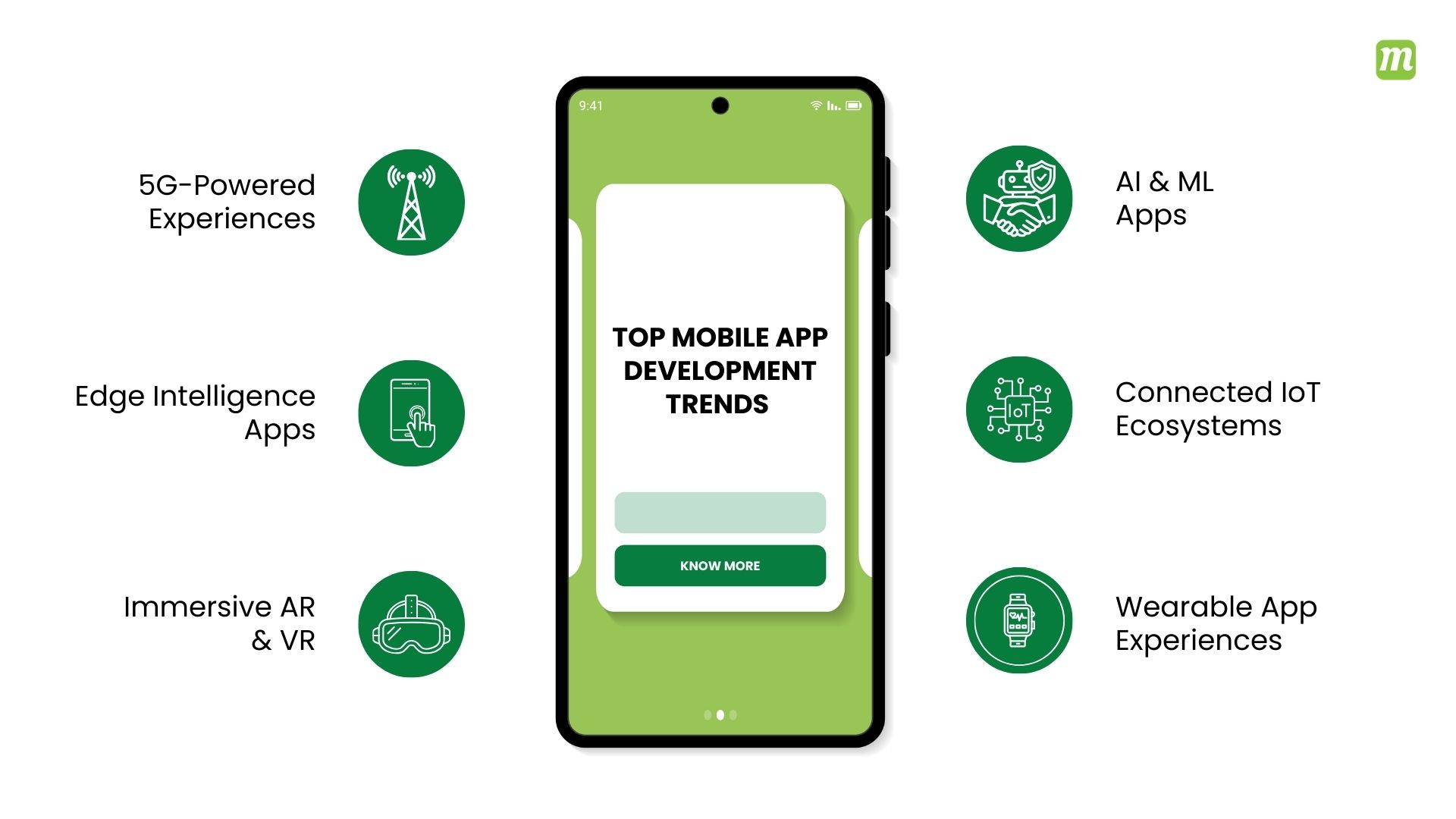
1. 5G-Powered Experiences
Gone are the days when 5G was treated as just a simple connectivity upgrade. Nowadays, it is drastically changing how mobile applications perform and scale. For most business owners out there, integrating these mobile app development trends for 2026 into existing applications means leveraging superfast load times, negligible latency, and smooth real-time experiences.
This directly leads to longer session durations, higher user engagement, and increased conversion rates. Such benefits make a significant difference in data-heavy use cases, such as:
- Video streaming
- Multiplayer gaming
- Fintech transactions
- IoT-powered applications
2. Immersive AR & VR
Augmented Reality and Virtual Reality are not just cutting-edge technologies for mobile app development for startups, but powerful business tools. For most leaders in the market, these mobile app development trends for startups provide a new way to engage users, reduce decision friction, and boost confidence during digital interactions.
The C-suite executives from the retail background can enable virtual try-ons, manufacturing or logistics companies can offer remote assistance & training, and real estate firm owners can provide immersive property walkthroughs. Doing such things will not just reduce costs but also improve results for businesses, for example, immersive experiences enhance:
- User engagement
- Emotional connection
- Brand recall
3. Edge Intelligence Apps
Edge computing is transforming mobile app architecture by shifting data processing closer to users, for example, on devices or nearby edge servers. For senior leadership, this translates into faster decision-making, reduced latency, and minimal cloud costs. Mobile applications that require real-time responses benefit extensively from edge-enabled architectures, like:
- Fintech fraud detection
- Healthcare monitoring
- Autonomous systems
- Location-based services
If you look at these mobile app development trends for SMBs from the business perspective, edge computing enhances user experience during traffic spikes and ensures continuity even with limited connectivity. The good news for small and medium-sized companies is that they can benefit from optimized infrastructure costs and gain a competitive edge in the market through smarter, faster, and more resilient digital products.
4. AI & ML Apps
Artificial intelligence is trending in 2026 and is going to be more popular in the upcoming years. Many app development companies in India prefer AI and machine learning for their application development. Now, most search engines and virtual assistants support AI.
The popularity of virtual communication is increasing rapidly and replacing face-to-face contact. Applications like Siri support the users by helping them with multiple things; All the credit goes to cloud computing, which has brought great strength to create smart devices and add AI models.
The amalgamation of Artificial Intelligence and machine learning solutions into the mobile application world will hold a special place in the hearts of mobile application users globally.
5. Connected IoT Ecosystems
The Internet of Things is now ruling the world; this technology is winning hearts worldwide by making their interaction and lifestyles smarter. IoT provides a simple and relatively convenient environment for users to interact with their smart devices and appliances in real-time. Now, more and more users prefer to manage their electronic devices or appliances with smart applications.
Billions of people are going to use IoT in the upcoming years to manage everything in real-time, from kitchen appliances to their smartphones. The potential for data sharing within the network makes IoT the most preferred mobile application trend in 2026.
6. Wearable App Experiences
There was a progressive growth in wearable technology a few years ago. Many applications have been introduced in the market to monitor health and avoid the COVID-19 outbreak. Smart wearable devices could be an ideal replacement for smartphones, specifically in the Healthcare sector. And soon, it is going to become an important part of our lives.
Along with that, many in-app payment solutions and mobile banking application solutions have appeared in the past year. This idea of contactless payment is going to strengthen in 2026.
7. Cross-Platform Development
Instead of working with native applications written in native languages for Android and iOS, the application developers prefer a Cross-platform approach for app development. Applications are built with React Native, Flutter, Xamarin, and hybrid JS-based applications.
In other words, we can say that the native software is not the only or universal option available anymore. The highly interactive applications, like games with advanced features in some specific cases, will use native development. Perhaps, creating a cross-platform solution capable of working offline and faster would be an ideal option.
8. Instant App Experiences
The instant app concept was introduced by Google a decade ago as new software. It is the most demanded software from the developer’s perspective and incredibly convenient from the user’s perspective.
One can use the instant application straight away by using the link in their email, search engine, or messenger. But, only the fully featured demo versions get the promotion like this. Still, these solutions boost the downloading rate and increase the overall software promotion.
The major benefits included are:
- Lightweight software.
- Unbeatable UX with minimum downsides and distractions.
- Availability of web-like functionalities.
Instant applications allow users to play online games without actually installing them on their devices. These applications are compatible across the Android platform, cover minimum space, and share the best UI design and friendly user experience. Instant applications are particularly useful for E-Commerce and the gaming industry.
9. Voice-First Interfaces
Voice communication and recognition are already bringing rapid changes in the Retail Industry, Telemarketing, and Customer Service. In the upcoming years, many people will prefer to browse only using voice instructions.
The voice user interface (VUI) uses voice recognition technology to provide a stable connection between the user and the device for a specific technology. It not only helps to understand the present needs but also to incorporate future predictions. So, if you are running an Android App Development Company, you should consider paying attention to this mobile application development trend this year.
10. Mobile-First Entertainment
The pandemic has engaged people in leisure activities and changed their way of shopping. Also, the gaming industry got a huge benefit from this situation, especially the mobile segment. Lockdown has increased the time people spend using their smartphone devices and increased the popularity of applications and games.
Gaming applications with Augmented reality, like Witcher Monster Slayer or Pokémon Go, and streaming applications like Netflix are great alternatives to stay busy while social distancing. This trend is going to boost the mobile entertainment and gaming industry this year.
How the Future of Mobile App Development Will Redefine User Experiences and Business Value?
The future of mobile app development is powered by rapid technological evolution and exceeding user expectations. As revolutionary innovations come together with proven technologies, mobile apps are becoming quicker, smarter, and more integrated into the everyday lives of users.
Companies that leverage such changes in mobile app development trends will notice new growth opportunities, offer highly personalized experiences, and build practical digital products. All these will then drive long-term engagement, efficiency, and competitive advantage in tomorrow’s mobile-first world.
Final Thoughts
With each passing year, innovations and trends come into existence and bring unexpected changes to society. To share the best user experience, the mobile application trends are constantly changing, and you need to adapt them to stay ahead. To build a successful mobile application, you must consider all the emerging and latest trends to dominate the mobile application industry in 2026.
Only those who embrace the changes are going to win any business battle in terms of technology. So, if you want to be one of them, you need a trustworthy mobile application development company on board.
Frequently Asked Questions About Mobile App Development Trends
1. What are the latest mobile app development trends?
The latest mobile app development trends are AI-powered personalization, 5G-enabled experiences, voice-based interfaces, super apps, fintech innovation, and cloud-native development. These trends help organizations scale faster, optimize engagement, and offer high-performance digital experiences.
2. What mobile app development trends will dominate in 2026?
The mobile app development trends that will dominate in 2026 are 5G integration, edge computing, AI-driven automation, AR/VR experiences, and cross-platform frameworks. These trends will empower real-time interactions, richer user experiences, and faster time-to-market for digital mobile applications.
3. Which are the latest technologies shaping mobile app development today?
The latest technologies shaping mobile app development today are artificial intelligence, machine learning, edge computing, blockchain, cloud-native architectures, IoT integration, and advanced analytics. The combined use of these technologies helps mobile app development companies create smart, scalable, and highly responsible applications across different industries.
4. What does the future of mobile app development look like?
The future of mobile app development focuses on smart, immersive, and connected experiences. Upcoming applications will become more context-centric, utilize real-time data, and focus on offering personalized value without compromising on security, scalability, and performance.
5. How are new technologies transforming modern mobile applications?
New technologies are transforming modern mobile applications by allowing real-time processing, immersive user experiences, predictive personalizations, and smooth integrations. The top technologies like AI, AR/VR, 5G, and cloud platforms enable apps to go beyond standard functionality and become robust engagement and conversion engines.
6. Which mobile app development frameworks are most popular right now?
Mobile app development frameworks that are very popular right now include Flutter, React Native, Kotlin, Swift, Ionic, and Xamarin. These frameworks help companies develop performance-oriented and reliable applications efficiently while minimizing development costs.