
Data is everywhere in today’s businesses, from CRMs and ERPs to cloud applications, databases, and third-party tools. The challenge isn’t collecting data anymore; it’s getting all of it to work together. When information is spread across multiple systems, teams often deal with duplicate records, inconsistent reports, and slow decision-making.
That’s where enterprise data integration platforms come in. They connect your data sources, automate data movement, and ensure everyone in the organization is working with accurate, up-to-date information. Whether you’re building a data warehouse, improving business reporting, or preparing your organization for AI and automation, the right integration platform can make the entire process faster and more reliable.
In this guide, we’ll explain what enterprise data integration platforms are, the features you should look for, and compare some of the best solutions available today to help you find the right fit for your business.
What is an Enterprise Data Integration Platform?
An enterprise data integration platform is a software system that collects, cleans, transforms, and combines raw data from many different company sources. It creates a single, unified view of information so teams can run business analytics, automate workflows, and make smart choices.
Core Functions
- Data extraction: Pulls raw data from cloud apps, local databases, and external files.
- Transformation: Cleans errors, removes duplicates, and changes data into a useful format (using methods like ETL or ELT).
- Consolidation: Sends the clean data to a central place like a data warehouse or data lake.
- Orchestration: Schedules and manages automated data pipelines on a regular timeline or in real time.
Main Benefits
- Unified view: Breaks down data silos so every department sees the same numbers.
- Better quality: Fixes incorrect or missing info before users make choices.
- Time savings: Stops workers from moving files or typing data by hand.
- Security: Adds safety rules and trackable access to meet legal needs
Why Businesses Need Enterprise Data Integration Platforms
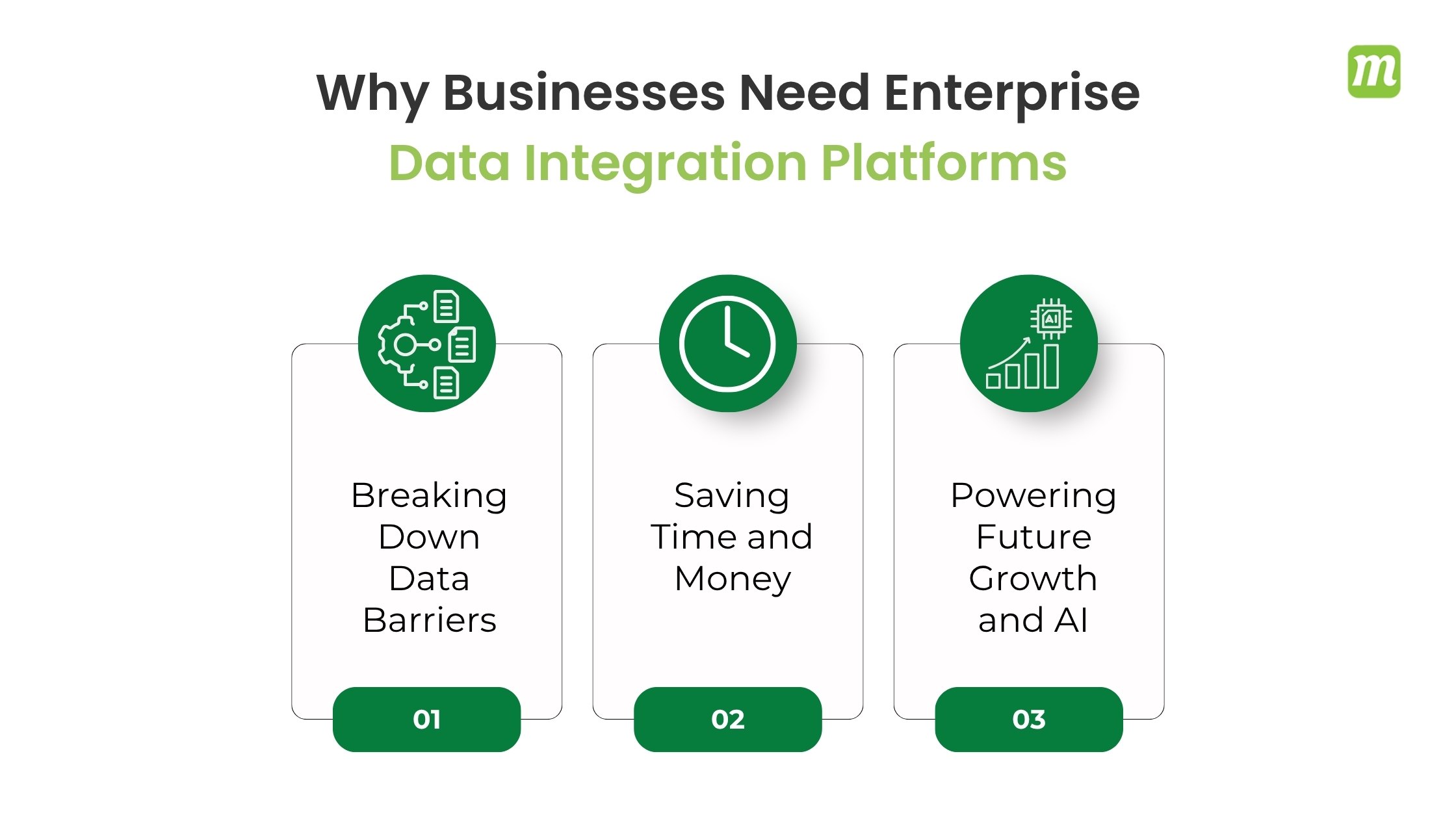
Businesses need enterprise data integration platforms to combine information from many separate tools into one clear, reliable view. These platforms stop data from getting trapped in isolated groups, cut down on manual work, help teams make faster and better choices, and provide clean data required for modern artificial intelligence tools.
Breaking Down Data Barriers
- No more isolated files: Connects sales, marketing, and finance systems so everyone sees the same facts.
- Clean information: Fixes spelling mistakes, removes duplicate files, and matches formats automatically.
- Single source of truth: Gives leaders a trusted place to look for real-time reports.
Saving Time and Money
- Less manual work: Stops workers from copying and pasting data by hand between different apps.
- Fewer mistakes: Lowers human error during data entry.
- Lower IT costs: Replaces messy, custom code connections with standard, easy-to-fix tools.
Powering Future Growth and AI
- Ready for AI: Feeds clean, steady data into machine learning models so they give accurate answers instead of mistakes.
- Easy scaling: Grows smoothly as the company collects more data over time.
- Better security: Keeps company and customer information safe under one set of rules.
Key Features to Look for in an Enterprise Data Integration Platform
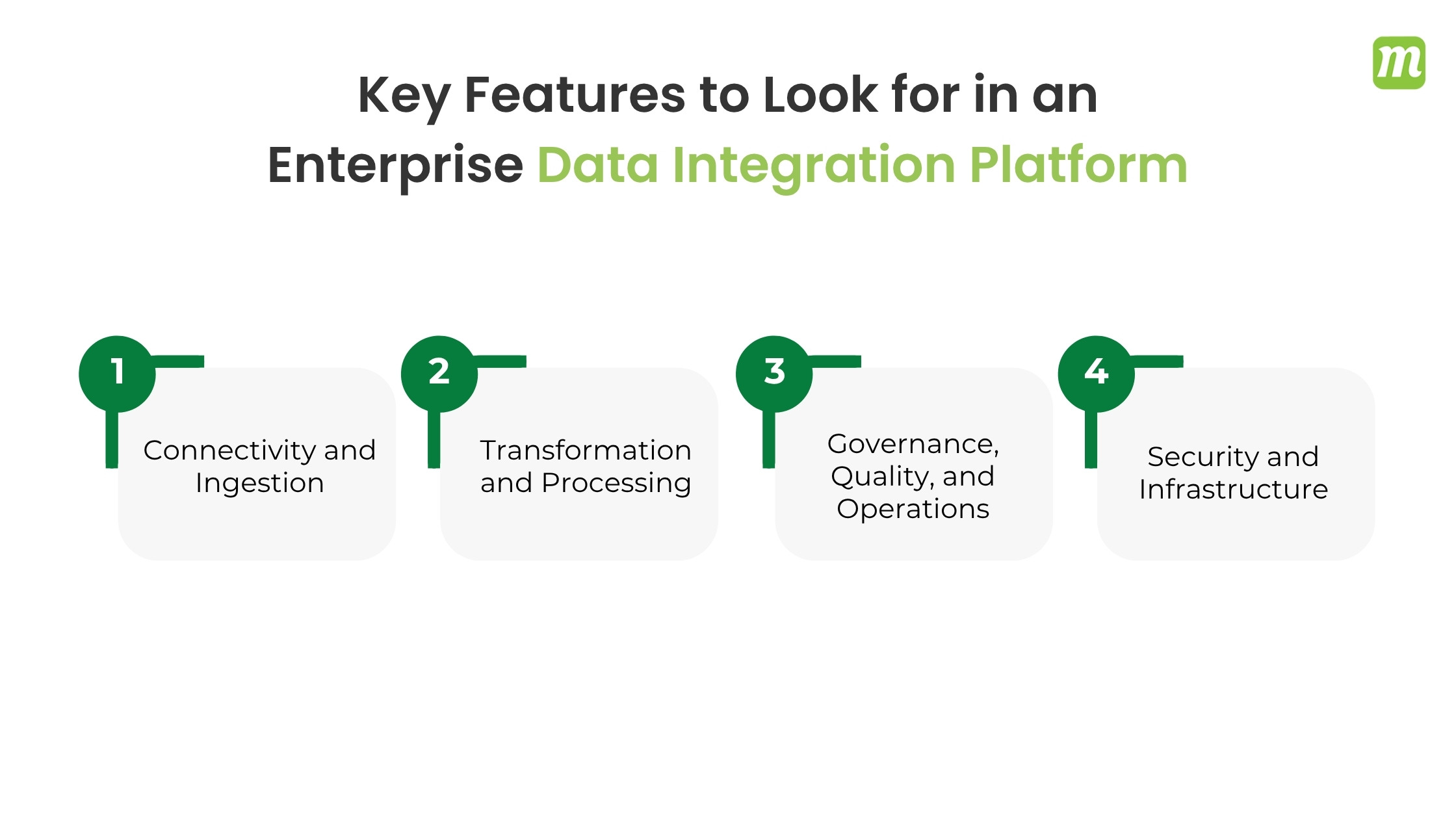
An enterprise data integration platform requires robust connectors, real-time streaming and CDC (Change Data Capture), automated transformations, ironclad governance and security, and high scalability. These capabilities ensure data flows safely and accurately from diverse sources to modern cloud warehouses.
Connectivity and Ingestion
- Pre-built connectors: Out-of-the-box integrations for SaaS apps, legacy databases, mainframes, and multi-cloud data warehouses.
- Real-time and batch support: Ability to handle both continuous event-streaming and scheduled bulk loads.
- Change Data Capture (CDC): Captures database row changes instantly without hurting source system performance.
Transformation and Processing
- Low-code/No-code mapping: Visual drag-and-drop interfaces alongside code options for complex transformations.
- In-flight processing: Cleans, masks, and aggregates data while it moves through the pipeline.
- AI-assisted mapping: Smart recommendations that automate field matching and schema drift adjustments.
Governance, Quality, and Operations
- Data quality rules: Automatic detection of duplicates, missing values, and formatting errors.
- Lineage and catalogs: End-to-end tracking of data origins, transformations, and usage compliance.
- Observability and alerts: Real-time health metrics, automated failure notifications, and detailed audit logs.
Security and Infrastructure
- Role-based access control: Granular permissions and secure credential vaults.
- Encryption: Standard data encryption both in transit and at rest.
- High scalability: Elastic compute resources to grow smoothly with expanding enterprise data volumes.
Best Enterprise Data Integration Platforms
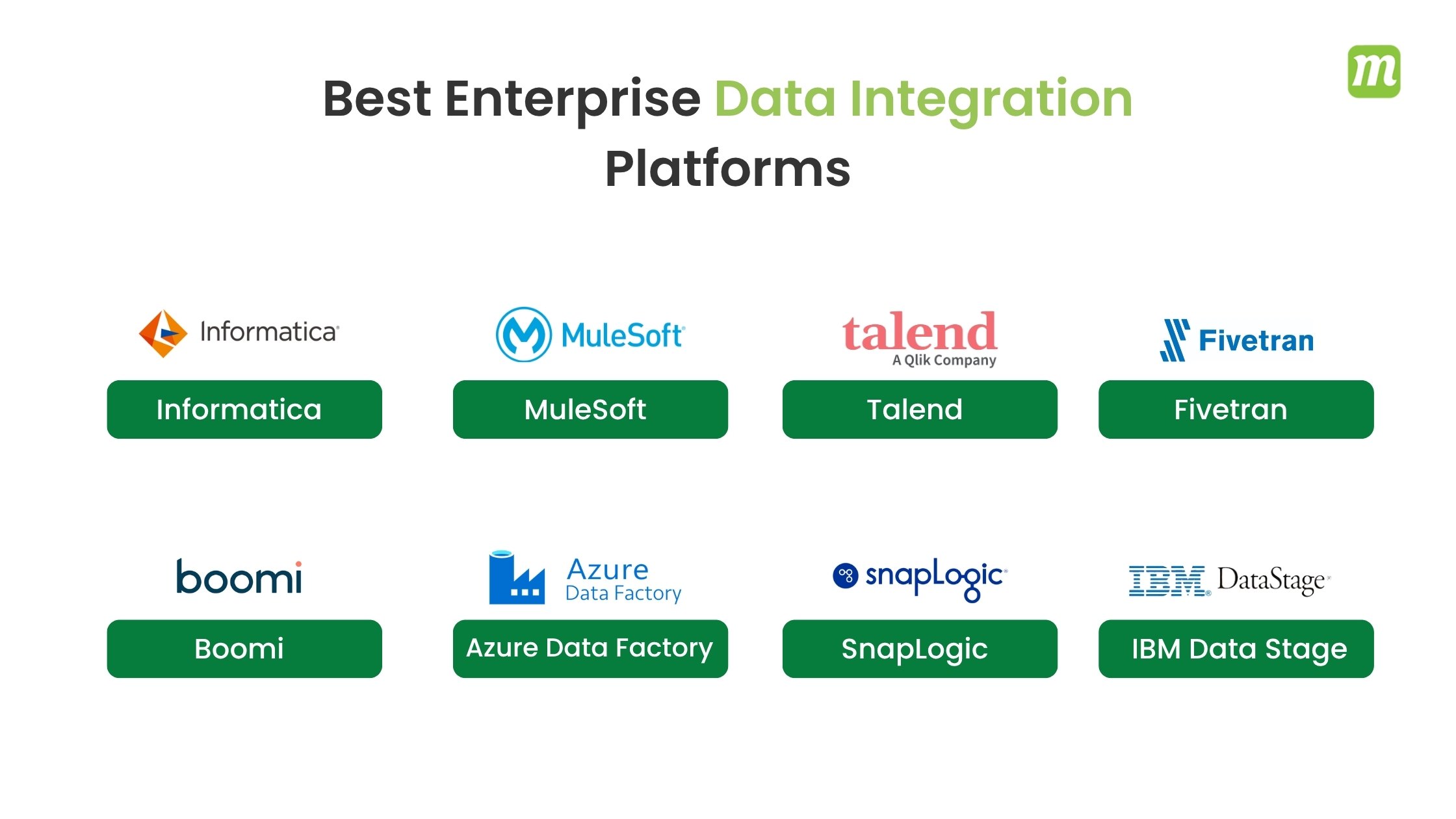
Top enterprise data integration platforms include Informatica for deep governance, MuleSoft for robust API orchestration, Qlik Talend for unified quality management, Fivetran for automated ELT pipelines, and cloud-native options like Microsoft Azure Data Factory and AWS Glue.
Leading Enterprise Platforms
1. Informatica
Informatica provides the Intelligent Data Management Cloud (IDMC), an AI-powered, cloud-native enterprise data integration platform. It uses a low-code/no-code visual framework and the CLAIRE AI engine to build, automate, and govern data pipelines, supporting hybrid and multi-cloud environments across major providers like AWS, Azure, and Google Cloud.
Core Capabilities
- Cloud Data Integration (CDI): Uses drag-and-drop tools and pushdown optimization to process and transform data efficiently.
- Cloud Mass Ingestion: Handles bulk data loading, database replication, and change data capture (CDC) for real-time streams.
- Cloud Application Integration: Manages APIs and real-time event-driven processes across disparate apps.
- Data Quality & Governance: Identifies errors, profiles datasets, and embeds compliance rules directly into pipelines.
Key Architecture Highlights
- Pre-Built Connectors: Accesses over 300 native connectors for SaaS tools, legacy databases, on-premises systems, and data lakes.
- AI-Driven Automation: Automates metadata tracking, asset discovery, and schema mapping via CLAIRE.
- Elastic Scalability: Supports serverless processing and elastic scaling to match varying enterprise compute workloads.
2. MuleSoft Anypoint Platform
The Anypoint Platform by MuleSoft is a unified, hybrid integration platform designed to link apps, data, and devices using APIs. It helps businesses connect systems on-premises or in the cloud to share data smoothly.
Core Components
- Anypoint Studio: A visual tool for building and editing data flows.
- CloudHub: A cloud service to run integrations without managing hardware.
- DataWeave: A tool to map and change data formats like JSON or XML.
- Anypoint Exchange: A library to share and reuse APIs and connectors.
- Mule Runtime: The core engine that runs integration apps.
Key Benefits
- API-Led Approach: Reusable building blocks speed up new projects.
- Hybrid Deployment: Run workloads in the cloud or on local servers.
- Pre-Built Connectors: Ready-to-use links for common software like Salesforce.
3. Qlik Talend
Qlik Talend Cloud is a unified enterprise data integration and quality platform. It combines Qlik’s real-time change data capture (CDC) with Talend’s data fabric capabilities. The platform automates data pipelines, ensures data governance, and prepares hybrid or multi-cloud data for analytics and AI.
Core Capabilities
- Real-Time Data Movement: Uses log-based change data capture (CDC) for low-latency streaming from mainframes, databases, and SAP into cloud data warehouses.
- Automated Transformations: Offers visual, SQL-based, and AI-assisted data pipeline design to automate data warehouse and lakehouse architectures.
- Data Quality & Governance: Profile, cleanse, and monitor data accuracy across the pipeline lifecycle with automated rules and stewardship tools.
- AI Readiness: Formats and delivers trusted data structures directly to vector stores and LLM platforms for retrieval-augmented generation (RAG).
Architecture & Deployment
- Platform Agnostic: Connects seamlessly across on-premises, hybrid, and multi-cloud targets like Snowflake, Databricks, Google Cloud, and Microsoft Fabric.
- Agentless Ingestion: Minimizes operational impact on source systems during high-volume data transfers.
- Subscription Tiers: Available across options like Starter, Standard, Premium, and Enterprise, scaled primarily by data volume usage.
4. Fivetran
Fivetran is a fully managed, cloud-based data movement platform that automates the Extract, Load, and Transform (ELT) process. It offers over 700 pre-built connectors to securely centralize data from databases, applications, and files directly into cloud data warehouses or data lakes with zero maintenance.
Core Capabilities
- Pre-built Connectors: Over 700 automated connectors for SaaS apps, databases, and event logs.
- Automated Schema Migration: Detects and adapts to source schema changes automatically.
- Incremental Syncs: Efficiently syncs only changed data to save compute power and reduce latency.
- Connector SDK: Allows custom Python connector creation for niche data sources.
Key Benefits
- Zero Maintenance: Eliminates custom pipeline engineering and upkeep.
- ELT Architecture: Loads raw data first, enabling flexible, SQL-based in-warehouse transformations.
- Reliability & Security: Offers enterprise-grade encryption, role-based access, and high idempotency to prevent duplicates.
5. Boomi
Boomi is a cloud-native Integration Platform as a Service (iPaaS) that connects cloud apps, on-premises systems, and data sources using a low-code visual interface. It provides tools for data integration, API management, master data hub governance, and workflow automation.
Core Architecture & Components
- Atoms: Lightweight, single-tenant runtime engines that execute integration processes locally, in the cloud, or at the edge.
- Molecules: Clustered, multi-node runtime setups built for high availability and load balancing on-premises.
- Visual Designer: A drag-and-drop canvas utilizing shapes for connection, logic, and data execution without heavy coding.
- Pre-Built Connectors: Over 1,000 ready-made integration blocks for popular enterprise software like Salesforce, SAP, and AWS.
Key Platform Capabilities
- Data Integration: Extract, transform, and load (ETL) data pipelines between disparate systems.
- API Management: Design, secure, publish, and scale APIs across the enterprise lifecycle.
- Boomi Data Hub: Manage master data quality, synchronization, and “golden records” stewardship.
- AI Readiness: Synchronize clean, unified data pipelines to power enterprise AI models and automated agents.
6. Microsoft Azure Data Factory
Azure Data Factory (ADF) is Microsoft’s fully managed, cloud-based data integration service designed to orchestrate and automate enterprise-scale Extract, Transform, Load (ETL), Extract, Load, Transform (ELT), and data movement workflows. It functions as a serverless, scale-out solution that bridges the gap between disparate on-premises and cloud data silos.
Core Architecture & Components
Azure Data Factory relies on five primary building blocks to build data workflows:
- Pipelines: Logical groupings of activities that perform a specific unit of work together.
- Activities: Individual processing steps within a pipeline (e.g., Copy Activity, executing a Databricks Notebook, or running an Azure HDInsight Hive query).
- Datasets: Named data structures that point to or reference the data you want to use within your activities.
- Linked Services: Much like connection strings, they define the security and connection information needed to connect to external resources.
- Triggers: Scheduled or event-driven execution units that dictate when a pipeline should kick off.
Key Enterprise Features
- Hybrid Connectivity: Features over 100 native, built-in connectors. It effortlessly links multi-cloud data (like AWS S3, Google BigQuery, Snowflake) and on-premises environments.
- Mapping Data Flows: Allows developers to build complex, code-free data transformation logic visually. This logic executes directly on automated, scale-out Apache Spark clusters.
- SSIS Integration: Simplifies cloud migration by allowing organizations to lift and shift existing SQL Server Integration Services (SSIS) packages. They run natively inside managed SSIS Integration Runtimes.
- Integration Runtime (IR): The actual compute engine driving the operations. Azure Data Factory uses three types: Azure IR (cloud data), Self-Hosted IR (private/on-premises data), and Azure-SSIS IR (legacy package execution).
- Built-in Security & Monitoring: Operates inside secure Azure Virtual Networks (VNETs). It integrates with Azure Monitor for single-pane tracking, pipeline alerting, and strict access control.
Common Enterprise Use Cases
Organizations primarily leverage Azure Data Factory to build automated data foundations:
[Raw Sources: SaaS/On-Prem] ──> (ADF Ingestion) ──> [Data Lake Storage] ──> (ADF Mapping Data Flows / Databricks) ──> [Azure Synapse / Fabric] ──> [Power BI Reports]
- Data Lake Hydration: Aggregating relational data, logs, and SaaS applications into central storage.
- Big Data Preparation: Cleaning and restructuring unorganized data before loading it into cloud data warehouses like Azure Synapse Analytics.
- Legacy Migrations: Transitioning on-premises ETL routines into modern cloud environments safely.
Strategic Context: ADF and Microsoft Fabric
Azure Data Factory remains a fully supported, standard industry solution recognized in the Gartner Magic Quadrant for data integration. For modern cloud architectures, Microsoft has also embedded Data Factory directly inside Microsoft Fabric, providing identical pipeline capabilities with an upgraded Next-Gen Dataflow interface.
7. SnapLogic
SnapLogic is a leading low-code/no-code enterprise integration Platform-as-a-Service (iPaaS). It connects cloud apps, on-premises systems, and data warehouses using a visual drag-and-drop interface. The platform features over 1,000 pre-built connectors called “Snaps” and uses AI tools like SnapGPT to build automated workflows via natural language.
Core Platform Features
- Visual Designer: Build data pipelines using drag-and-drop components without writing custom code.
- Pre-Built Connectors: Access over 1,000 modular “Snaps” for databases, SaaS applications, and APIs.
- AI-Driven Assistance: Utilize SnapGPT and AutoSuggest to generate and optimize integration pipelines using text prompts.
- Hybrid Deployment: Manage data workflows across both cloud-hosted environments and on-premises infrastructure.
- API Management: Create, publish, and manage APIs alongside standard ETL and ELT data loads.
Common Use Cases
- Data Warehousing: Load and transform data into cloud data warehouses like Snowflake, Databricks, or Azure.
- Application Integration: Sync customer and operational data across different business software suites.
- Process Automation: Automate routine business workflows and orchestrate AI decision-making agents.
8. IBM DataStage
IBM DataStage is an enterprise-grade data integration platform that enables organizations to design, execute, and manage data pipelines using Extract, Transform, Load (ETL) and Extract, Load, Transform (ELT) patterns. It acts as a cornerstone for data fabric architectures, helping businesses move massive volumes of complex data across hybrid and multi-cloud environments.
Core Architecture & Key Capabilities
- Parallel Processing Engine: Uses a high-performance parallel engine (PX) to scale jobs horizontally or vertically. This processes large datasets across multiprocessor hardware systems with minimal bottlenecking.
- Hybrid & Multi-Cloud Elasticity: Modernized to deploy anywhere via IBM Cloud Pak for Data. It runs workloads locally near the data source to minimize transfer costs and satisfy data residency regulations.
- Flexible Pipeline Design: Supports a low-code/no-code visual designer, an AI-powered flow assistant using natural language, and a Python SDK for code-first engineering.
- Real-Time & Batch Integration: Seamlessly ingests both data at rest (such as Hadoop/Data Lakes) and data in motion (streaming data).
Strategic Benefits for Enterprises
- Automated Data Quality: Integrates directly with IBM’s data governance tools to profile, standardize, and cleanse data during the integration pipeline.
- Prebuilt Connectivity: Offers hundreds of out-of-the-box native connectors to bridge disparate enterprise applications, relational databases, and cloud warehouses like Snowflake.
- Ready for AI: Delivers clean, orchestrated data pipelines tailored for machine learning models and downstream analytics.
Enterprise Data Integration Platforms Comparison Table
The eight data integration platforms vary significantly in their architectural focus, target use cases, and ideal operational environments. The ultimate choice depends on whether an enterprise requires comprehensive data governance, rapid API management, automated cloud data warehousing, or hybrid application orchestration.
Enterprise Data Integration Platforms Comparison Table
| Platform | Primary Integration Type | Core Strength | Target User | Deployment Architecture | Key Consideration / Challenge |
| Informatica (IDMC) | ETL, ELT, Data Governance | Advanced enterprise data governance, quality, and cataloging | Enterprise Data Engineers & Architects | Hybrid, Multi-cloud, On-premises | Module-heavy setup; steep learning curve |
| MuleSoft (Anypoint) | iPaaS, API Management | API-led connectivity bridging modern SaaS to legacy systems | API Developers & Enterprise Architects | Hybrid, Cloud-native, On-premises | High licensing cost; complex for simple data pipelines |
| Talend (by Qlik) | ETL, ELT, Data Quality | Deep, flexible data transformations and open-source foundation | Data Engineers & Developers | On-premises, Cloud, Hybrid | Recent ownership changes may impact product roadmaps |
| Fivetran | Automated ELT, Ingestion | Zero-maintenance, fully-managed ingestion into modern data warehouses | Analytics Engineers & BI Teams | Cloud-native | Limited native transformations; relies heavily on external tools like dbt |
| Boomi | iPaaS, App Integration | Rapid low-code visual design and broad connector library | Integration Specialists & IT Teams | Cloud-managed with localized runtimes | Lacks advanced natively embedded heavy data governance features |
| Microsoft Azure Data Factory | Cloud ETL / ELT, Orchestration | Seamless integration with Azure services & massive scalability | Cloud Data Engineers & Developers | Cloud-native (Azure) | Best optimized only if heavily invested in Microsoft’s cloud ecosystem |
| SnapLogic | Hybrid iPaaS, ETL Pipelines | Visual, AI-assisted “Snaps” pipeline creation without boilerplate code | Enterprise IT & Data Integrators | Cloud-native with hybrid runtimes | Complex customization can be limited by the visual-first framework |
| IBM DataStage | Heavy Enterprise ETL | Deep compliance, lineage tracing, and mainframe connectivity | Large Enterprise Data Teams | On-premises, Cloud (Cloud Pak) | High infrastructure footprint and maintenance overhead |
How to Choose the Right Enterprise Data Integration Platform
When choosing the right enterprise data integration partner they will help you to select best platform requires defining business goals, mapping data sources (like CRM, ERP, or legacy systems), and evaluating criteria such as scalability, connector breadth, real-time change data capture (CDC), security compliance, and total cost of ownership.
1. Core Evaluation Criteria
- Connectivity & Sources: Ensure native support for legacy on-premises databases, modern cloud data warehouses (Snowflake, Databricks, BigQuery), and streaming frameworks (Kafka).
- Processing Capabilities: Look for a balance of traditional batch ETL/ELT and real-time event-driven or streaming architectures.
- Ease of Use: Prioritize low-code or visual drag-and-drop orchestration if citizen integrators or non-developers will build pipelines.
- Governance & Security: Verify fine-grained access control, PII handling, audit logging, and regulatory compliance features.
2. Total Cost and Scalability
- Cost Optimization: Factor in software licensing, initial setup labor, compute resources, and long-term maintenance overhead.
- Future Proofing: Select flexible platforms that adapt easily to emerging integration patterns and expanding data volumes without performance bottlenecks.
Which Enterprise Data Integration Platform Is Best for Your Business?
The best enterprise data integration platform depends on your team’s core needs: choose Fivetran for zero-maintenance cloud ingestion, MuleSoft for API-led app connectivity, Informatica for deep data governance, Azure Data Factory for Microsoft-centric cloud stacks, or Boomi for rapid low-code integration.
Top Platforms by Use Case
1. Cloud Ingestion & Pipelines
- Fivetran: Best for automated ELT and fast warehouse loading with minimal setup.
- Microsoft Azure Data Factory: Best for native scaling and orchestration inside the Azure ecosystem.
2. API & Application Integration
- MuleSoft (Anypoint): Best for complex API management and linking legacy systems to modern SaaS.
- Boomi: Best for fast, low-code visual integration across diverse cloud apps.
3. Governance & Heavy Enterprise Processing
- Informatica (IDMC): Best for advanced data quality, cataloging, and strict governance rules.
- IBM DataStage: Best for massive legacy systems, mainframes, and strict compliance tracing.
- Talend (by Qlik): Best for flexible data transformations across mixed environments.
- SnapLogic: Best for AI-assisted, visual pipeline building without deep coding.
How InnovationM Helps Enterprises Build Scalable Data Integration Solutions?
InnovationM listed as top data engineering service providers in India have expertise and can deliver enterprise-grade data engineering solutions that unify distributed ecosystems, modernize legacy stacks, and build resilient, cloud-first architectures aligned with governance and analytics at scale. They evaluate and implement top platforms like Informatica (IDMC), MuleSoft, and Microsoft Azure Data Factory to match specific organizational needs.
Core Capabilities & Solutions
- Architecture Design: Building hybrid, multi-cloud, and on-premises data pipelines tailored to existing enterprise infrastructure.
- ETL/ELT Modernization: Shifting legacy batch jobs into high-performance, automated, cloud-native ingestion routines.
- Data Governance & Quality: Implementing robust cataloging, compliance lineage tracing, and data cleansing frameworks.
- API-Led Connectivity: Bridging modern SaaS environments smoothly with secure legacy backends.
Platform Fit Strategy
- Informatica (IDMC): Best for deep, heavy enterprise governance and multi-cloud cataloging despite a steeper learning curve.
- MuleSoft: Ideal for API-heavy application connectivity and microservices orchestration.
- Boomi & SnapLogic: Preferred for rapid low-code or AI-assisted visual pipeline creation.
- Azure Data Factory & Fivetran: Optimized for cloud-native warehousing, massive scaling, and automated zero-maintenance ingestion.
FAQs
1. What is the best enterprise data integration platform?
There is no single best platform. The right choice depends on your team, budget, and tech stack. Informatica leads for heavy governance. Fivetran wins for fast analytics ingestion. Azure Data Factory fits Microsoft shops. MuleSoft excels at APIs.
2. What features should an enterprise data integration platform have?
An enterprise data integration platform needs strong capabilities in data movement (ETL/ELT), API management, hybrid cloud support, and built-in data governance. It must handle massive scale, secure data pipelines, and offer a wide range of connectors for both legacy systems and modern cloud apps.
3. How do I choose the right data integration platform?
To choose the right data integration platform, define your data volume, source compatibility, and technical skill level. Match your architecture needs—such as ETL, ELT, or real-time streaming—with your cloud ecosystem (like Azure Data Factory or Snowflake) while evaluating total costs and governance features.
4. Which platform is best for cloud and hybrid environments?
For true multi-cloud, hybrid, and on-premises environments, Informatica (IDMC) and SnapLogic are the top choices from your list. Informatica excels at deep data governance and multi-cloud architectures, while SnapLogic provides agile, AI-assisted hybrid pipeline execution through local runtimes.
Conclusion
There’s no one-size-fits-all enterprise data integration platform. The best choice depends on your business goals, existing technology stack, budget, and the complexity of your data environment. Some platforms are better suited for large enterprises with strict governance requirements, while others focus on cloud-native integration, API management, or quick, low-maintenance data pipelines.
The key is to choose a platform that not only solves your current integration challenges but can also grow with your business. A reliable data integration solution helps eliminate data silos, improves data quality, and gives your teams access to consistent, trusted information laying the foundation for better analytics, smarter automation, and successful AI initiatives.
As enterprise data continues to grow in volume and complexity, investing in the right integration platform is no longer just an IT decision, it’s a business decision that can drive efficiency, innovation, and long-term growth.