
The Requirement Traceability Matrix (RTM) is a document that identifies and tracks users’ needs through test cases. It captures all client requirements and tracking requirements in a single document, delivered at the end of the Software Development cycle. The main purpose of the Requirement Traceability Matrix is to ensure that all requirements are assessed using test conditions so that there is no unstructured performance during Software testing.

Why RTM is Important?
- The main agenda of every software tester should be to understand the client’s requirements and ensure that the output product should be bug-free. To achieve this goal, every QA fully understands the requirement and creates testing conditions that indicate it has positive and negative test cases.
- This could mean that the software requirements provided to the client should be re-categorized into different scenarios and further test case trials continued. Each of these cases must be executed individually.
- An easy way to track a requirement with its corresponding test conditions and test cases. This is simply called the ‘Requirement Traceability Matrix.’
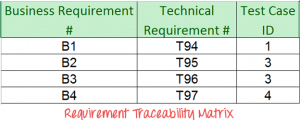
Types of RTM (Requirement traceability matrix) :-
- Forward traceability: This matrix is used to check if the Project is progressing the way you want and the right product. It ensures that each requirement is applied to the product and that each requirement is properly evaluated. It sets out the requirements for the investigation of test cases.
- Backward traceability: Used to ensure that the current product remains on track. The purpose of this type of tracking is to ensure that we do not increase the scope of the project by adding code, design elements, tests, or other unspecified functions to requirements. It sets the test cases to requirements.
- Bi-directional traceability: This tracking matrix ensures that all requirements are covered by test cases. It analyzes the impact of change on the needs of the Feature in the product of the work and vice versa.
Advantages of RTM:-
- It helps to achieve 100 % requirements coverage.
- Highlights any missing requirements or document inconsistencies.
- Indicates every mistake or circumstance by focusing on the needs of the business.
- It is useful for analyzing or evaluating the impact of QA teamwork on revision or re-use in assessment situations.