

A mobile app is a versatile tool for businesses that are looking to streamline their operations, increase productivity, and boost customer engagement. This tool is a boon for C-level executives and enterprise owners who are willing to build long-lasting relationships with customers, drive revenue growth, and achieve a high return on their investment. This clearly highlights the importance of mobile app development for businesses in today’s world.
What is even more surprising to know is that the global mobile application market size was valued at USD 252.89 billion in 2023, which is expected to grow to USD 626.39 billion by 2030. And this market covers apps across multiple industries, including gaming, media and entertainment, health and fitness, retail and eCommerce, and social networking. But the question comes: how to get started with mobile app development for business? Well, that’s where the best mobile app development company comes into the picture.
At InnovationM, we have been processing custom mobile app development for enterprise for more than a decade, which has helped our clients achieve significant growth in their revenue. Through this experience, we have gained deep expertise in turning mobile app visions into success stories for hundreds of businesses across the globe.
In this mobile app development guide, we have discussed why investing in mobile apps has become highly important for enterprises, a strategic step-by-step roadmap to build high-engagement and high-conversion apps, and the top 5 emerging trends every enterprise leader must adopt to stay competitive in the market.
Let’s proceed with the knowledge sharing process now:
Why is Mobile App Development for Businesses Extremely Necessary?
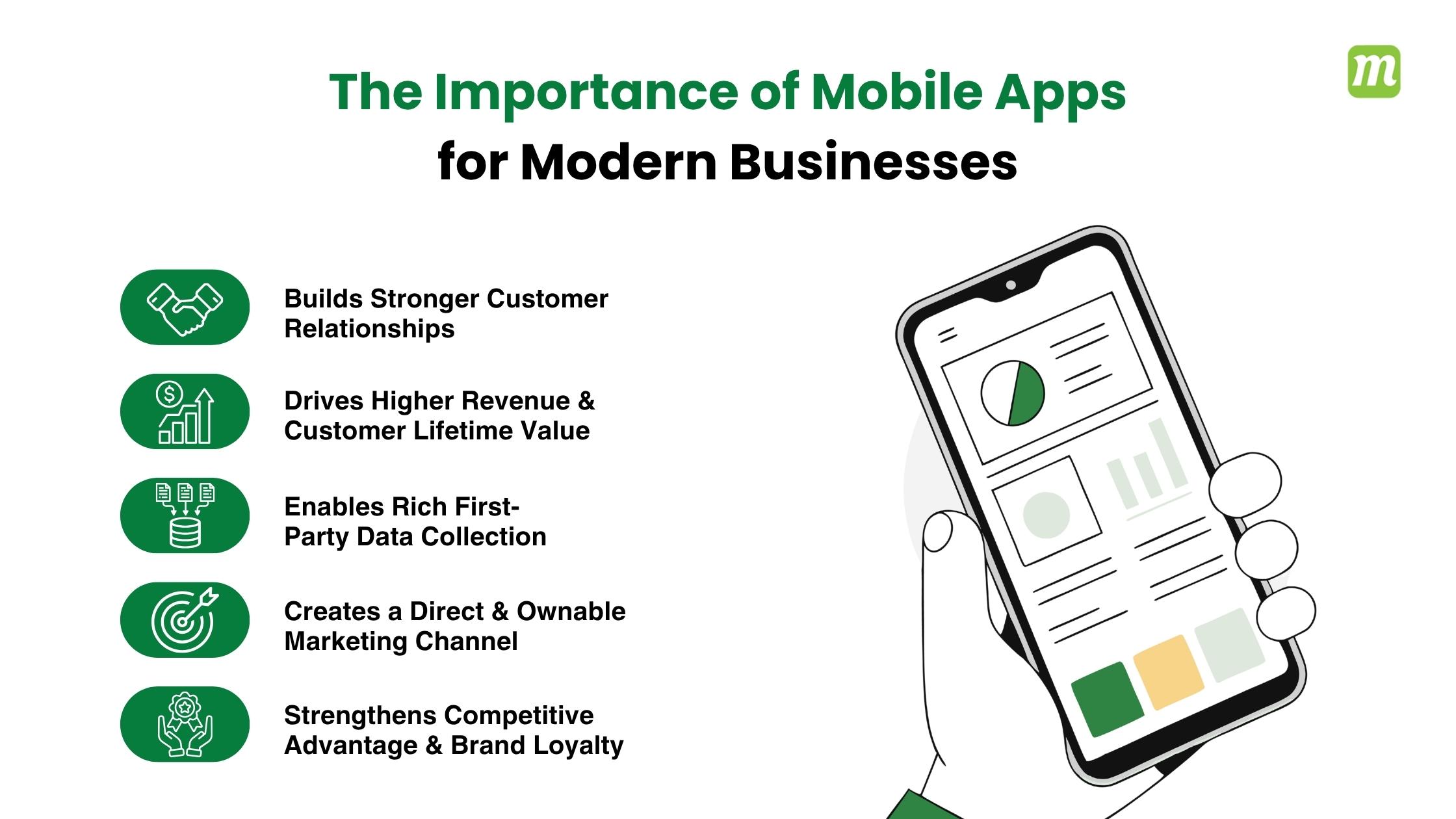
Mobile app development has become an indispensable necessity for businesses that are aiming to be at the forefront of the mobile-first ecosystem. This solution enables companies to directly interact with their customers, deliver personalized experiences, and drive exponential growth through increased engagement and data-driven decision-making.
1. Builds Stronger Customer Relationships
Mobile app development for businesses allows them to engage with customers through personalized content, real-time notifications, and uninterrupted communication channels. By taking advantage of unified customer profiles and behavioral insights, organizations can deliver personalized experiences that promote trust, increase satisfaction, and reduce customer churn in the long run.
For the unversed, unified customer profiles refer to a single record of a customer, combining data from all sources, including online and offline, for example, website, POS, and CRM. These profiles provide a comprehensive view of customers, merging their demographics, purchase history, and behavioral data to enable personalized marketing and improved decision-making.
2. Drives Higher Revenue & Customer Lifetime Value
The business mobile application development, once optimized well, helps simplify the buying journey of customers, leading to higher conversion rates and repeat purchases. Growing brands can leverage in-app promotions, personalized recommendations, and seamless payment options to take customer spending, retention, and lifetime value to the next level.
3. Enables Rich First-Party Data Collection
Mobile app development for startups works as an effective tool to capture user behavior, preferences, and their engagement patterns. The first-party data collected through mobile apps helps businesses improve their marketing strategies, audience segmentation, and create targeted campaigns that deliver massive ROI while ensuring more meaningful customer interactions.
4. Creates a Direct & Ownable Marketing Channel
Unlike third-party platforms, startup app development allows businesses to establish a direct communication channel to interact with their most engaged users. Using this channel, organizations can share exclusive offers, product updates, and personalized messages without relying on external sources. This helps in establishing consistent brand visibility and gaining stronger marketing control.
5. Strengthens Competitive Advantage & Brand Loyalty
Investing in custom mobile applications development for businesses helps brands differentiate themselves by providing unique services and delivering unforgettable digital experiences. Keep in mind, having a feature-rich app not only helps in improving brand perception but also builds long-term loyalty. As a result, companies find it easy to position themselves as innovative leaders in a competitive market.
A Step-By-Step Guide for Mobile App Development for Businesses Chasing High Engagement & Conversion
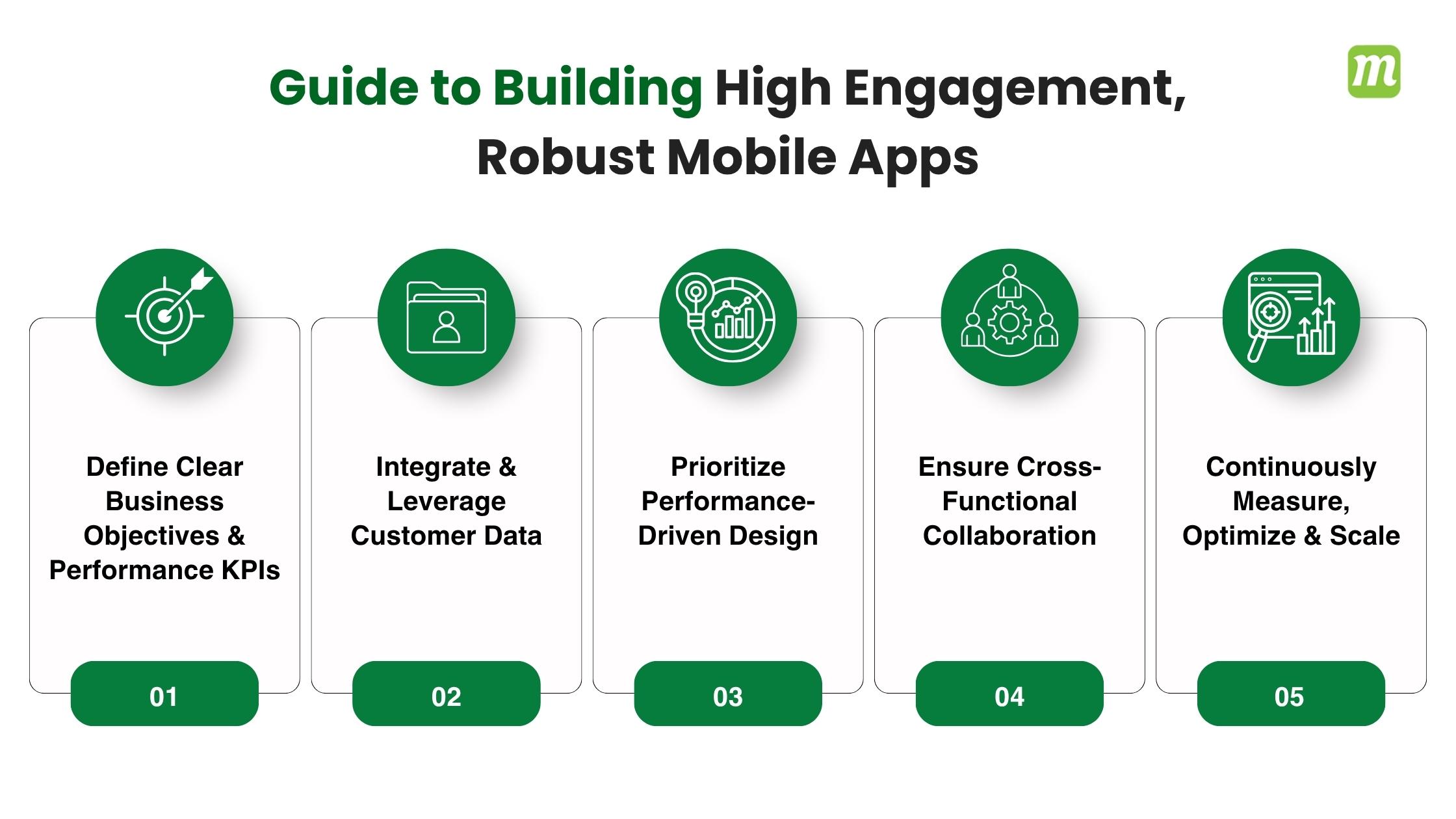
The mobile app development for enterprise is not just a technical execution, but an entire strategic business workflow that aligns your growth objectives with your digital capabilities. And once you follow a well-structured mobile app development guide, it makes it easy to achieve deeper engagement, faster time to market, and a significant increase in revenue, retention, and customer experience.
1. Define Clear Business Objectives & Performance KPIs
Begin your business mobile application development process by defining the main purpose of your app. Whether your goal is to increase revenue, improve customer loyalty, or reduce operational costs, outline the key KPIs clearly. This includes conversion rates, session duration, retention, and customer lifetime value that play a key role in tracking real business outcomes.
2. Integrate & Leverage Customer Data
Just to let you know, high-performing mobile app development for business is built on deep customer understanding. Therefore, it is important to integrate data from various sources to create unified user profiles. This allows leadership teams to detect behavioral trends, identify pain points in the customer journey, and design mobile experiences that deliver real monetary value.
3. Prioritize Performance-Driven Design
This is a crystal clear fact that engagement and conversion are driven by the overall user experience of the mobile app development for startups. So, it is advisable to focus on creating intuitive, seamless, and well-optimized app journeys that minimize pain points and foster repeat usage. Just so you know, even minor improvements in speed, navigation, and usability are so beneficial that they can influence business metrics and customer satisfaction to a great extent.
4. Ensure Cross-Functional Collaboration
A successful mobile-first strategy requires a strong partnership between technology, marketing, and design teams. Hence, it is suggested to implement structured workflows and centralized project visibility to ensure perfect alignment, quicker decision-making, and flawless execution. As a result, innovation will speed up, and time-to-market will shorten big time.
5. Continuously Measure, Optimize & Scale
Once a business mobile app is developed and launched, another phase of support, maintenance, and growth starts from here. All you need to do is track the performance of your business mobile app development using advanced analytics, conduct A/B testing, and make the most of AI-driven personalization to enhance user experiences.
Be informed that continuous optimization comes in handy to enhance customer engagement, improve conversions, and gain an edge over competitors in the long run.
So, this is how you can go with your business mobile app development. Just to inform you, YouTube tops the list of the monthly time spent on selected mobile apps in the U.S. in 2025, as per a report published on Statista. On average, active users spent 11 hours and 32 minutes per month in the U.S., followed by TikTok with an average session duration of 9 hours and 5 seconds.
So, if you also wish to build a social media app or video-sharing app for monetization purposes, make sure to connect with the best mobile app development company that has expertise in building solutions simplifying content creation, sharing, and interaction. You can also explore some of the best app development companies in india to find experienced teams that deliver scalable and user-friendly applications.
Top 5 Trends in Business Mobile App Development Every Enterprise Leader Must Know
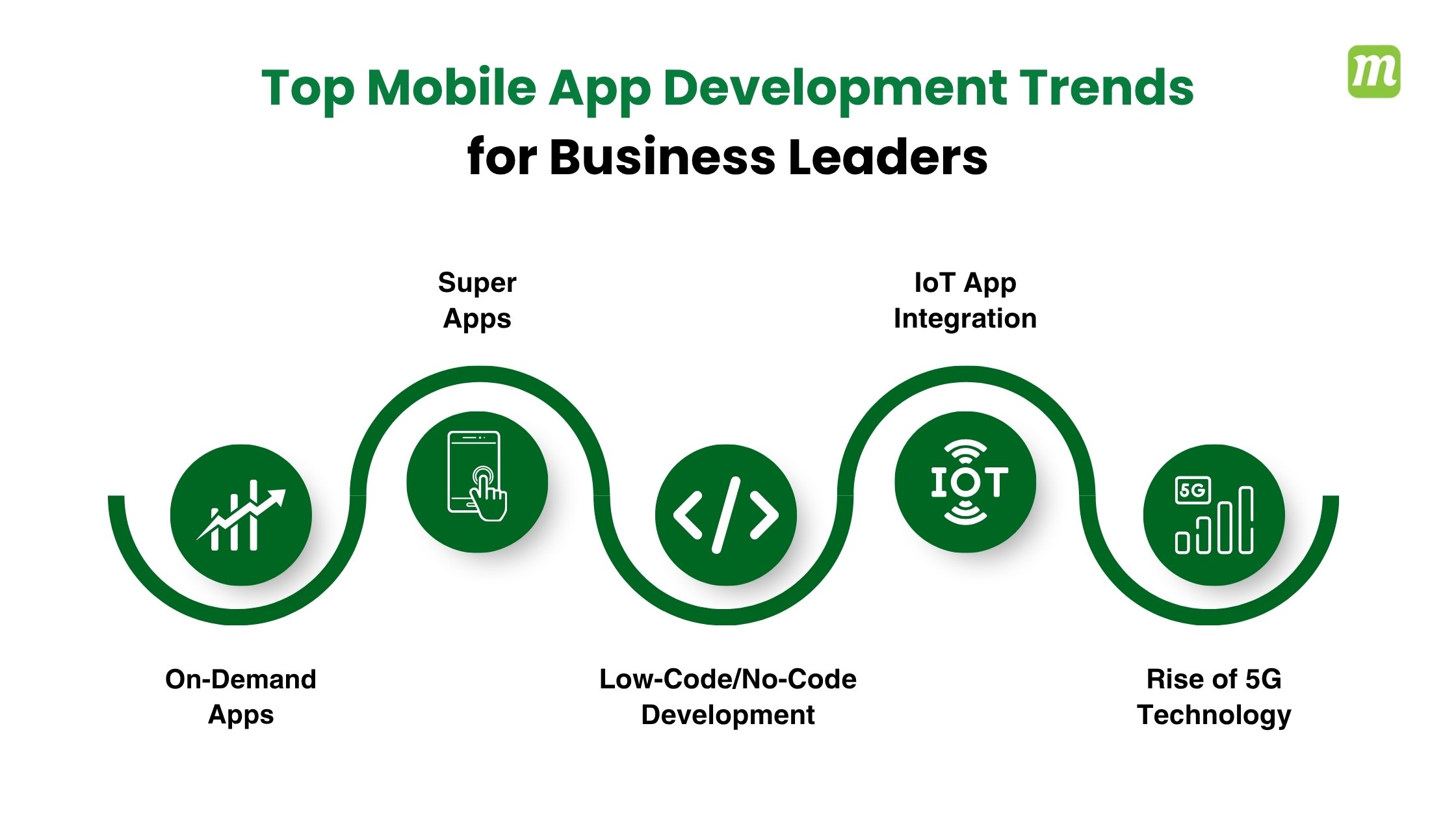
There is always something happening in the field of business mobile application development. Here is a list of emerging trends transforming the entire mobile app development ecosystem:
1. On-Demand Apps
On-demand apps are mobile apps that directly connect customers with specific service providers to fulfill their requirements. These requirements can be fulfilled through food delivery services, ride-hailing services, or home-repairing services that are availed with the touch of a few buttons. Businesses looking to enter this space often prioritize on demand food delivery app development to capture the growing market of hungry consumers seeking convenience. Uber, Ola, Instacart, Taco Bell, Teleflora, Angi, and TaskRabbit are some popular on-demand applications that help businesses create greater customer value while establishing new revenue streams at the same time.
2. Super Apps
Super apps are “one-stop-shop” mobile apps that integrate a long list of services, including payments, messaging, ride-hailing, shopping, and food delivery into just one platform. Treat it as an app inspired by “Swiss Army Knife” that acts like a small operating system, allowing users to access several services without going from one app to another. It is a new trend of mobile app development for businesses that helps streamline the overall customer experience.
Gojek, Alipay, WeChat, Careem, and Tata Neu are some real-life examples of super apps that help companies generate significant value through a single platform.
3. Low-Code/No-Code Development
Low-code/no-code development is quite an effective method for building software, applications, or workflows with the help of drag-and-drop components, visual interfaces, and pre-built templates instead of traditional programming languages.
The good news about this business mobile app development approach is that it enables quicker app development, not just by professional developers but non-technical users as well. Also, a sharp increase in the popularity of low-code/no-code development indicates that more than 70% of new business applications will leverage it by 2025.
4. IoT App Integration
Internet of Things or IoT app integration is the next growing trend on this list that refers to the process of connecting devices and sensors with apps and databases to generate data-driven outcomes for your business. The main advantage of building a connected ecosystem is that it helps organizations ensure transparency in their operations and plan better for future business decisions.
5. Rise of 5G Technology
5G is the best trend of mobile app development for enterprise that delivers up to 100 times faster performance compared to 4G, with up to 10 Gbps speed. By implementing this trend, you can allow mobile apps to load content and deliver information almost immediately to simplify the management of data-intensive operations such as video streaming, augmented reality, and virtual reality. One more benefit of the adoption of 5G technology is that it enhances GPS performance, improves cloud compatibility, and enables faster response times.
BONUS
In addition to all the trends we discussed above, some other recent innovations include touchless UI, customized applications for foldable devices, AI-powered development, chatbots and conversational interfaces, and most importantly, beacon technologies. The implementation of all these trends in the business mobile application development field is leading to more transformation than ever, translating into the emergence of a new era of possibilities and challenges.
How InnovationM Can Help You Maximize ROI from Your Mobile App Investment?
To maximize ROI from your business mobile app development, you need not just build features but also deliver high-performance, seamless, and value-driven digital experiences. InnovationM is a leading custom app development partner that helps businesses discover the full potential of their app investments through strategic consulting, intuitive UI/UX design, robust web and mobile development, and reliable post-launch support.
Unfortunately, many companies worldwide still struggle to meet user expectations. Recent research by App Developer Magazine shows that 41% of end-users face issues like unsupported devices, slow performance, and complex interfaces, while 40% come across the unavailability of native apps. These gaps can significantly hurt business outcomes, no matter which industry they belong to. In fact, 90% of IT professionals estimate that poor app quality can make companies lose up to $2.49 million in revenue.
The good news is that InnovationM addresses these challenges with a proven development process, experienced engineering talent, and a strong focus on performance, navigation, and security. From validating the technical feasibility of your app idea to accelerating time-to-market and ensuring continuous optimization, our startup app development company helps you build high-quality applications that drive engagement, conversions, and rapid business growth.
Final Thoughts on Investing in Custom Mobile Applications Development for Businesses
Investing in custom mobile application development has become an effective move for businesses looking to accelerate growth, strengthen customer relationships, and open new revenue streams. When mobile apps are closely aligned with core business objectives, supported by unified data insights, and continuously optimized for user experience, they turn into high-performing digital assets that drive massive ROI, stronger brand loyalty, and long-term competitive advantage.
However, achieving these outcomes requires a thoughtful strategy, seamless execution, and ongoing innovation in addition to custom mobile applications development for businesses. This is where partnering with the right development expert makes a significant difference. As a leading mobile app development company, InnovationM focuses on performance, personalization, and long-term value creation. We empower enterprises to maximize user engagement, improve conversions, and ensure their mobile investments deliver growth beyond expectations.
Frequently Asked Questions on Mobile App Development for Businesses
1. Why is mobile app development important for businesses today?
Mobile app development is important for businesses today because it helps brands enhance their customer engagement, improve brand visibility, and streamline overall operations. Since smartphone usage is increasing across the world, mobile app development for businesses plays a crucial role in providing personalized experiences, enabling real-time communication, and creating new revenue opportunities in competitive markets.
2. How much does it cost to develop a mobile app for a business?
The cost to develop a mobile app for a business depends on a wide variety of factors, including features, complexity, platform choice, and development location. For your information, simple apps may cost a few thousand dollars, while advanced enterprise solutions with integrations, security, and scalability can require relatively higher investments.
3. How long does it take to build a mobile app for business use?
If you wish to build a basic app, it may take almost 2 to 4 months; however, if you want to develop a feature-rich or enterprise-grade application, it may take around 6 to 12 months from ideation to deployment. Bear in mind, the timeline for business mobile application development depends on multiple factors, such as app complexity, design requirements, testing scope, and overall integrations.
4. Which platform is better for business apps: Android or iOS?
Making the right selection between Android and iOS apps depends on your target audience, market reach, and business goals. The best part of Android is that it offers a wider global reach, while iOS delivers higher user spending and engagement capabilities. However, many businesses adopt cross-platform strategies in order to amplify their growth and return on investment.
5. What features should a business mobile app include?
Major features that a business mobile app should include are user-friendly UI/UX, secure authentication, push notifications, analytics integration, offline functionality, and seamless payment options. What else? Advanced startup app development may also leverage AI, personalization, and cloud connectivity to enhance application performance and overall customer experience.
6. What is the future of mobile experiences?
The future of mobile experiences will be driven by AI-powered personalization, immersive technologies like AR and VR, faster connectivity through 5G, and seamless cross-platform interactions. Resultantly, businesses will focus on predictive features, voice interfaces, and extremely convenient digital journeys to enhance user engagement and satisfaction.