Software testing is evolving rapidly. Traditional automation frameworks that once helped teams accelerate releases are now struggling to keep up with modern development cycles, complex user journeys, and continuous deployment pipelines. Businesses are shipping features faster than ever, and QA teams are under constant pressure to ensure quality without slowing innovation.
This is where AI testing tools, AI-powered software testing, and AI-driven QA automation are transforming the software testing landscape.
From self-healing test scripts and intelligent bug detection to predictive analytics and autonomous test generation, artificial intelligence is redefining how quality assurance works. Modern enterprises are increasingly adopting AI automation testing tools, AI software testing tools, and AI-powered QA solutions to improve efficiency, reduce testing costs, and accelerate software delivery.
Modern enterprises are increasingly investing in AI testing platforms, AI-powered testing tools, and AI-driven QA automation solutions to streamline software delivery, improve testing accuracy, and support scalable digital transformation initiatives.
In this guide, we’ll explore:
- What AI testing is
- How AI is changing software testing
- Best AI testing tools in 2026
- AI test automation trends
- Benefits and challenges of AI in QA
- How to choose the right AI testing platform
What is AI Testing?
AI testing refers to the use of artificial intelligence and machine learning technologies to improve and automate software testing processes. Unlike traditional automation testing, AI-powered testing tools can learn from application behavior, adapt to UI changes, generate test cases intelligently, and reduce manual maintenance.
Traditional automation testing depends heavily on predefined scripts. If an element changes in the application, tests often fail and require manual updates. AI testing tools solve this problem using smart object recognition, adaptive algorithms, predictive learning, and intelligent pattern analysis.
Today, AI software testing combines machine learning, analytics, and automation intelligence to create smarter QA workflows compared to traditional scripted automation approaches.
Advanced platforms use machine learning in testing and adaptive intelligence to improve automation resilience over time.
Key Components of AI Testing
1. Self-Healing Test Automation
AI systems automatically detect changes in application elements and update test scripts without manual intervention.
These self-healing capabilities are becoming a standard feature in modern AI test automation tools because they significantly reduce maintenance effort. Instead of rewriting broken scripts after every UI update, teams can rely on adaptive locators and machine learning models to maintain test stability automatically.
This form of intelligent test automation improves test stability and reduces failures caused by dynamic UI updates in modern applications.
AI-driven frameworks use smart locators and adaptive testing algorithms to automatically recover from UI element changes.
2. Intelligent Test Case Generation
AI tools analyze user behavior, requirements, and historical data to create optimized test cases.
Generative AI models can now create functional, regression, API, and edge-case tests using natural language prompts. This improves productivity for QA teams and accelerates software delivery cycles by reducing manual scripting efforts.
AI-powered systems support advanced test case generation and smart test generation by analyzing user journeys and historical defect patterns.
3. Visual AI Testing
AI compares UI elements visually instead of relying only on code-based locators.
This approach improves cross-browser testing, responsive design validation, and UI consistency checks. Visual AI testing is especially valuable for customer-facing applications where even minor UI inconsistencies can impact user experience and conversions.
Modern visual AI testing solutions help teams maintain UI consistency across responsive web applications and mobile devices.
Advanced visual regression testing capabilities help maintain strong UI consistency testing across browsers and screen sizes.
4. Predictive Analytics
AI identifies high-risk areas in applications and prioritizes testing efforts accordingly.
By analyzing historical defects, code commits, and production incidents, predictive QA systems help teams focus testing resources on the most vulnerable application components. This leads to smarter test prioritization and improved defect prevention.
These systems use software defect prediction models to identify high-risk application areas before production releases.
5. Natural Language Processing (NLP)
Some AI testing platforms allow testers to create test cases using plain English commands.
Example:
“Verify login functionality with valid credentials.”
NLP-based automation lowers the barrier to entry for non-technical stakeholders, enabling product managers, business analysts, and manual testers to contribute to test automation workflows more effectively.
This shift from rule-based automation to intelligent automation is the foundation of modern AI software testing.
Why AI is Transforming Software Testing
Software applications today are more dynamic than ever:
- Frequent UI changes
- Continuous deployments
- Multi-device compatibility
- API-heavy architectures
- Complex integrations
Traditional testing approaches struggle to scale efficiently in this environment.
AI solves these challenges by introducing adaptability, intelligence, and autonomous decision-making into the testing lifecycle. AI-powered testing platforms can continuously learn from application behavior, helping teams improve test resilience and reduce manual intervention.
Businesses adopting AI QA testing and AI-powered software testing strategies are achieving faster release cycles and better software reliability in competitive Agile environments.
Faster Release Cycles
Organizations practicing Agile and DevOps release updates weekly or even daily. AI automation testing tools accelerate regression testing and reduce bottlenecks.
By automatically prioritizing high-impact tests and reducing execution time, AI-powered QA enables continuous delivery pipelines to operate more efficiently without sacrificing software quality.
AI-driven platforms also strengthen DevOps testing, continuous delivery testing, and cloud-native deployment validation.
Reduced Maintenance Costs
Maintaining automation scripts is one of the biggest QA expenses. AI-driven testing reduces maintenance using self-healing capabilities.
This dramatically lowers long-term automation costs and helps QA engineers spend more time improving test coverage rather than fixing brittle scripts.
AI improves test maintenance reduction, enhances test coverage optimization, and accelerates overall software validation processes.
Improved Test Coverage
AI can identify gaps in coverage by analyzing application behavior and usage patterns.
Advanced AI testing platforms can also generate edge-case scenarios and recommend additional validations that traditional automation frameworks may overlook.
Better Defect Prediction
Machine learning models can predict areas likely to fail based on historical bug data.
This predictive testing approach allows teams to identify risky modules earlier in the development cycle, helping reduce production defects and downtime.
Enhanced User Experience Testing
AI-powered visual testing ensures UI consistency across browsers and devices.
Modern AI QA tools can detect layout shifts, accessibility issues, visual regressions, and rendering inconsistencies more accurately than traditional scripted validations.
AI-driven testing also improves digital experience testing and customer-facing application quality.
As businesses increasingly prioritize speed and quality, AI in software testing is becoming essential rather than optional.
Key Features of AI Testing Tools
Not all AI testing tools offer the same capabilities. However, leading platforms typically include the following features.
Self-Healing Automation
One of the most valuable AI testing features is self-healing. Instead of failing when UI elements change slightly, AI tools intelligently identify alternative locators.
Benefits include:
- Lower maintenance effort
- More stable test suites
- Reduced downtime
- Better automation reliability
- Faster recovery from UI updates
This feature is particularly valuable for enterprise applications with frequently changing interfaces.
Smart Test Generation
AI tools can automatically generate:
- Functional test cases
- Regression tests
- API tests
- Edge-case scenarios
- Data-driven automation flows
This significantly improves productivity and allows QA teams to scale testing faster while improving overall software quality assurance.
Visual Validation
Visual AI testing compares screens pixel-by-pixel or contextually to detect UI inconsistencies.
Useful for:
- Responsive design testing
- Cross-browser testing
- UI regression testing
- Accessibility validation
- Mobile application testing
Visual testing is increasingly important for organizations prioritizing digital experience and frontend consistency.
Intelligent Defect Analysis
AI platforms analyze test results and identify:
- Root causes
- Risk areas
- Failure patterns
- Flaky tests
- Performance anomalies
Advanced analytics help engineering teams resolve issues faster and improve release confidence.
AI platforms also improve intelligent bug detection and enable better root-cause analysis for faster issue resolution.
NLP-Based Testing
Some tools allow non-technical users to create tests using plain English instructions.
This democratizes automation testing and enables wider collaboration across QA, product, and business teams.
Autonomous Regression Testing
AI can automatically prioritize and execute the most relevant regression tests based on code changes and application impact.
This approach enhances AI regression testing and supports efficient regression testing automation within CI/CD pipelines.
This improves CI/CD efficiency and reduces unnecessary test execution, helping organizations accelerate software delivery pipelines.
Best AI Testing Tools in 2026
The AI testing ecosystem is growing rapidly. Here are some of the leading AI-powered software testing tools businesses are adopting.
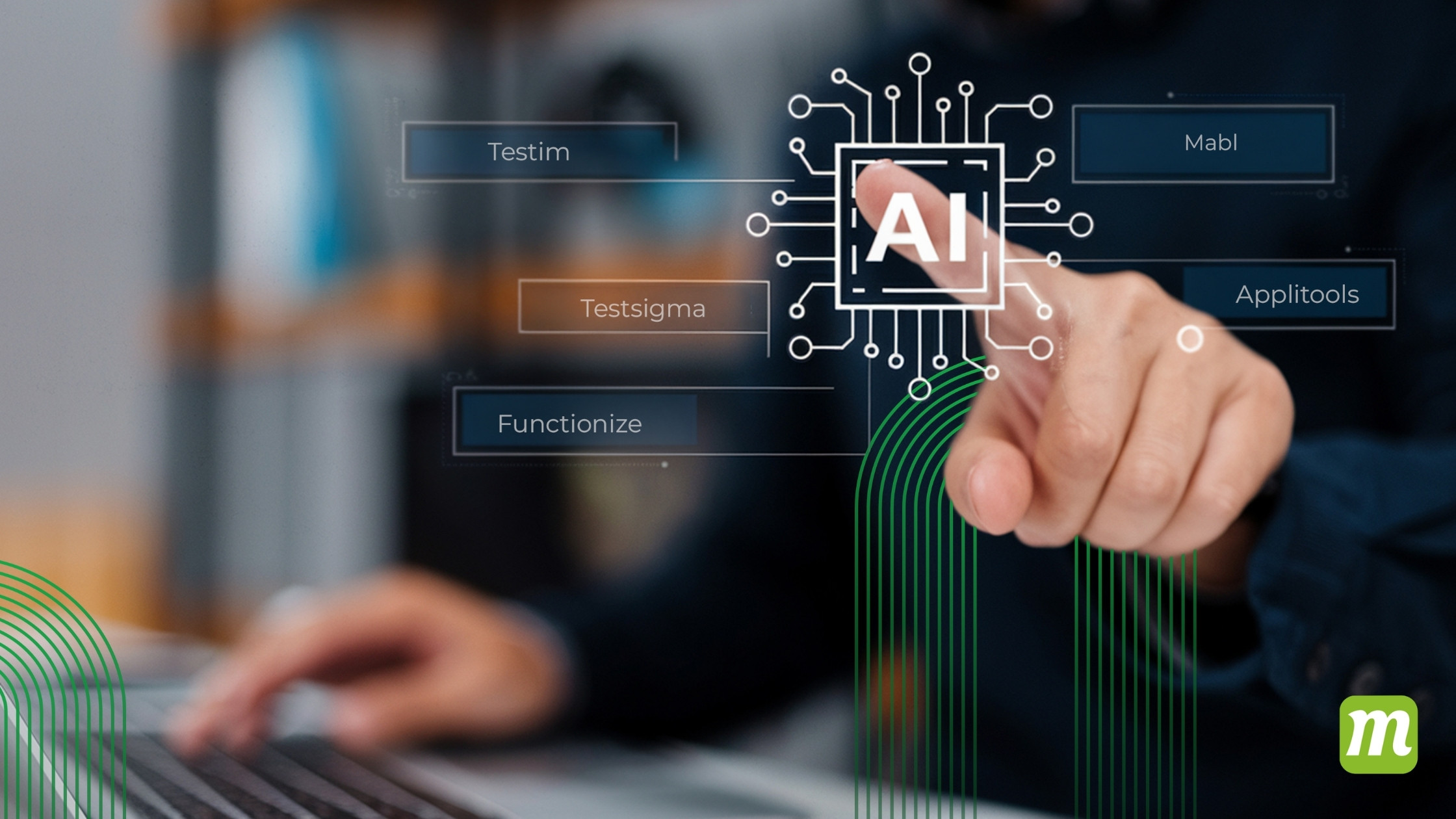
1. Testim
Testim is a popular AI-driven testing platform focused on fast test creation and reduced maintenance.
Key Features
- Self-healing locators
- AI-powered test stabilization
- Low-code automation
- CI/CD integrations
- Smart element detection
Best For
Agile teams and fast-moving startups.
Advantages
- Easy to use
- Fast execution
- Good scalability
- Reduced script maintenance
Limitations
Advanced customizations may require coding knowledge.
2. Functionize
Functionize uses machine learning and NLP to automate software testing.
Key Features
- Natural language test creation
- AI regression testing
- Visual testing
- Cloud scalability
- Intelligent analytics
Best For
Enterprise-level QA automation.
Advantages
- Excellent AI capabilities
- Smart analytics
- Reduced manual effort
- Strong enterprise support
Limitations
Higher pricing for smaller teams.
3. Mabl
Mabl focuses on intelligent end-to-end testing for modern web applications.
Key Features
- Auto-healing tests
- Integrated performance testing
- Visual validation
- CI/CD support
- Cloud-native architecture
Best For
DevOps-oriented organizations.
Mabl is widely used for continuous testing, end-to-end testing, and cloud-native DevOps workflows.
4. Applitools
Applitools is known for advanced visual AI testing.
Key Features
- Visual regression testing
- AI-powered UI validation
- Cross-browser testing
- Layout comparison
- Responsive UI analysis
Best For
UI-heavy applications and design consistency testing.
Applitools is especially valuable for organizations prioritizing frontend quality assurance and pixel-perfect user experiences.
5. ACCELQ
ACCELQ provides codeless automation powered by AI.
Key Features
- No-code automation
- API testing
- Web and mobile support
- Intelligent maintenance
- Cloud execution support
Best For
Teams with limited automation expertise.
Its codeless interface supports both low-code testing tools and no-code automation testing requirements for enterprise teams.
6. Katalon
Katalon combines traditional automation with AI-powered enhancements.
Key Features
- Smart XPath generation
- AI recommendations
- Web, API, desktop, and mobile testing
- Test analytics
Best For
Mid-sized QA teams.
Katalon balances flexibility and ease of use, making it suitable for organizations transitioning from manual to AI-assisted automation testing.
7. Testsigma
Testsigma is gaining popularity for AI-assisted low-code testing.
Key Features
- NLP-based testing
- Parallel execution
- Cloud device testing
- Cross-platform support
Best For
Cross-functional QA teams.
Testsigma helps organizations accelerate automation adoption while reducing dependency on programming expertise.
8. Tricentis Tosca
Tricentis offers enterprise-grade AI test automation capabilities.
Key Features
- Risk-based testing
- Model-based testing
- SAP testing support
- Enterprise integrations
- AI-assisted optimization
Best For
Large enterprises and regulated industries.
Tricentis is particularly popular in banking, healthcare, telecom, and enterprise ERP testing environments.
Open-Source AI Testing Tools
Many organizations prefer open-source solutions due to flexibility and lower costs.
Selenium with AI Extensions
Selenium remains one of the most widely used testing frameworks. AI plugins and integrations now enhance Selenium with:
- Smart locators
- Self-healing automation scripts
- AI-powered analytics
- Intelligent reporting
Selenium continues to dominate enterprise automation ecosystems because of its flexibility and large community support.
Playwright with AI Integrations
Playwright supports modern browser automation and integrates with AI-powered testing utilities.
Benefits
- Faster execution
- Better stability
- Modern architecture
- Improved browser support
Playwright is increasingly favored for modern web application testing because of its reliability and developer-friendly APIs.
Robot Framework with AI Plugins
Robot Framework allows integration with machine learning and intelligent testing libraries.
Advantages of Open-Source AI Testing
- Lower licensing costs
- Community support
- Customizable workflows
- Flexible integrations
Many organizations combine open-source frameworks with QA automation tools to build scalable and customizable testing ecosystems.
Challenges
- Requires technical expertise
- Limited enterprise support
- Additional maintenance effort
Organizations with strong engineering teams often combine open-source frameworks with AI extensions for customized QA automation solutions.
AI in QA and Quality Assurance
AI is changing the role of QA engineers significantly.
Instead of manually executing repetitive tests, QA professionals now focus more on:
- Strategy
- Exploratory testing
- Test optimization
- AI supervision
- Quality engineering
- Risk analysis
The rise of AI-powered testing does not eliminate QA roles. Instead, it shifts QA professionals toward higher-value activities that require human judgment, creativity, and business understanding.
Modern QA professionals increasingly focus on QA engineering, Agile testing, and intelligent automation strategy rather than repetitive execution tasks.
AI QA Responsibilities in 2026
Modern QA engineers increasingly work with:
- AI-assisted automation
- Predictive analytics
- Intelligent monitoring
- Autonomous testing systems
- Generative AI workflows
- Continuous quality engineering
Teams now rely heavily on modern QA workflows and AI-powered reporting systems to improve operational visibility and release quality.
This shift is creating strong demand for professionals skilled in both software testing and AI-driven quality assurance workflows.
Benefits of AI Testing for Enterprises
Faster Time-to-Market
AI accelerates test execution and reduces bottlenecks in release cycles.
Organizations can release software more frequently while maintaining high-quality standards and minimizing production risks.
Advanced AI test automation capabilities also help organizations improve collaboration between development, QA, and DevOps teams through continuous quality validation.
Reduced Operational Costs
Self-healing automation significantly lowers maintenance costs.
AI also reduces repetitive manual work, enabling QA teams to focus on strategic quality initiatives.
Higher Accuracy
AI minimizes human errors and improves testing consistency.
Machine learning algorithms can analyze large datasets and identify anomalies more efficiently than manual testing processes.
Better Scalability
AI testing tools can manage large-scale enterprise applications efficiently.
Many enterprises now prioritize cloud scalability testing to ensure application performance during traffic spikes.
This scalability is particularly valuable for cloud-native platforms, SaaS applications, and multi-platform ecosystems.
Enhanced Customer Experience
Better software quality leads to:
- Fewer bugs
- Improved performance
- Higher customer satisfaction
- Better application reliability
AI-powered quality assurance ultimately contributes to stronger customer trust and brand reputation.
Challenges of AI-Based Testing
Despite its advantages, AI testing also presents challenges.
Initial Investment
Advanced AI testing platforms can be expensive.
Enterprises often need to evaluate licensing costs, infrastructure requirements, and implementation expenses before adopting AI-driven QA solutions.
Learning Curve
Teams need training to adopt AI-powered testing workflows.
QA professionals must understand AI-assisted automation, analytics, and prompt-based testing methodologies.
Data Dependency
AI systems perform better with quality historical data.
Without sufficient testing history and application data, predictive capabilities may be limited.
Integration Complexity
Integrating AI tools into existing pipelines may require effort.
Organizations often need compatibility with:
- CI/CD integrations
- Cloud platforms
- Test management systems
- Software delivery pipelines
- Reporting dashboards
Modern platforms support deep cloud infrastructure compatibility and scalable automation pipelines.
Over-Reliance on Automation
Human judgment remains essential for exploratory and usability testing.
AI should enhance QA teams, not replace them entirely.
How to Choose the Right AI Testing Tool
Choosing the right platform depends on several factors.
| Requirement | Recommended Solution |
| Enterprise QA | Tricentis Tosca |
| Startup Teams | Testim |
| Visual Testing | Applitools |
| No-Code Automation | ACCELQ |
| DevOps Pipelines | Mabl |
| Open-Source Flexibility | Selenium + AI |
Factors to Consider
Budget
Evaluate licensing and maintenance costs.
Organizations should compare total cost of ownership, including implementation, training, and long-term scalability.
Team Expertise
Some tools require coding skills while others are low-code.
Selecting the right platform depends heavily on your team’s automation maturity and technical capabilities.
Integration Support
Ensure compatibility with:
- CI/CD tools
- Cloud platforms
- Test management systems
- DevOps workflows
- Reporting dashboards
Scalability
Choose tools that support future growth.
Choose solutions that support scalable automation, enterprise growth, and evolving application ecosystems.
Reporting & Analytics
Advanced reporting improves decision-making.
Modern AI testing platforms provide intelligent insights, predictive analytics, and failure trend analysis to improve QA workflow optimization.
Future of AI in Software Testing
The future of software testing is increasingly autonomous.
From self-healing automation and intelligent test generation to predictive analytics and autonomous QA workflows, AI is transforming how organizations and software testing companies approach software testing. Industry leaders are closely watching emerging AI testing trends in 2026 to stay competitive in rapidly evolving software markets. If you want to explore software testing companies in India for your needs, you can explore leading providers in this space to find the right fit.
Generative AI Testing
Generative AI models are beginning to:
- Create test cases automatically
- Generate synthetic test data
- Simulate user behavior analysis
- Improve automation workflows
- Build intelligent testing scenarios
Generative AI is rapidly becoming a core component of modern AI software testing ecosystems.
AI Agents for QA
AI agents may soon:
- Execute tests autonomously
- Detect failures
- Suggest fixes
- Optimize test coverage
- Analyze production risks
The rise of AI agents for QA is expected to redefine autonomous validation and intelligent software delivery pipelines.
Predictive Quality Engineering
AI will help organizations predict production issues before deployment.
The future of QA will increasingly depend on predictive quality engineering, AI-assisted automation, and autonomous validation systems.
Autonomous Testing Ecosystems
Future testing systems will continuously learn and optimize themselves with minimal human intervention.
Future systems will support autonomous QA workflows, autonomous test execution, and continuous self-optimization.
Businesses that adopt AI testing early will gain significant competitive advantages in speed, scalability, and product quality.
Conclusion
AI testing is no longer a futuristic concept. It is becoming a critical component of modern software quality assurance.
From self-healing automation and intelligent test generation to predictive analytics and autonomous QA workflows, AI is transforming how organizations and every software testing company approach software testing.
The right AI testing tool can help businesses:
- Accelerate releases
- Improve test coverage
- Reduce maintenance costs
- Enhance software quality
- Scale QA operations efficiently
As organizations continue adopting software QA automation, the demand for scalable and intelligent AI quality assurance solutions will continue to grow across industries.
Large enterprises increasingly rely on enterprise software testing and intelligent automation platforms to support digital transformation initiatives.
However, successful adoption requires the right strategy, tooling, and collaboration between AI systems and human testers.
Organizations that embrace AI-powered testing today will be better positioned to deliver faster, smarter, and more reliable digital experiences in the future.
Frequently Asked Questions (FAQs)
What is AI testing?
AI testing uses artificial intelligence and machine learning technologies to improve software testing processes through automation, intelligent analysis, adaptive testing, and predictive quality assurance.
How does AI improve software testing?
AI improves testing by:
- Reducing manual effort
- Enabling self-healing automation
- Generating smart test cases
- Improving defect detection
- Enhancing automated regression testing
- Optimizing test coverage
Which are the best AI testing tools?
Popular AI testing tools include:
- Testim
- Functionize
- Mabl
- Applitools
- ACCELQ
- Testsigma
- Tricentis Tosca
Is AI replacing QA engineers?
No. AI is enhancing QA workflows, but human expertise remains essential for strategy, exploratory testing, usability validation, and business-focused quality assurance.
What is AI-driven test automation?
AI-driven test automation uses machine learning and intelligent algorithms to automate testing processes more adaptively than traditional automation.
Are there open-source AI testing tools?
Yes. Selenium, Playwright, and Robot Framework can integrate with AI-powered plugins and extensions.
How is generative AI used in software testing?
Generative AI can:
- Create test cases
- Generate synthetic test data
- Simulate user scenarios
- Improve automation workflows
- Assist QA engineers with intelligent recommendations
What industries use AI QA testing?
Industries using AI testing include:
- Healthcare
- Finance
- Retail
- SaaS
- E-commerce
- Telecom
- Manufacturing
These industries rely heavily on AI-driven quality assurance, intelligent software validation, and AI-enabled testing tools to improve reliability, compliance, scalability, and customer experience.