
In today’s digital-first world, there is no denying the fact that software quality has the power to directly affect customer trust, brand reputation, and more importantly, business growth. Whether it is a web application, mobile app, SaaS platform, or enterprise system, software testing tools play a crucial role in ensuring their quality, performance, security, and user experience. Without availing rigorous software testing services, businesses risk releasing products with bugs, security vulnerabilities, performance bottlenecks, and usability issues that can lead to customer dissatisfaction, revenue loss, compliance challenges, and costly post-release fixes.
Also, from a product perspective, poor testing can compromise functionality and user adoption, while from a business perspective, it can damage brand credibility and increase operational risks. Just to let you know, the growing importance of QA testing services is reflected in market trends as well. For instance, according to Mordor Intelligence, the software testing market reached USD 54.44 billion in 2026 and is expected to grow to USD 99.94 billion by 2031. This indicates that QA professionals are becoming extremely important resources to achieve software success and drive demand for advanced testing tools and quality assurance practices.
In this blog, we will cover what software testing tools are, their key types, the top 10 tools every QA professional should know, automated vs. manual testing, tool selection criteria, and emerging software testing trends. But first, let’s start with:
What are Software Testing Tools?
Software testing tools are specialized applications that help QA teams validate the quality, functionality, reliability, performance, and security of software applications. They automate and streamline critical testing processes, from unit and integration testing to end-to-end quality assurance, to enable testers to identify defects early, accelerate release cycles, and reduce risks. This way, QA teams ensure every software they test meets the highest standards of performance and user satisfaction.
Why are Software Testing Tools More Important Than Ever in 2026?
As software ecosystems become more complex and release cycles grow shorter, software testing tools have evolved from being a QA advantage to a business necessity. Users expect cutting-edge applications to perform flawlessly across multiple devices, platforms, and environments while meeting rising expectations for speed, reliability, and security. This is where the best software testing tools 2026 come in handy for various reasons; for example, they help:
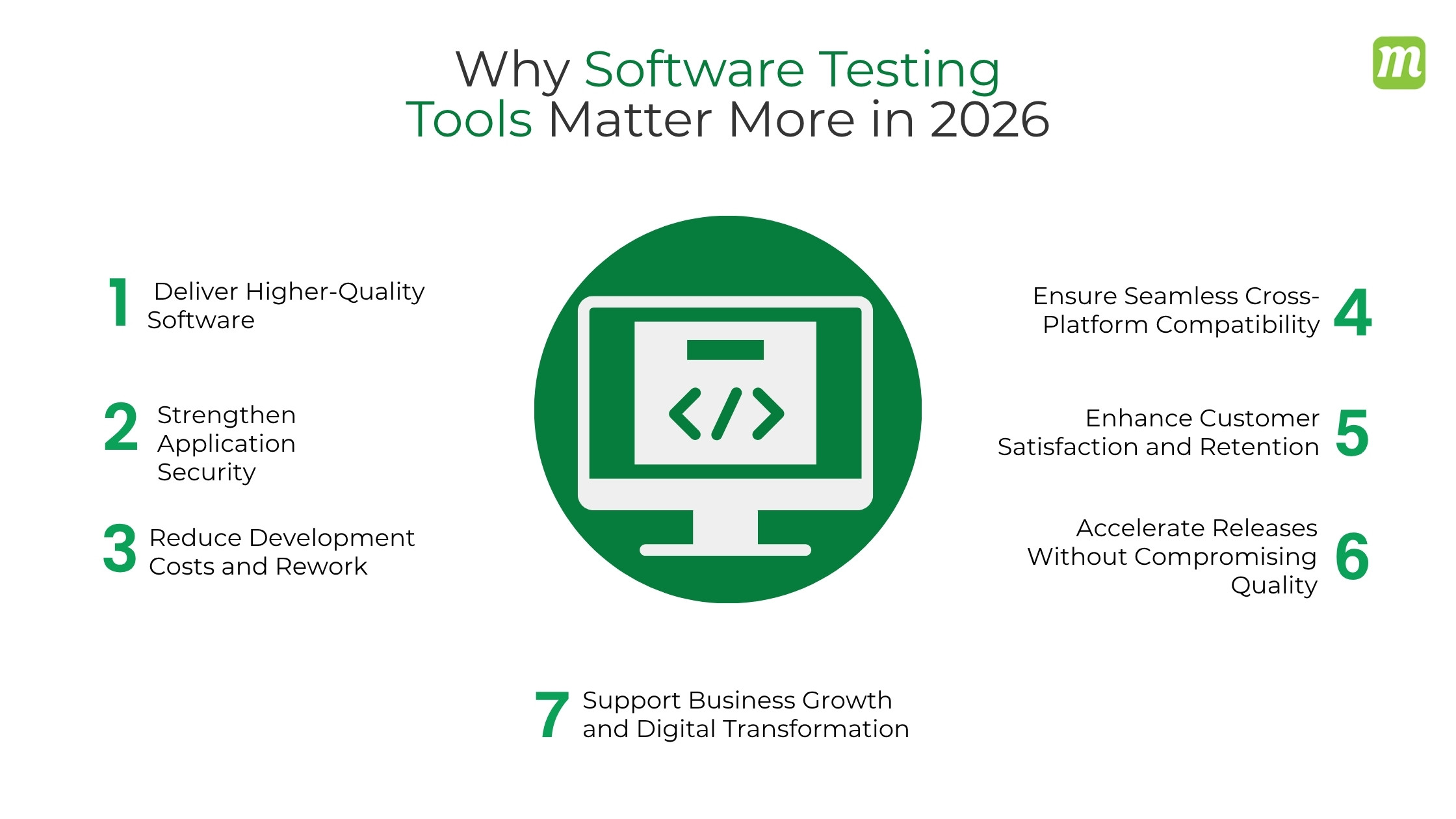
1. Deliver Higher-Quality Software
Software testing tools help QA teams improve test accuracy, expand test coverage, and identify defects early in the development lifecycle. This enables organizations to release stable, high-performing applications with greater confidence and fewer post-production issues.
2. Strengthen Application Security
As cyber threats are becoming more advanced, security can no longer be an afterthought. Test automation tools help detect vulnerabilities, misconfigurations, and security gaps before deployment to reduce the risk of data breaches, compliance violations, and reputational damage.
3. Reduce Development Costs and Rework
Fixing defects after deployment is comparatively more expensive than addressing them during development. Top QA testing tools enable teams to discover bugs early, minimize rework, optimize development resources, and lower the overall cost of software delivery.
4. Ensure Seamless Cross-Platform Compatibility
Users interact with applications across a wide range of browsers, operating systems, devices, and screen sizes. Leading AI testing tools help verify consistent functionality and performance across diverse environments, ensuring a seamless user experience everywhere.
5. Enhance Customer Satisfaction and Retention
In a highly competitive digital world, even minor software issues can lead to user frustration and churn. By helping teams deliver reliable, fast, and user-friendly applications, software testing tools contribute directly to better customer experiences, stronger brand trust, and higher customer retention rates.
6. Accelerate Releases Without Compromising Quality
As organizations adopt Agile and DevOps practices, rapid releases have become a common practice. Software testing tools 2026 automate repetitive tasks, provide continuous feedback, and support CI/CD pipelines, enabling QA teams to release software faster while maintaining quality standards.
7. Support Business Growth and Digital Transformation
Software quality directly impacts business performance. For instance, reliable applications improve operational efficiency, strengthen customer confidence, reduce downtime, and support long-term scalability, making software testing tools the key to successful digital transformation initiatives.
Common Types of Software Testing Tools Every QA Team Should Know
Software testing tools can be categorized into the following types:
1. Static Testing Tools
These tools help identify defects in code, design, and documentation without executing the software. Some of the common examples include:
- Flow Analyzers
- Interface Analyzers
- Path Testers
- Coverage Analyzers
2. Dynamic Testing Tools
These QA testing tools evaluate software behavior during execution using real-time data and test environments. A few common examples include:
- Test Drivers
- Test Beds
- Emulators
- Mutation Analyzers
3. Other Essential Software Testing Tools
QA teams also rely on specialized tools for specific testing requirements, including:
- Test Management Tools
- Automated Testing Tools
- Performance Testing Tools
- Cross-Browser Testing Tools
- Integration Testing Tools
- Unit Testing Tools
- Mobile Testing Tools
- Bug Tracking Tools
- Security Testing Tools
Together, these testing tools help QA teams improve software quality, accelerate testing cycles, and deliver reliable, secure, and high-performing applications.
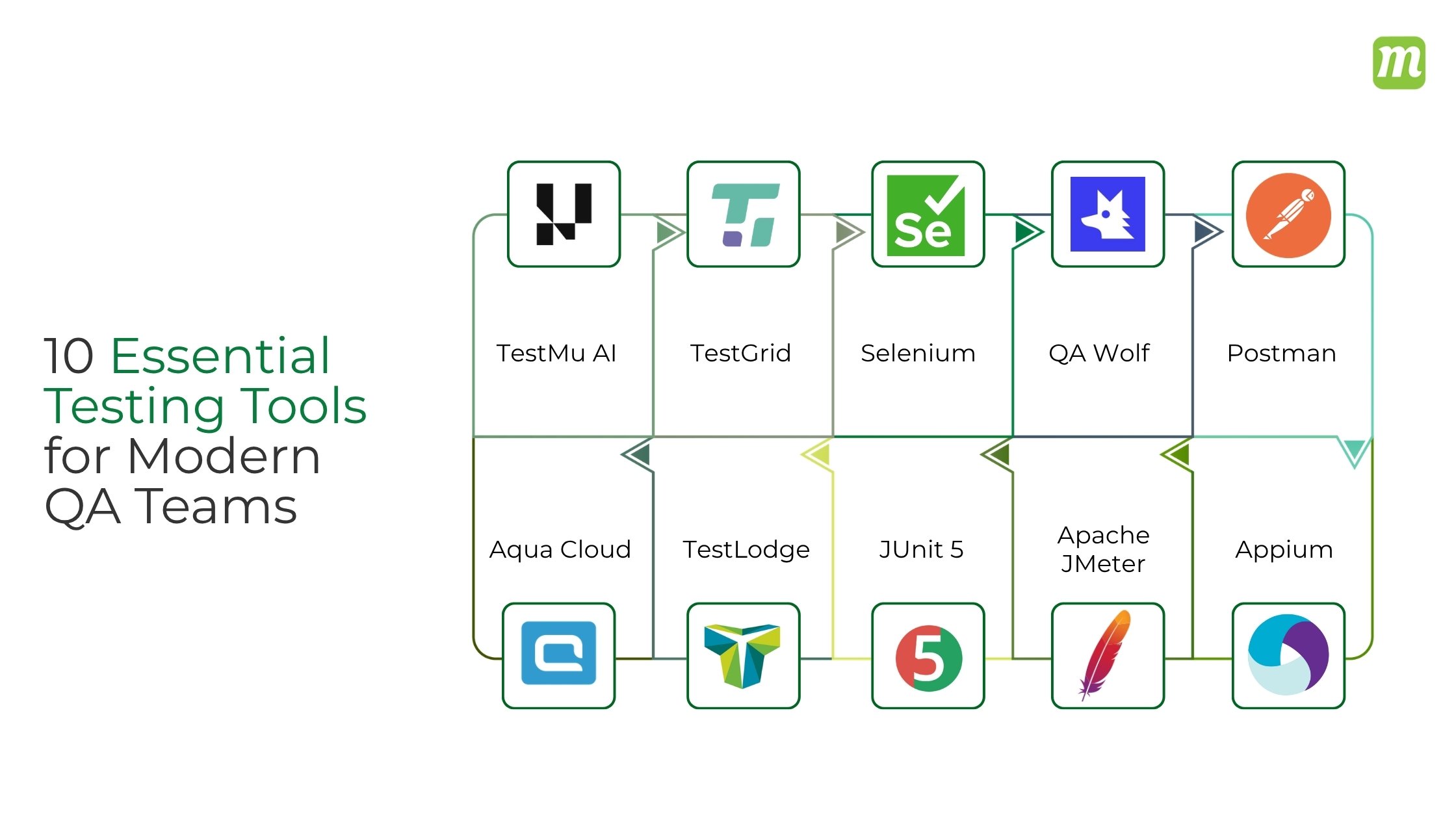
10 Must-Have Software Testing Tools for Modern QA Teams
Now, let’s take a look at the top software testing tools modern QA teams use to automate testing, improve software quality, accelerate releases, and deliver seamless digital experiences.
| Tool Name | Best For | Testing Type | AI Features | Supported Platforms | Pricing |
| TestMu AI | AI-powered test automation and cross-browser testing | Manual, Automated, End-to-End, Cross-Browser | AI test orchestration, auto-healing, intelligent execution | Web, Mobile, Real Devices, Cloud Environments | Free plan available; Paid plans start at $19/month |
| TestGrid | End-to-end web and mobile application testing | Automated, Manual, Cross-Browser, Mobile Testing | AI-driven scriptless testing | Web, Mobile, Real Devices, Private Cloud | Starts at $199/month |
| Selenium | Web automation testing | Automated Functional Testing | No native AI capabilities | Web Applications (Chrome, Firefox, Safari, Edge) | Free & Open Source |
| Postman | API development and testing | API Testing, Automated API Testing | Limited AI-assisted API development features | Web, Desktop, APIs | Free plan available; Paid plans start at $9/month |
| QA Wolf | Managed end-to-end test automation | End-to-End Testing, Web & Mobile Testing | AI-assisted test maintenance and optimization | Web, Mobile, Salesforce, SAP | Custom Pricing |
| Aqua Cloud | AI-powered test management | Test Management, Manual & Automated Testing | AI Copilot, AI-generated test cases, AI QA assistant | Web-Based Platform | Free trial available; Starts at €19/month |
| TestLodge | Manual test case management | Manual Testing, Test Management | No native AI features | Web-Based Platform | Free trial available;
Starts at $34/month |
| JUnit 5 | Java unit testing | Unit Testing, Test-Driven Development | No native AI capabilities | Java Applications, JVM (Java Virtual Machine) Ecosystem | Free & Open Source |
| Apache JMeter | Performance and load testing | Load Testing, Stress Testing, Performance Testing | No native AI capabilities | Web Applications, APIs, Databases, Servers | Free & Open Source |
| Appium | Mobile app automation testing | Automated Mobile Testing | No native AI capabilities | Android, iOS, Windows, macOS, Mobile Browsers | Free & Open Source |
1. TestMu AI (Formerly LambdaTest)
TestMu AI is one of the advanced AI testing tools that helps QA teams accelerate software releases through intelligent test orchestration, cloud-based execution, and comprehensive cross-browser and cross-device testing. It enables organizations to run automated and manual tests on a large scale while improving test efficiency, coverage, and reliability across modern applications.
Key Features
- Supports Selenium, Playwright, Appium, Cypress testing tool, and other automation frameworks.
- Enables high-speed parallel execution and AI-driven test orchestration with HyperExecute.
- Integrates seamlessly with CI/CD and project management tools like Jenkins, Jira, and GitHub Actions.
Pricing
Free plan available. Paid plans start at $19/month (Starter) and $99/month (Pro), while Enterprise pricing is available on request.
2. TestGrid
TestGrid is a powerful end-to-end testing platform that is designed to simplify web and mobile application testing. With cloud-based infrastructure, scriptless automation capabilities, and robust reporting features, these software testing tools empower QA teams to improve software quality while reducing testing complexity and execution time.
Key Features
- Supports cross-browser, cross-device, and mobile application testing.
- Offers scriptless test automation and seamless CI/CD integrations.
- Provides detailed analytics, remote debugging, and private cloud deployment options.
Pricing
Paid plans start at $199/month, while Growth and Enterprise plans are available through custom quotations.
3. Selenium
Selenium remains one of the most trusted open-source automation testing tools in 2026. Since it is widely adopted by QA teams worldwide, it enables reliable browser automation across multiple platforms and programming languages, making it a preferred choice for testing complex web applications.
Key Features
- Automates browser interactions using Selenium WebDriver.
- Supports parallel test execution through Selenium Grid.
- Compatible with Java, Python, JavaScript, C#, Ruby, PHP, and more.
Pricing
100% free and open-source
4. Postman
Postman is one of the leading API testing tools that simplifies the entire API lifecycle. From designing and testing APIs to documentation and collaboration, it helps development and QA teams build reliable, high-performing APIs faster and more efficiently.
Key Features
- Supports API request creation, automation, and validation.
- Enables API mocking, version control, and team collaboration.
- Automatically generates comprehensive API documentation.
Pricing
Free plan available. Paid plans start at $9/month (Solo) and $19/user/month (Team), while the Enterprise plan costs $49/user/month with additional enterprise-grade governance and security features.
5. QA Wolf
QA Wolf combines test automation tools with managed QA services to help organizations achieve extensive end-to-end test coverage in less time compared to the usual timeframe. It enables faster releases, fewer production issues, and reduced testing maintenance efforts.
Key Features
- Achieves up to 80% end-to-end test coverage within weeks.
- Eliminates inconsistent tests through continuous maintenance and monitoring.
- Supports web, mobile, accessibility, performance, Salesforce, and SAP testing.
Pricing
Custom pricing based on test coverage requirements.
6. Aqua Cloud
Aqua Cloud is an AI-powered test management platform built to streamline QA operations and improve testing productivity. By leveraging AI testing tools for test creation, traceability, reporting, and defect management, it enables teams to deliver higher-quality software with greater speed and precision.
Key Features
- AI Copilot generates requirements and test cases automatically.
- Provides complete traceability and intelligent test coverage management.
- Offers advanced bug reporting, dashboards, and custom analytics.
Pricing
Free trial available. Paid plans start at €19/month for Test Runner DEV and €89/month for Requirement Management and Test Management licenses, while Enterprise plans are available with custom pricing.
7. TestLodge
TestLodge is a lightweight yet effective test management solution designed for teams focused on manual testing. The intuitive interface, flexible planning capabilities, and seamless defect-tracking integrations of these software testing tools make it easy to organize, execute, and monitor testing activities efficiently.
Key Features
- Simplifies test case management and execution tracking.
- Integrates with Jira, Trello, GitHub, and other popular tools.
- Provides detailed reporting, analytics, and unlimited team collaboration.
Pricing
Offers a 30-day free trial with no credit card required. Paid plans start at $34/month (Personal) and go up to $279/month (Premium), with unlimited users included across all plans.
8. JUnit 5
JUnit 5 is the industry-standard testing framework for Java applications, offering developers a flexible and state-of-the-art environment for creating reliable automated tests. The powerful architecture of these software testing tools 2026 supports Test-Driven Development (TDD) while ensuring compatibility with legacy JUnit projects.
Key Features
- Supports parameterized, repeated, and nested test execution.
- Includes JUnit Platform, Jupiter, and Vintage modules.
- Integrates seamlessly with Maven, Gradle, IntelliJ IDEA, and Eclipse.
Pricing
Using the JUnit 5 framework for software testing is 100% free.
9. Apache JMeter
Apache JMeter is one of the best, widely used open-source performance testing tools designed to evaluate application scalability, stability, and responsiveness under varying workloads. It helps QA teams identify performance bottlenecks and ensure systems can handle real-world traffic demands.
Key Features
- Performs load, stress, and performance testing for web applications and APIs.
- Supports multiple protocols, including HTTP, FTP, JDBC, LDAP, and SOAP.
- Provides detailed reporting, scripting, and offline performance analysis.
Pricing
Apache JMeter is 100% free and open-source software.
10. Appium
Appium is a leading open-source mobile automation testing framework that enables seamless testing of native, hybrid, and mobile web applications. Its cross-platform compatibility allows QA teams to automate testing across Android, iOS, desktop, and browser environments using a single framework.
Key Features
- Supports Android, iOS, Windows, macOS, and mobile browsers.
- Enables automation using Java, Python, JavaScript, C#, Ruby, and PHP.
- Supports real devices, emulators, simulators, and advanced mobile gestures.
Pricing
Appium is a free, open-source mobile automation framework.
Automated vs. Manual Testing: Which Approach Delivers Better QA Outcomes?
Both manual and automated testing play vital roles in modern QA efforts, and choosing the right approach depends on your project goals, release speed, complexity, and testing requirements. The scenarios given below will give you a better understanding of when to choose automated or manual testing.
1. You Should Use Manual Testing When You Need to:
- Organize and manage test materials efficiently.
- Improve visibility into test execution and results.
- Track bugs and issues identified during testing.
- Validate user interface behavior across multiple browsers.
- Test API functionality, security, performance, and reliability.
- Capture screenshots and evidence to communicate defects accurately.
2. You Should Use Automated Testing When You Need to:
- Increase the speed and accuracy of testing processes.
- Expand test coverage across a larger codebase.
- Integrate testing seamlessly into Agile and DevOps workflows.
- Automatically share test results and insights with the concerned stakeholders.
- Free QA teams from repetitive tasks and let them focus on complex test scenarios.
- Quickly assess whether a software build is reliable, stable, and ready for deployment.
- Support the growing demand for faster, high-quality software delivery, as the automation testing market is expected to grow from USD 28.1 billion in 2023 to USD 55.2 billion by 2028.
How to Choose the Best Software Testing Tools: Top 6 Factors Every QA Team Should Consider
Selecting the right QA testing tools requires evaluating their usability, capability, scalability, and compatibility with your software development team to ensure efficient and reliable quality assurance. Here is a list of factors that you must consider while choosing the best software testing tools 2026:
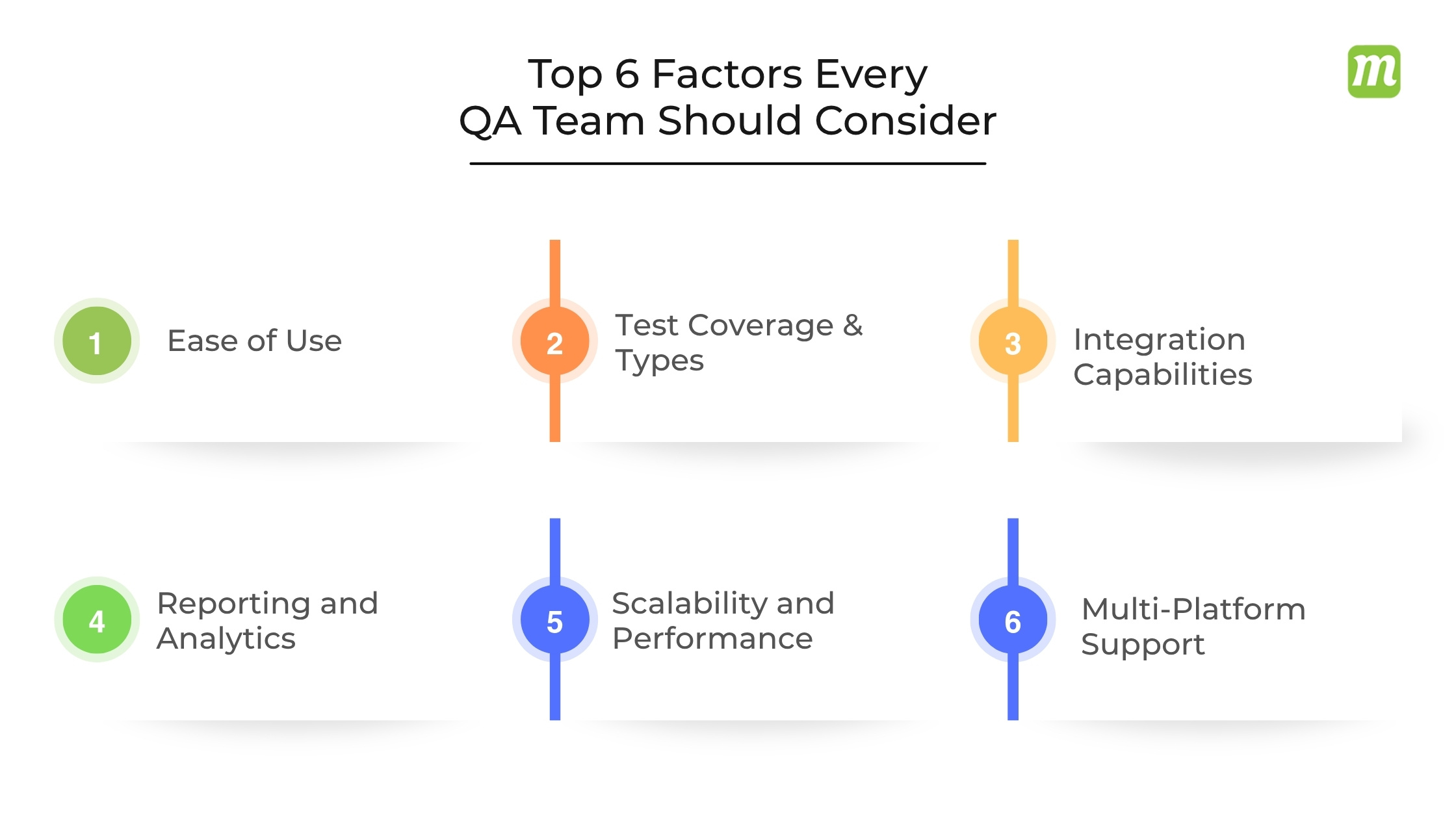
1. Ease of Use
Choose a software quality assurance tool with an intuitive interface, simple setup process, and minimal learning curve to maximize your team’s productivity and adoption.
2. Test Coverage and Types
Ensure the continuous testing tool you choose supports multiple testing types, including functional, performance, security, usability, unit, integration, system, and acceptance testing.
3. Integration Capabilities
Look for software testing tools that enable seamless integration with Git, CI/CD pipelines, Jira, and other development and project management tools.
4. Reporting and Analytics
Prioritize testing tools that provide detailed reports, dashboards, and actionable insights into test results and defect trends.
5. Scalability and Performance
Select manual and automation testing tools that are capable of handling large projects, growing test suites, and complex workloads without compromising efficiency.
6. Multi-Platform Support
Pick software and mobile testing tools that support testing across web, mobile, desktop, and cloud applications while ensuring compatibility across different browsers and operating systems.
Key Software Testing Trends to Watch in 2026
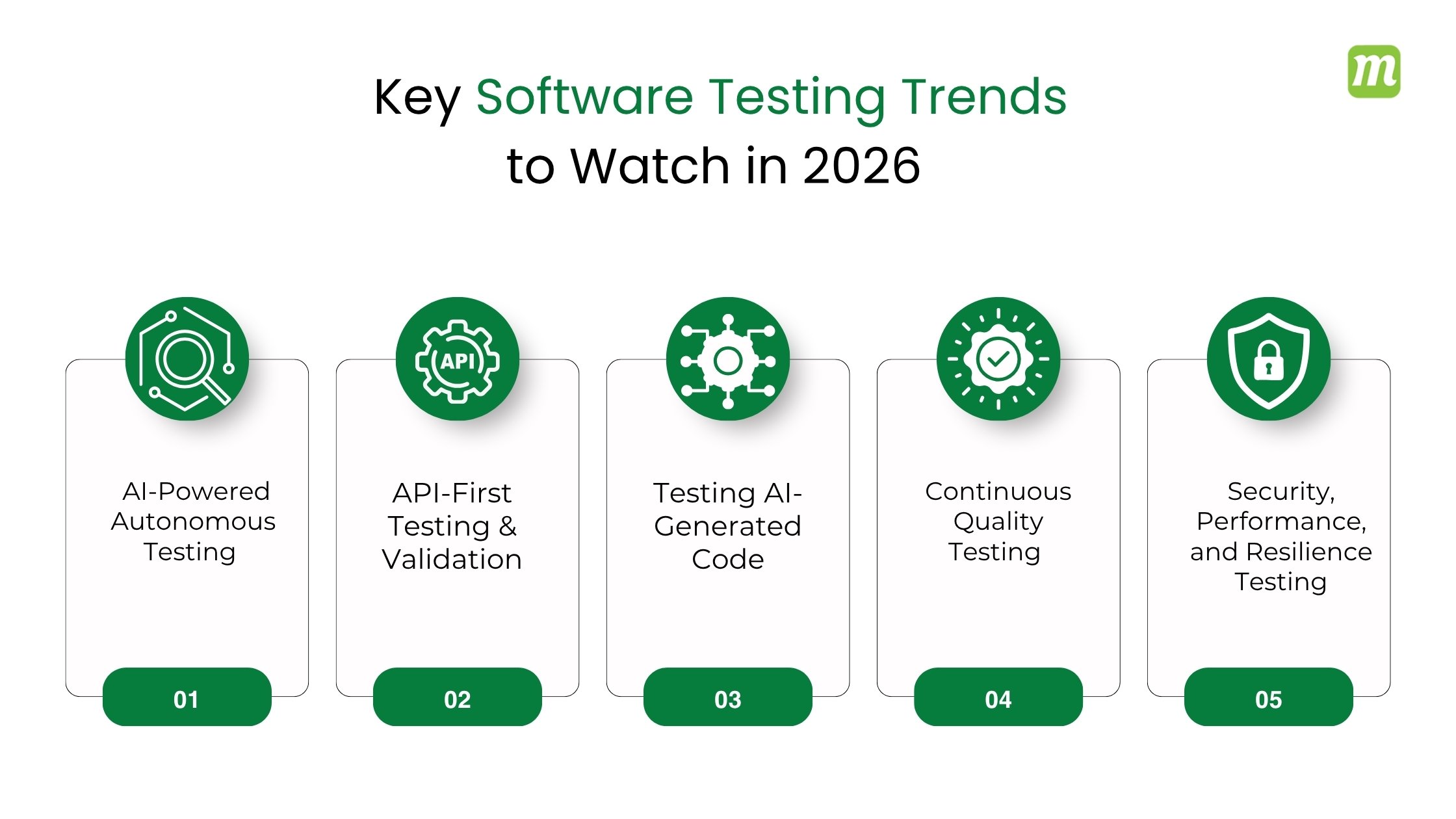
As the IT ecosystem becomes excessively complex and AI-driven, QA teams must stay on top of new software quality assurance trends to deliver secure, trusted, and performance-oriented digital experiences. Here is a list of emerging software testing trends you must be aware of:
1. AI-Powered Autonomous Testing
AI testing tools are helping QA teams automate repetitive tasks such as analyzing failed tests, identifying anomalies, and recommending test improvements. This allows testers to focus on complex quality and validation activities.
2. API-First Testing and Validation
As modern applications rely heavily on APIs, QA teams are leveraging API testing tools early in software development to ensure service reliability, maintain compatibility, and prevent integration issues.
3. Testing AI-Generated Code
With AI generating code on a large scale, testers at renowned software development companies in India are adopting stronger code reviews, static analysis, and unit testing practices to identify hidden bugs, security vulnerabilities, and performance issues.
4. Continuous Quality Testing
Software quality assurance testing is no longer limited to the end of development. Organizations are integrating continuous testing throughout the software development lifecycle to detect issues earlier and keep monitoring application performance even after release.
5. Security, Performance, and Resilience Testing
Modern QA strategies are expanding beyond functionality to include security validation, performance testing, stress testing, and resilience checks, as they ensure applications remain secure, scalable, and reliable under real-world conditions.
Ready to Deliver High-Quality Software with Confidence?
Software testing tools have become essential resources for digital product companies to deliver highly secure, reliable, and maintainable applications. Right from identifying defects early and improving test coverage to accelerating release cycles and enhancing customer satisfaction, the right performance testing tools help QA teams maintain quality at every stage of development. By understanding the different types of testing tools, their use cases, and emerging trends, organizations can make informed decisions that will improve their software quality and development efficiency.
Ready to leverage the right software testing solutions to deliver glitch-free software?
Have a word with InnovationM to build a robust QA strategy, automate critical workflows, and accelerate software releases without compromising quality, performance, or security.
Frequently Asked Questions
1. What is the best software testing tool in 2026?
There is no single best software testing tools 2026. Popular choices in 2026 include Selenium, Playwright, Cypress, Postman, and AI-powered platforms, depending on testing requirements and technology stack.
2. Are AI-powered testing tools replacing QA engineers?
No. AI testing tools are not replacing QA engineers but enhancing QA productivity by automating repetitive tasks, generating test cases, and identifying defects. Just for your information, human expertise is necessary for creating strategy, ensuring validation, and performing decision-making.
3. What is the best free software testing tool?
Selenium testing tool is widely recognized as one of the best free software testing tools due to its open-source nature, extensive community support, cross-browser compatibility, and automation capabilities.
4. Which tool is best for API testing?
Postman is one of the most popular API testing tools that offers intuitive request management, automated testing, collaboration features, and seamless integration with CI/CD pipelines.
5. What testing tools do enterprise companies use?
Enterprise companies use Selenium, Postman, JMeter, TestComplete, BrowserStack, Playwright testing, and AI-driven testing platforms to ensure scalability, reliability, performance, and faster software releases.
6. How do I choose the right software testing tool?
Your decision to choose the right software testing tools should be based on your project requirements, supported platforms, automation needs, integration capabilities, team expertise, scalability, budget, and long-term maintenance considerations.
7. What are the top 5 automation tools for software testing?
Most reputed software testing companies in India suggest the top 5 automation tools for software testing as Selenium, Playwright, Cypress, Appium, and TestComplete, as they are known for their reliability, flexibility, and support for modern application testing.