

Launching a software application without checking its performance is not a smart idea at all. It’s because doing this can result in slow response times, poor user experiences, and ultimately, lost revenue opportunities. As customers’ expectations are rising rapidly, businesses need to implement a proactive approach to ensure their digital applications are stable, scalable, and faster in performance. Since manual testing has become obsolete, conducting performance test automation for your application is a great idea.
The best part of automated performance testing is that it helps identify bottlenecks early, accelerate release cycles, and improve application reliability to a great extent. And these benefits of rigorous testing are the reason the software testing market size reached the USD 54.44 billion mark in 2026 and is expected to grow to USD 99.94 billion by 2031. So, if you are planning to test your mobile application or web application anytime soon, explore our software testing services to ensure your application delivers exceptional user experiences and long-term business success. InnovationM combines AI-powered automation, experienced QA engineers, and proven testing frameworks to build fast, scalable, and reliable applications.
In this blog, we have covered the fundamentals of performance testing, its business benefits, key testing types, essential performance metrics, the end-to-end testing process, and the best performance testing tools. Apart from that, we have also explained why partnering with InnovationM for automated performance testing can help you build fast, scalable, and reliable applications for your business. So, let’s start the discussion now:
What is Performance Testing and Why is It Essential for Modern Applications?
Performance testing is the process of evaluating an application’s speed, stability, scalability, and responsiveness under varying workloads to ensure it performs flawlessly in real-world conditions. The best software testing tools measure critical performance metrics such as response times, server processing speed, concurrent user capacity, resource utilization, and system reliability.
By identifying performance bottlenecks before deployment, software performance testing helps your business deliver seamless user experiences, maintain application availability, and support overall growth with confidence.
Key Benefits of Performance Testing for High-Performing Applications
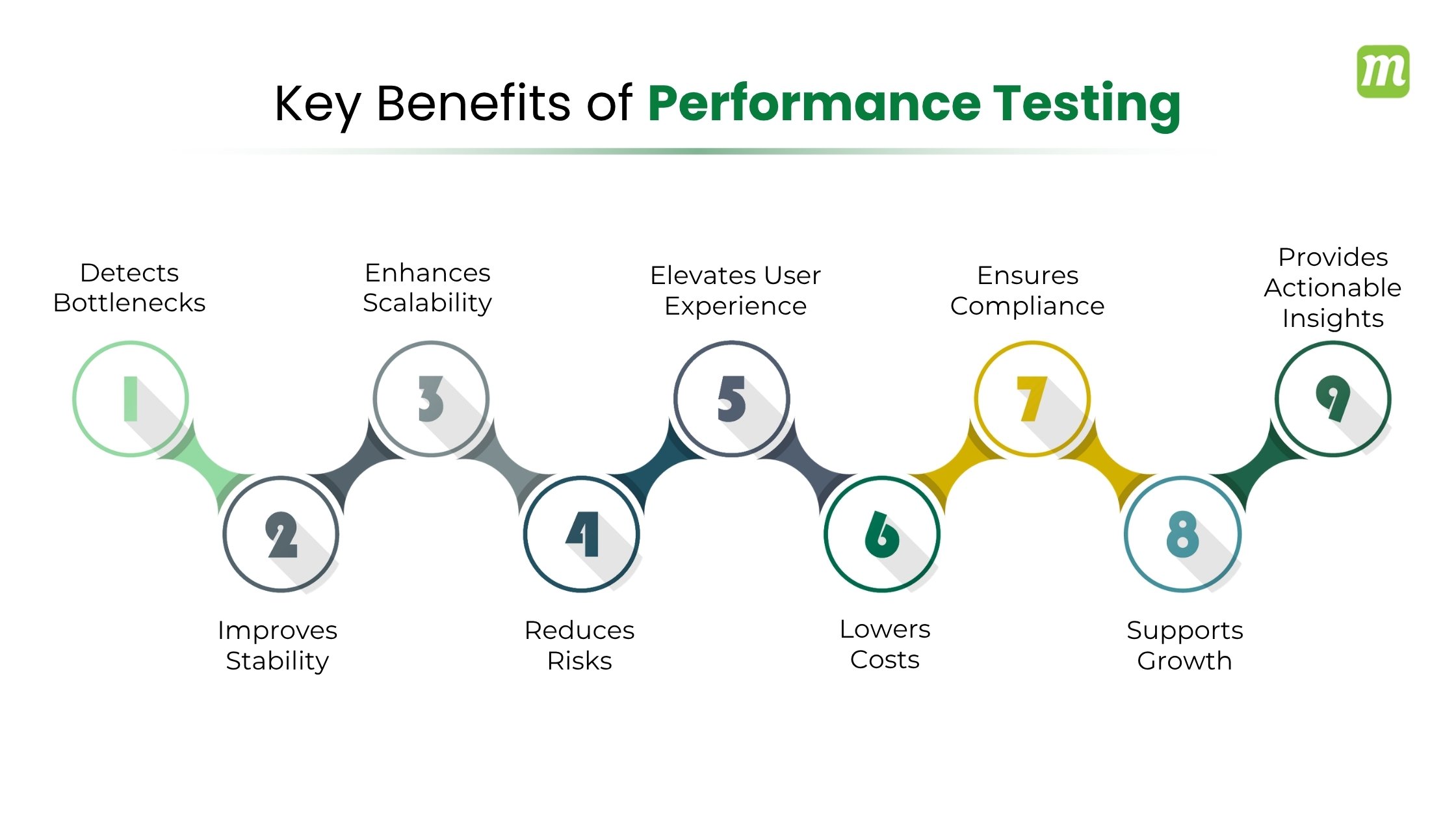
- Detects Bottlenecks: The main benefit of performance testing automation is that it identifies slow queries, memory leaks, and network performance issues early.
- Improves Stability: These testing techniques ensure consistent application performance under normal and peak workloads.
- Enhances Scalability: By availing performance test automation services, it becomes easy to evaluate system behavior as user traffic and demand continue growing.
- Reduces Risks: Using such testing methods effectively also helps detect performance issues early to prevent costly production failures later.
- Elevates User Experience: The best performance testing solutions deliver faster response times and seamless application interactions consistently.
- Lowers Costs: When performing performance testing, executing load testing automation minimizes expensive post-deployment fixes through proactive performance validation.
- Ensures Compliance: These testing procedures make it easy to meet industry standards with reliable, secure, and optimized application performance.
- Supports Growth: They prepare applications to handle future traffic spikes without disruptions.
- Provides Actionable Insights: Last but not least, a top-notch performance testing framework analyzes system behavior deeply to make informed optimization and scaling decisions.
Essential Types of Performance Testing Every Application Needs
Modern applications require different performance testing methods to validate their speed, stability, scalability, and reliability under diverse workloads and real-world usage scenarios. Here is a list of application performance testing methods every QA team must perform:
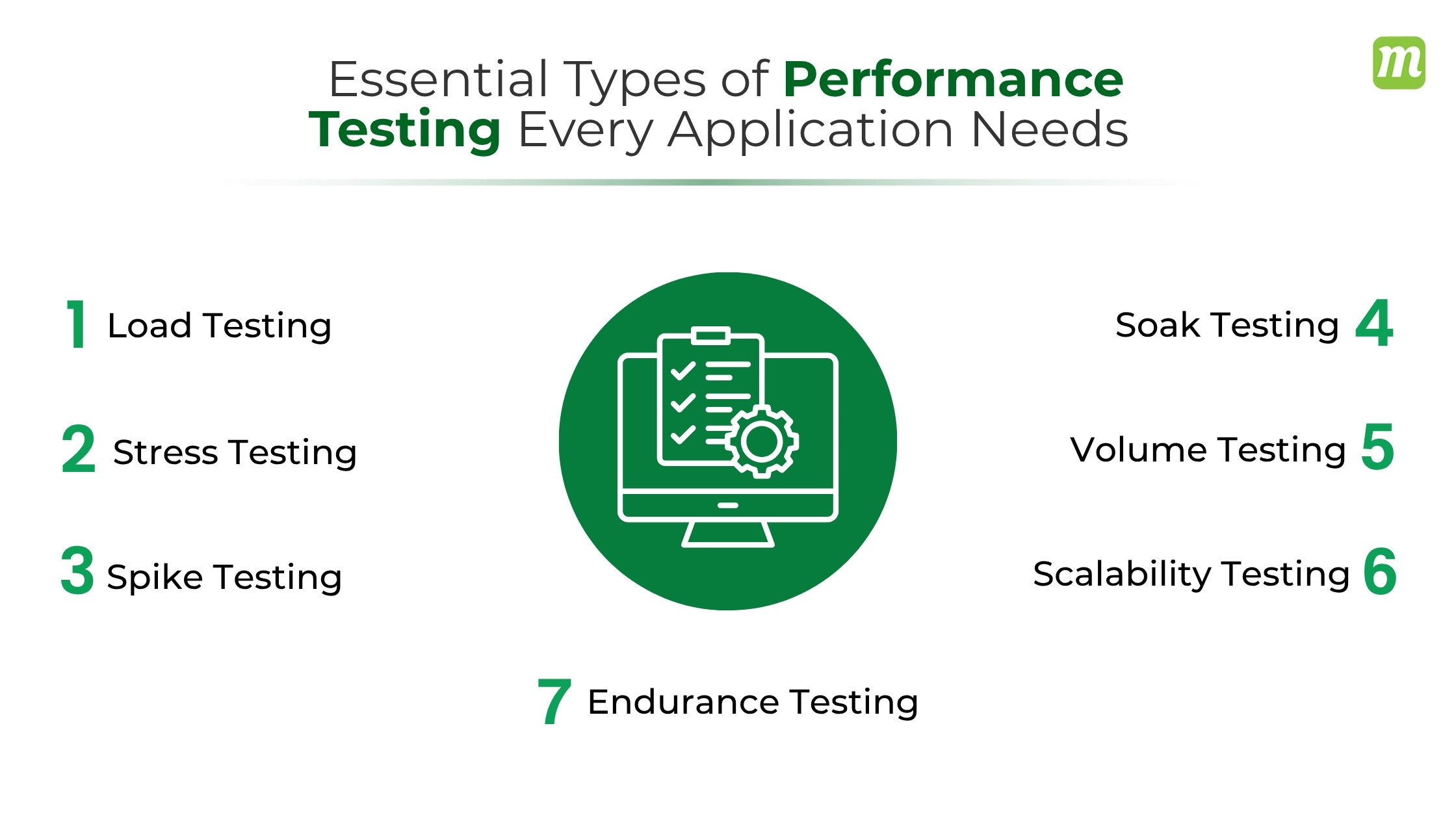
- Load Testing: It simulates expected user traffic to identify bottlenecks and validate application performance.
- Stress Testing: The biggest advantage of stress testing automation is that it pushes systems beyond capacity to evaluate their resilience, stability, and recovery capabilities.
- Spike Testing: This type of performance automation testing assesses application behavior during sudden traffic surges and unexpected usage spikes.
- Soak Testing: It helps in evaluating long-term system stability by running continuous workloads over extended periods.
- Volume Testing: This type of web application performance testing helps measure application performance while processing massive datasets and growing database volumes.
- Scalability Testing: It determines how efficiently applications scale as user demand continuously increases or decreases.
- Endurance Testing: Relying on this type of manual performance testing helps verify consistent performance under sustained workloads without performance degradation or resource exhaustion.
Top Performance Metrics Every High-Performing Application Should Measure
Monitoring the right performance metrics helps enterprises identify bottlenecks, optimize application behavior, and deliver fast, reliable, and delightful user experiences. Here is a list of metrics every application should be measured on:
1. Load Time: It measures how quickly an application starts and becomes fully usable, ensuring minimal delays that improve user satisfaction and overall application experience.
2. Response Time: Response time testing is the second metric on this list that assesses the time between a user action and a system response, helping deliver faster interactions and seamless application performance under varying workloads.
3. Bottleneck Detection: Performance bottleneck analysis helps identify hardware limitations, inefficient code, and system constraints that reduce application efficiency. These findings enable targeted optimizations that help achieve improved performance and reliability of the application.
4. Scalability Assessment: It measures how effectively applications maintain performance as concurrent users and workloads increase, ensuring consistent experiences during business growth and traffic spikes.
A Step-by-Step Guide to the Performance Testing Process
A well-structured process for software performance testing helps find bottlenecks early, check application readiness, and ensure uninterrupted performance across real-world workloads and business-critical scenarios.
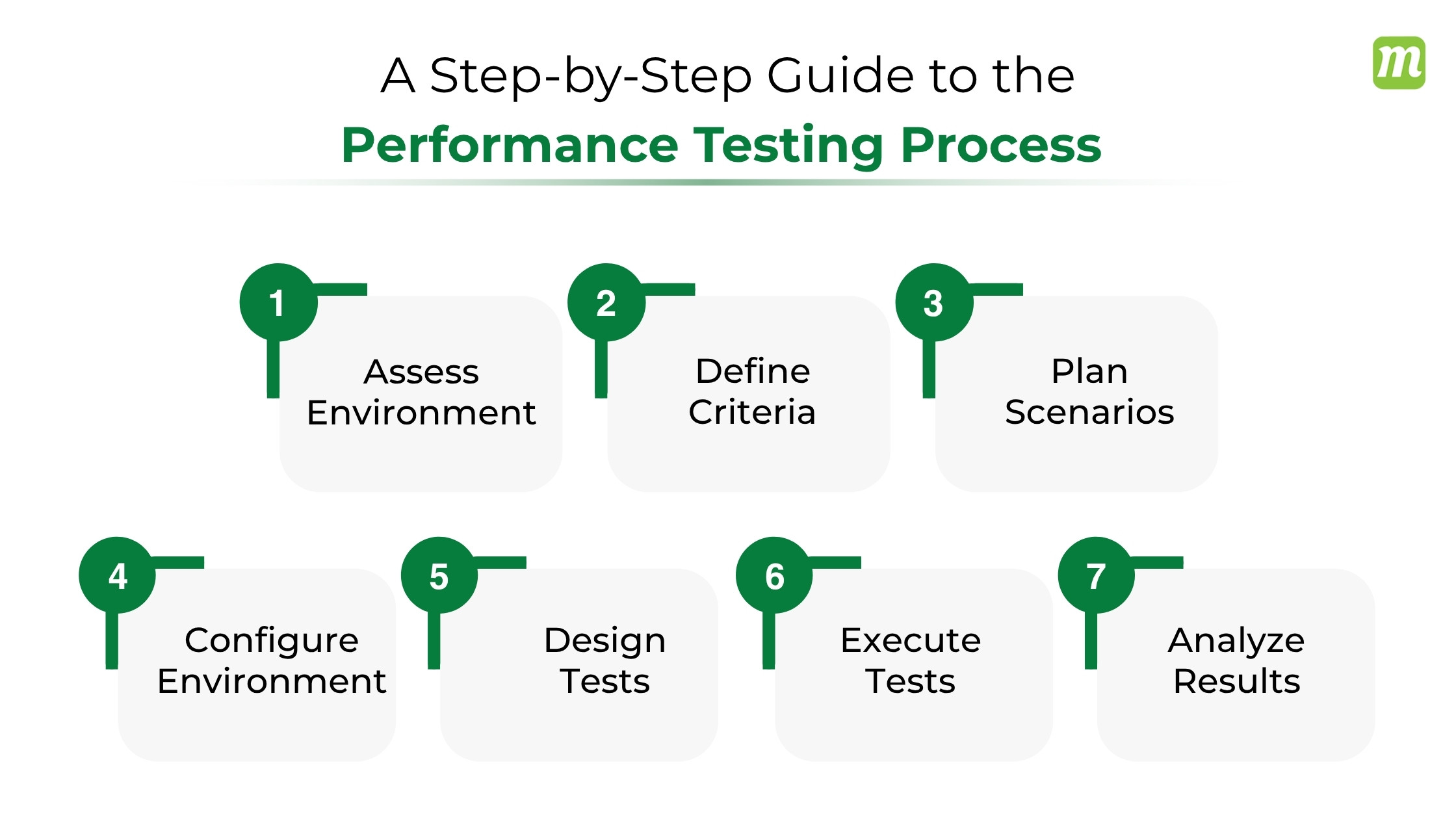
Below is a 7-step process for application performance testing that QA teams of your company must be aware of:
1. Assess Environment: The first and foremost thing a QA needs to do is to understand hardware, software, and network configurations to establish accurate testing conditions and identify environment-specific issues before executing performance tests.
2. Define Criteria: The next step involves establishing clear performance goals, response time thresholds, and scalability benchmarks to accurately measure application success against predefined business requirements.
3. Plan Scenarios: After that, it is time to create realistic user journeys, workloads, and test data during performance automation testing that closely simulate actual usage patterns for reliable and meaningful performance evaluation.
4. Configure Environment: Coming to the fourth stage in the overall mobile application testing process, mobile app performance testing focuses on replicating production infrastructure, deploying the application, and integrating monitoring tools to capture accurate performance metrics throughout the testing process.
5. Design Tests: In this phase, the dedicated QA teams create comprehensive test scripts covering load, stress, and scalability scenarios aligned with your business objectives and expected user interactions.
6. Execute Tests: Now it is time to run automated performance testing while continuously monitoring response times, throughput, resource utilization, and potential bottlenecks that affect application stability and performance.
7. Analyze Results: Finally, based on performance testing best practices, QA teams evaluate test outcomes, optimize identified performance issues, and repeat testing to verify improvements, ensuring the concerned application consistently meets defined performance objectives.
5 Best Performance Testing Tools for Load, Stress, and Scalability Testing
Five popular performance testing tools, including several modern AI testing tools, that help ensure optimal system performance, fast application speed, and excellent release quality are:
1. Apache JMeter
Apache JMeter is a widely used open-source performance testing tool that supports load, stress, and functional testing across multiple protocols. Its flexible architecture, extensive plugin ecosystem, and robust reporting capabilities make it an excellent choice for web application performance testing, API performance testing, and enterprise applications testing.
Features:
- Multiple protocol support
- Plugin ecosystem
- Customizable test scenarios
- Detailed performance reports
Advantages:
- Free
- Open-source
- Highly flexible
- Large community support
Disadvantages: Steep learning curve for beginners
Cost: Free
2. LoadRunner
LoadRunner is an enterprise-grade software performance testing solution designed to validate complex applications under heavy workloads. It supports multiple technologies, offers real-time monitoring, and delivers comprehensive analytics, making it ideal for large-scale enterprises requiring reliable application scalability testing.
Features:
- Protocol-level testing
- Real-time monitoring
- Large-scale scalability
- Comprehensive analytics
- Micro Focus ecosystem integration
Advantages: Highly scalable and suitable for enterprise environments
Disadvantages: Complex implementation and setup process.
Cost: Available on request
3. LoadNinja
LoadNinja is a well-known cloud performance testing platform that executes tests using real browsers to accurately replicate end-user experiences. Its no-code approach enables teams to create automated load tests quickly while identifying performance issues before they impact production environments.
Features:
- Real browser testing
- Cloud execution
- Automated test creation
- Detailed reporting
Advantages: No coding required and quick test execution
Disadvantages: Primarily designed for web applications
Cost: Starts from $301
4. Katalon
Katalon combines automated performance testing with functional testing in a single platform to support web, mobile, desktop, and API applications. Its intuitive interface, scriptless capabilities, and seamless CI/CD integration help QA teams accelerate testing while maintaining software quality throughout the software development.
Features:
- Scriptless automation
- Cross-platform testing
- Reporting and analytics
- CI/CD integration
Advantages: User-friendly and easy to integrate into DevOps workflows
Disadvantages: Limited scalability for large enterprise projects
Cost: Starts from $1,499/year
5. StormForge
StormForge leverages machine learning technology to optimize application performance by automatically analyzing workloads and recommending infrastructure improvements. With real-time monitoring, automated analysis, and cloud scalability integration, its application performance testing feature helps organizations proactively enhance application scalability, efficiency, and overall user experience.
Features:
- Machine learning optimization
- Automated analysis
- Cloud integration
- Real-time monitoring
- Performance reporting
Advantages: Intelligent optimization and actionable performance recommendations
Disadvantages: Requires a basic understanding of machine learning concepts
Cost: Available on request
Why Partner with InnovationM for Automated Performance Testing?
InnovationM helps businesses deliver fast, scalable, and resilient applications through AI-powered automated performance testing and comprehensive software development services. It’s because the automation testing market is growing and is expected to rise to USD 55.2 billion by 2028 from USD 28.1 billion in 2023. Keeping this in mind, our experts simulate real-world traffic, identify performance bottlenecks early, and optimize response times to ensure seamless user experiences under peak loads. By integrating performance testing into CI/CD pipelines, we accelerate release cycles, reduce development costs, and minimize production risks. Backed by 15+ years of experience, AI-driven automation frameworks, and a quality-first approach, we empower organizations to launch high-performing, reliable applications that scale confidently with their evolving business demands.
Ready to Build a Digital Application with Predictable Stability?
So far, you must have understood that performance test automation is essential for delivering digital applications that remain fast, stable, and scalable as user demands evolve. By leveraging the right testing tools, proven automation strategies, and continuous performance validation, businesses can identify bottlenecks early, reduce deployment risks, and ensure exceptional user experiences.
Thus, rather than treating performance testing as a one-time activity, it is advised to make it an integral part of your software development lifecycle to support continuous improvement and long-term growth. Partner with InnovationM today to leverage its AI-powered performance testing expertise and build resilient, high-performing applications through our app development services that scale effortlessly as your business evolves.