

Artificial intelligence use cases in telecom now touch nearly every layer of the business from how networks are optimized to how customers are served and retained. NVIDIA’s State of AI in Telecommunications report, which surveyed 400 telecom industry professionals, found that 67% of respondents saw a sharp increase in revenue after adopting AI. That’s a strong signal that AI in the telecom industry has moved past the pilot stage and is now driving measurable business outcomes.
The scale of that shift shows up in market data too: Grand View Research estimated the global AI in telecom market at USD 1.45 billion in 2022, projecting growth to USD 11.29 billion by 2030. For telecommunications companies, including operators across India and other fast-growing markets, the question isn’t whether to adopt artificial intelligence anymore it’s which use cases to prioritize first.
This article breaks down the highest-impact AI use cases in telecom, the sub-applications within each one, the core benefits, the real challenges operators face while scaling adoption, and where the technology is headed next.
Key Takeaways:
- AI use cases in telecom fall into six core areas: customer segmentation, network analytics, network optimization, predictive maintenance, automated customer service, and fraud detection.
- The global AI in telecom market is projected to grow from USD 1.45 billion (2022) to USD 11.29 billion by 2030.
- 67% of telecom professionals surveyed by NVIDIA reported a revenue increase after adopting AI.
- AI-driven RAN energy management has delivered reported power savings ranging from roughly 7% to 30%, depending on deployment scale.
- Scaling AI adoption globally is slowed by infrastructure cost, data privacy compliance, and a shortage of specialized AI/ML talent.
- The next phase centers on autonomous, self-healing networks and telecom operators becoming AI infrastructure providers in their own right.
AI in Action: The Top Use Cases Transforming Telecom
AI use cases in telecom industry break down into six core categories: customer segmentation, predictive network analytics, network optimization, predictive maintenance, automated customer service, and fraud detection — each addressing a distinct operational problem. Most telecom operators run several of these artificial intelligence use cases in parallel rather than picking just one, and each one breaks down further into specific, deployable sub-use cases.
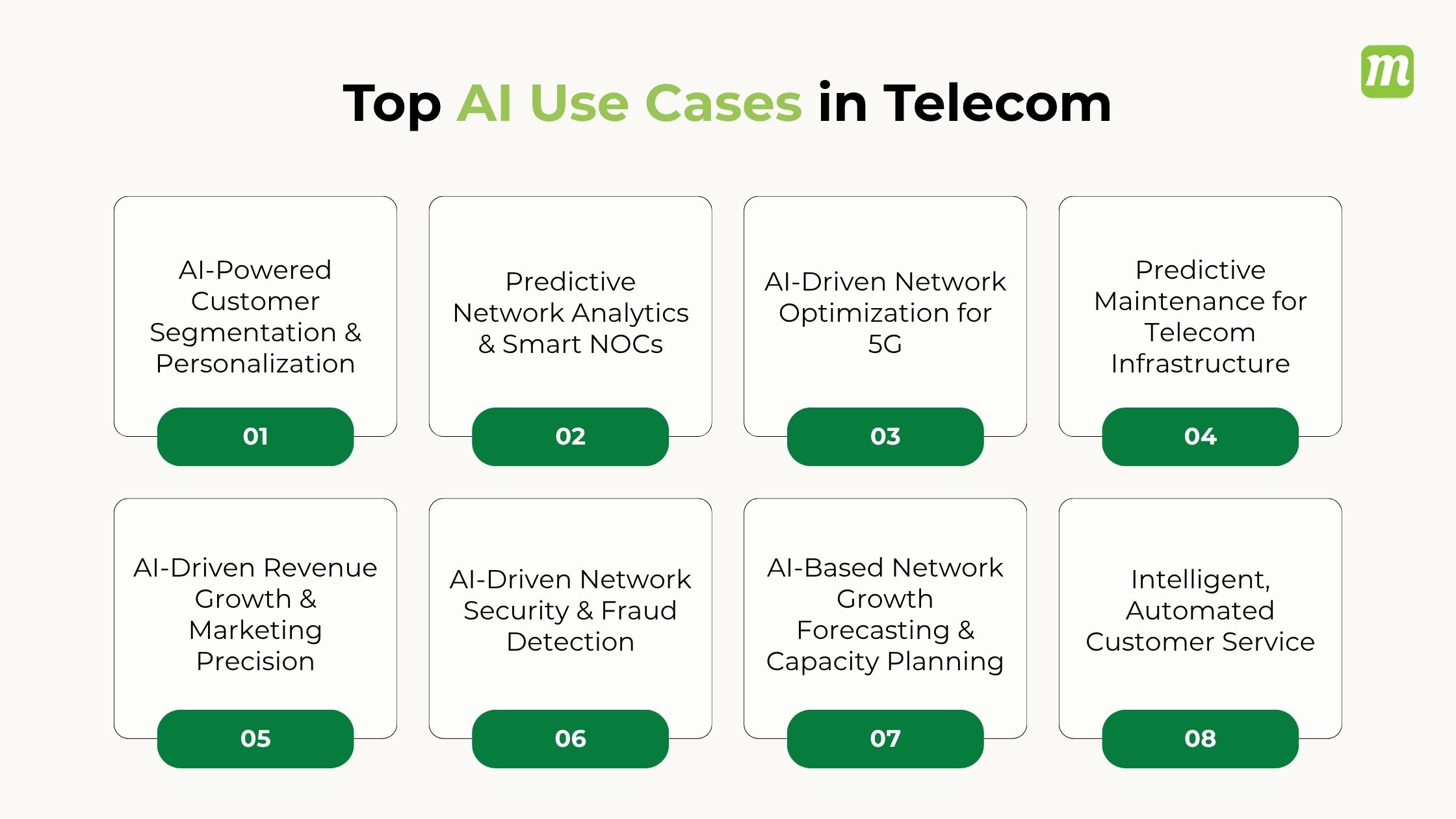
AI-Powered Customer Segmentation & Personalization
AI is well suited to analyzing large telecom customer data sets usage patterns, demographics, device behavior, and preferences to build precise micro-segments instead of broad customer buckets.
- Micro-segmentation: Models group subscribers by usage, device type, and behavior far more precisely than demographic categories alone allow.
- Dynamic personalized offers: Real-time behavioral data drives individualized plan and bundle recommendations instead of one-size-fits-all promotions.
- Churn-risk targeting: Predictive scoring flags high-value subscribers likely to leave, triggering retention offers before they actually churn.
- Cross-sell and upsell modeling: Propensity models identify which add-ons or upgrades a specific subscriber is statistically likely to accept.
Together, these sub-use cases let telecom marketing teams move from broad campaigns to individual-level targeting which is where most of the ARPU and lifetime-value gains from AI in telecom actually show up.
Predictive Network Analytics & Smart NOCs
Telecom companies generate enormous volumes of real-time network, subscriber, and device data, and AI is what turns that volume into a usable early-warning system rather than a reporting backlog.
- Anomaly detection: Machine learning models flag unusual traffic or performance patterns in real time, before they escalate into an outage.
- Incident prioritization: AI ranks network incidents by business impact, so NOC teams address revenue-critical issues first.
- Automated root-cause analysis: Pattern-matching across historical incidents speeds up diagnosis compared with manual log review.
- Self-healing remediation: Select issues trigger automated fixes rerouting traffic or resetting nodes without waiting on a human ticket.
In practice, AI applications in telecom automate complex network tasks, cut operational costs, and personalize the customer experience at scale, the most widely deployed being predictive network maintenance, AI-powered customer support, real-time fraud detection, dynamic traffic routing, and churn prediction. That same predictive, data-driven approach also extends beyond live network operations into planning: InnovationM has developed a GIS-enabled broadband and fiber survey platform for Airtel that applies real-time, AI-supported data capture to nationwide fiber rollout planning.
AI-Driven Network Optimization for 5G
5G’s variable, high-density traffic patterns are exactly the kind of problem AI is built to handle, which is why network optimization is one of the fastest-adopted AI use cases in telecom.
- Dynamic traffic engineering: Algorithms reroute traffic in real time based on live congestion data across the network.
- Adaptive bandwidth allocation: Capacity shifts automatically between network slices as demand changes throughout the day.
- AI-driven RAN energy management: Sleep-mode automation powers down idle radio resources during low-traffic windows, with operators reporting power savings ranging from roughly 7% up to 30% depending on how aggressively the system is deployed.
- Capacity load balancing: AI spreads subscriber load across cell sites to prevent localized congestion during peak hours.
Energy management deserves particular attention here: since the radio access network typically accounts for the majority of a mobile site’s total power draw, even modest AI-driven efficiency gains translate into a meaningful reduction in one of telecom’s largest operating costs.
If you’re mapping out a budget before committing to a full rollout, this breakdown of the cost to build an AI app is a useful starting point.
Predictive Maintenance for Telecom Infrastructure
Predictive maintenance is one of the more mature AI use cases in telecom, since the underlying sensor and performance data already exists across most modern network infrastructure.
- Equipment health scoring: Sensor data feeds models that continuously score hardware condition instead of relying on fixed inspection schedules.
- Failure forecasting: Algorithms flag components likely to fail within a specific window, before symptoms are visible to a technician.
- Truck-roll reduction: Predictive alerts cut unnecessary site visits by scheduling maintenance only when the data actually indicates it’s needed.
- Spare-parts optimization: Demand forecasting for replacement parts helps avoid both stockouts and excess inventory.
Scheduling interventions ahead of a failure, rather than reacting to one, cuts downtime, lowers repair costs, and protects both revenue and customer experience.
Intelligent, Automated Customer Service
Generative AI and natural language processing (NLP) have turned telecom customer service from a pure headcount problem into a hybrid model AI for volume, humans for nuance.
- AI chatbots and virtual assistants: NLP-based tools handle high volumes of routine requests instantly, with research pointing to AI-powered assistants already managing an estimated 40-50% of customer service queries in more advanced telecom markets.
- Agent copilots: Generative AI transcribes calls live and surfaces next-best-action suggestions to human agents mid-call usually built through dedicated AI agent development rather than a generic chatbot framework.
- Multilingual support: Real-time translation extends service coverage across regional languages without hiring native-language staff for every market.
- Proactive issue resolution: AI flags a network problem affecting a specific customer and triggers outreach before that customer ever files a complaint.
This hybrid model is one of the clearest examples of how AI is used in the telecom industry to lower cost-to-serve without sacrificing customer satisfaction.
Must read: Top 10 AI Chatbot Development Companies Worldwide in 2026: A Buyer’s Guide for Enterprises
AI-Driven Network Security & Fraud Detection
As 5G, IoT, and cloud-based communications expand the attack surface, AI-based fraud and security detection has moved from a nice-to-have to a baseline requirement.
- Real-time anomaly flagging: Models detect irregular usage patterns, SIM swaps, and suspicious login attempts as they happen.
- Subscription and first-bill fraud detection: Automated systems catch abnormal activation or invoicing patterns tied to bad-actor accounts.
- Enhanced digital KYC: Automated document verification and facial recognition strengthen subscriber onboarding against identity fraud.
- Network intrusion detection: AI continuously scans traffic for signatures of cyberattacks across 5G and IoT-connected infrastructure.
Catching suspicious behavior early helps telecom operators prevent fraud, protect subscriber data, and stay ahead of regulatory compliance requirements.
AI-Based Network Growth Forecasting & Capacity Planning
By combining historical network data with real-time signals, AI models forecast future demand well before it materializes.
- Demand modeling: Combines historical and real-time signals to project subscriber growth region by region.
- Infrastructure investment prioritization: Forecasts guide where new towers or fiber routes deliver the highest return.
- Scenario simulation: Models test how planned expansions or new services will affect network load before rollout.
- Capacity buffer optimization: Forecasting reduces both over-provisioning and shortfall risk during demand spikes.
That forecasting supports smarter infrastructure investment and better-timed expansion decisions, helping telecom companies avoid both wasted capital and capacity shortfalls.
AI-Driven Revenue Growth & Marketing Precision
Beyond operations, AI is increasingly the engine behind how telecom companies price, market, and grow revenue per subscriber.
- Dynamic pricing: Models adjust offers and pricing in near real time based on demand, competition, and individual usage patterns.
- Campaign self-optimization: Marketing spend automatically shifts toward the channels and segments performing best in live campaign data.
- Next-best-offer modeling: AI recommends the single most relevant upsell or cross-sell for each subscriber interaction.
- Lifetime-value forecasting: Predictive models estimate long-term subscriber value to guide acquisition spend more precisely.
For telecom leadership, this shows up as higher ARPU, stronger cross-sell and upsell performance, and marketing spend that moves from broad segmentation to precise, individual-level engagement.
Key Benefits of AI in Telecom
Beyond individual use cases, AI delivers a consistent set of measurable benefits across telecom operations — from cost control to customer retention. Here’s what that impact typically looks like.
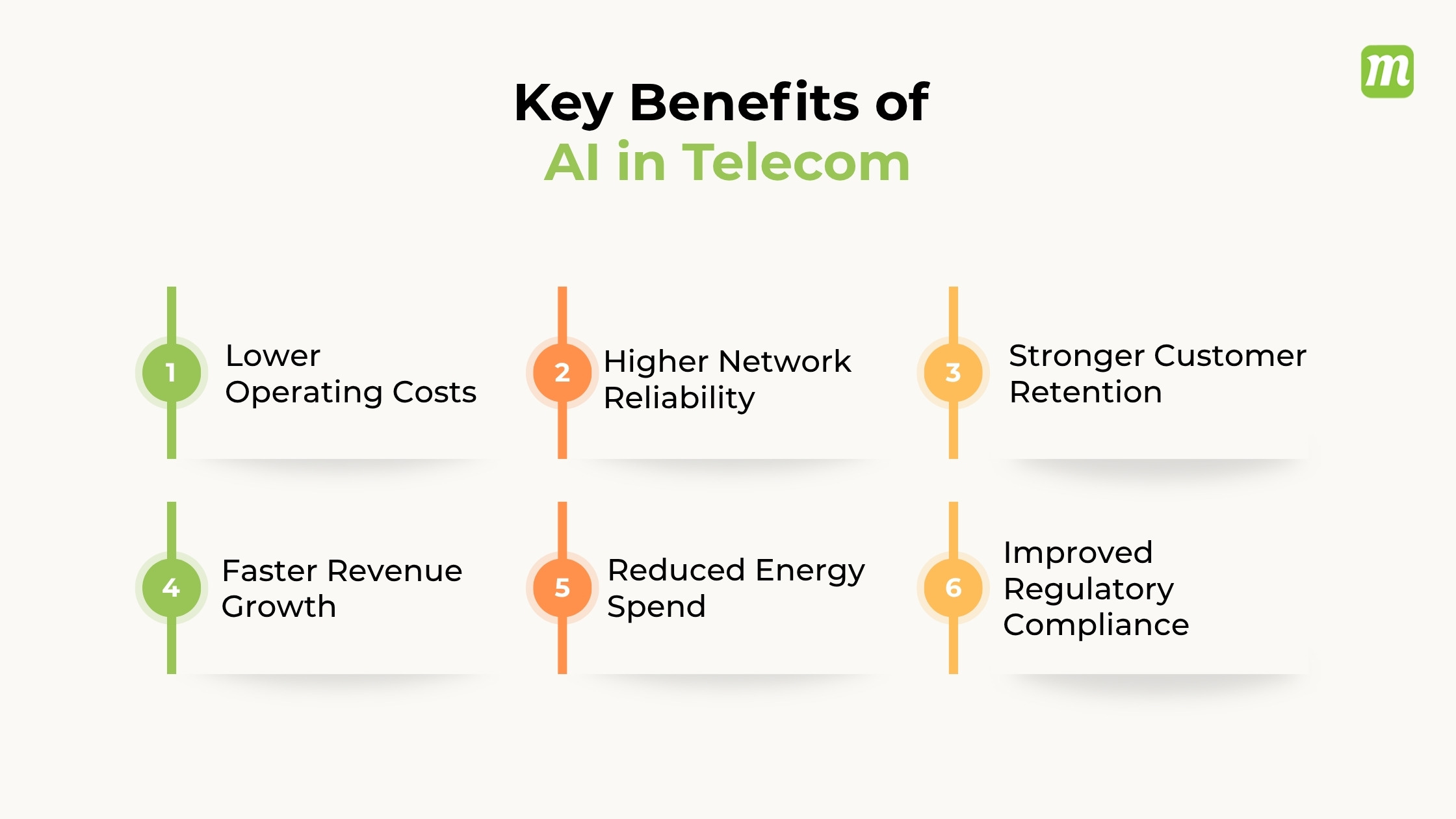
- Lower Operating Costs: Automating network monitoring, maintenance scheduling, and customer support reduces manual labor and unplanned downtime expenses.
- Higher Network Reliability: Predictive analytics and self-healing systems cut unplanned outages and shorten resolution times.
- Stronger Customer Retention: Personalized engagement and proactive issue resolution reduce churn before it happens.
- Faster Revenue Growth: Precision marketing and dynamic pricing lift ARPU and improve cross-sell conversion.
- Reduced Energy Spend: AI-driven RAN management can meaningfully cut network energy consumption, easing one of telecom’s largest operating cost lines.
- Improved Regulatory Compliance: Automated monitoring makes it easier to detect fraud and keep pace with evolving data-protection requirements.
Key Challenges in AI Adoption for Telecom Operators
Scaling AI use cases in telecom is harder in practice than in a pilot, and operators worldwide from established US and European carriers to fast-growing markets like India run into a similar set of hurdles.
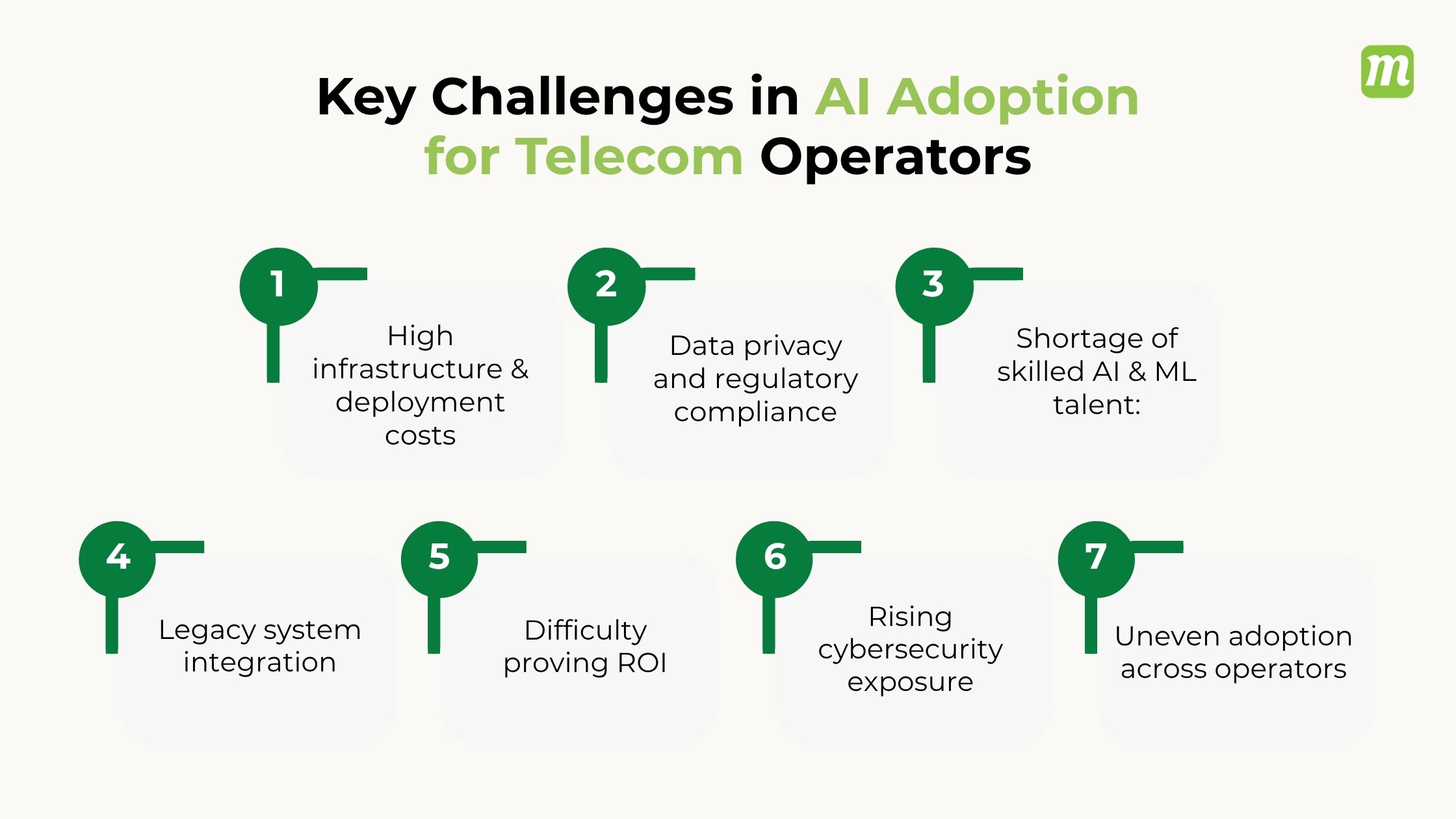
- High infrastructure and deployment costs: Building AI-ready infrastructure, from compute to data pipelines, requires significant upfront investment, which is a heavier lift for operators already running on thin margins.
- Data privacy and regulatory compliance: Large-scale subscriber data analytics has to be balanced against regional data-protection laws India’s Digital Personal Data Protection (DPDP) Act and TRAI’s recommendations on AI and big data being one example, alongside comparable frameworks like GDPR in Europe adding compliance overhead to every new AI use case.
- Shortage of skilled AI and ML talent: Demand for engineers who understand both telecom network architecture and applied machine learning is outpacing supply across most markets, slowing internal AI initiatives.
- Legacy system integration: Many operators are still running on legacy OSS/BSS systems that weren’t built for real-time AI integration, and decommissioning that legacy stack adds cost and risk to transformation projects. Working through proven legacy modernization approaches upfront reduces that risk before committing to a full AI rollout.
- Difficulty proving ROI: AI initiatives without a clearly defined use case, owner, or success metric are prone to stalling, particularly when leadership expects fast, measurable returns.
- Rising cybersecurity exposure: The same 5G, IoT, and cloud adoption that AI depends on also expands the attack surface, requiring continuous investment in network security alongside AI infrastructure.
- Uneven adoption across operators: Larger players with more capital Reliance Jio and Bharti Airtel in India, comparable scale operators elsewhere are investing aggressively in AI-driven network optimization and customer experience, while smaller or legacy-heavy operators risk falling further behind.
The Road Ahead: Where AI Takes Indian Telecom Next
The next phase of AI in Indian telecom won’t look like today’s networks with AI bolted on it will look like networks and business models that are intelligent by default. A few developments are already setting that direction.
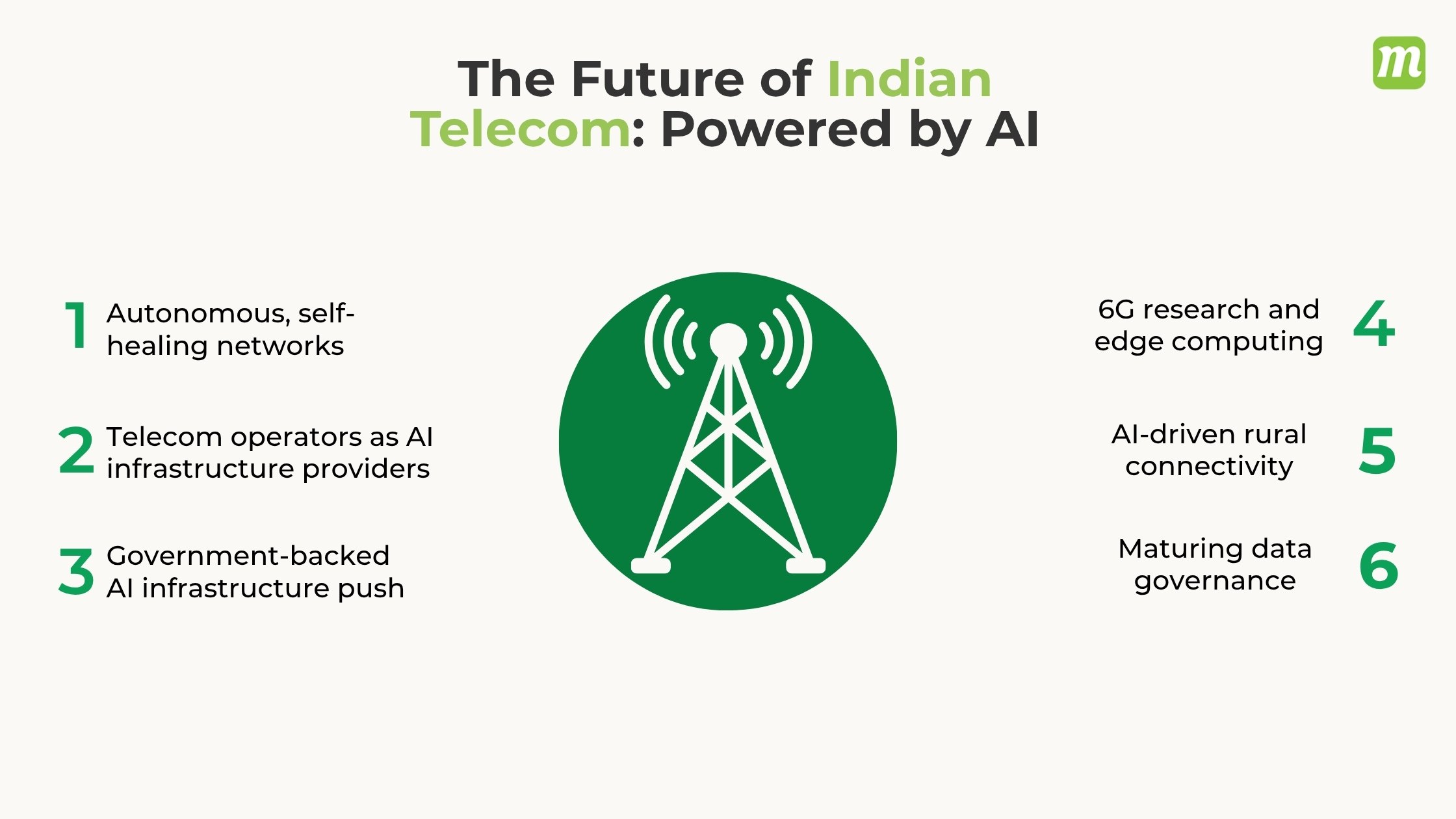
- Autonomous, self-healing networks: Systems that self-configure, self-heal, and self-optimize with minimal human intervention are on the near-term roadmap, promising lower operating costs and faster deployment cycles.
- Telecom operators as AI infrastructure providers: Discussion around the India AI Impact Summit 2026, including coverage from the World Economic Forum, points to telecom operators taking on a bigger role as strategic AI infrastructure providers rather than just connectivity providers.
- Government-backed AI infrastructure push: At the India AI Impact Summit 2026, India’s Minister of State for Communications, Dr. Pemmasani Chandrasekhar, framed telecom as foundational to the country’s broader AI ambitions, reflecting a policy push toward domestic AI capacity building through initiatives like the IndiaAI Mission.
- AI-driven rural connectivity: As coverage extends into underserved regions, AI is increasingly being applied to regional-language accessibility, affordability modeling, and digital-literacy-aware service design, not just raw network reach.
- 6G research and edge computing: Indian telecom operators and research bodies have already begun early 6G pilot work, alongside growing use of edge computing for lower-latency AI inference.
- Maturing data governance: As the DPDP Act moves toward full implementation, telecom operators will need to build AI systems that are compliant and auditable by design, not adapted after the fact.
Conclusion
AI use cases in telecom have moved well past experimentation network optimization, predictive maintenance, fraud detection, and personalized customer experience are already running in production at scale across the telecommunications industry. Real hurdles remain: infrastructure cost, data privacy compliance, and a limited pool of specialized AI talent all need a deliberate strategy rather than an ad hoc rollout, and that’s true whether an operator is based in North America, Europe, or India.
Telecom leaders who treat AI as a long-term investment rather than a one-off pilot are the ones best positioned for the next phase of network intelligence and autonomous operations. InnovationM’s Artificial Intelligence services cover this full lifecycle, from model design through deployment and monitoring, built around a telecom operator’s real network and customer data.
Ready to bring AI into your telecom network?
Connect with InnovationM’s AI engineering team to design, deploy, and monitor AI and ML models built around your real network and customer data with security and compliance built in from day one.
Frequently Asked Questions
What makes AI a good fit for the telecom industry?
Telecom networks generate massive real-time data across subscribers, devices, and infrastructure. AI turns that complexity into actionable analytics that optimize networks, predict failures, personalize services, and automate operations a natural fit for an industry built on data at scale.
How is generative AI changing telecom customer service?
Generative AI gives service agents real-time knowledge support and live call transcription, powers 24/7 chatbots and virtual assistants for routine requests, and enables multilingual support cutting handling time while reserving human agents for complex issues.
What are the benefits of AI in the telecom industry?
AI in telecom improves network reliability, reduces operational and energy costs, boosts customer satisfaction, speeds up service innovation, and opens new revenue streams largely through automation, predictive insight, and personalized engagement.
How does AI help telecom companies reduce costs?
AI reduces telecom costs by automating network monitoring, minimizing downtime, optimizing energy use in the radio access network, streamlining customer support, and improving resource allocation across the business.
Which AI use cases are telecom operators deploying at scale today?
The most widely deployed AI use cases in telecom right now include self-optimizing 5G networks, AI-driven fraud detection, churn analytics, real-time sentiment analysis, dynamic pricing, and predictive maintenance, with edge computing and autonomous network management emerging next.
What are the biggest challenges telecom companies face in scaling AI adoption?
The biggest global challenges are high infrastructure investment costs, data privacy compliance under regional laws, a shortage of skilled AI and ML talent, and integrating AI with legacy OSS/BSS systems still common across the industry.
What is the role of AI in 5G and 6G network rollouts in India?
AI supports 5G rollouts through dynamic traffic engineering, energy-efficient RAN management, and capacity forecasting, and is already informing early 6G pilot work by Indian operators and research bodies exploring next-generation wireless standards.
How is AI shaping the future of Indian telecom operators?
AI is pushing Indian telecom operators toward autonomous, self-healing networks, a bigger role as AI infrastructure providers, and AI-driven rural connectivity supported by government initiatives like the India AI Mission.