
When you work on a new software development project, you want it to succeed at any cost. Why? Because a lot of your hard-earned money is at stake. In fact, as per Statista, the global spending on enterprise software is predicted to reach almost 1.24 trillion U.S. dollars in 2026. And where does so much money go? In tools, frameworks, cutting-edge technologies, and most importantly, in building a software development team.
Now you might think a software development team structure must include highly experienced and skilled professionals to ensure the project’s success. But is that the only thing that matters? Certainly not! There are several factors that you must take into consideration while building the right software engineering teams for your project.
We will discuss all that and more in today’s article while prioritizing the response to how to build a software development team. Let’s begin the discussion you have been waiting for so long:
Understanding a Software Development Team
A Software Development Team is a group of experts who are responsible for building, maintaining, and enhancing digital products. Since such teams consist of software engineers, quality assurance specialists, product managers, and other similar professionals, they have to collaborate throughout the software development life cycle in order to deliver a flawless product.
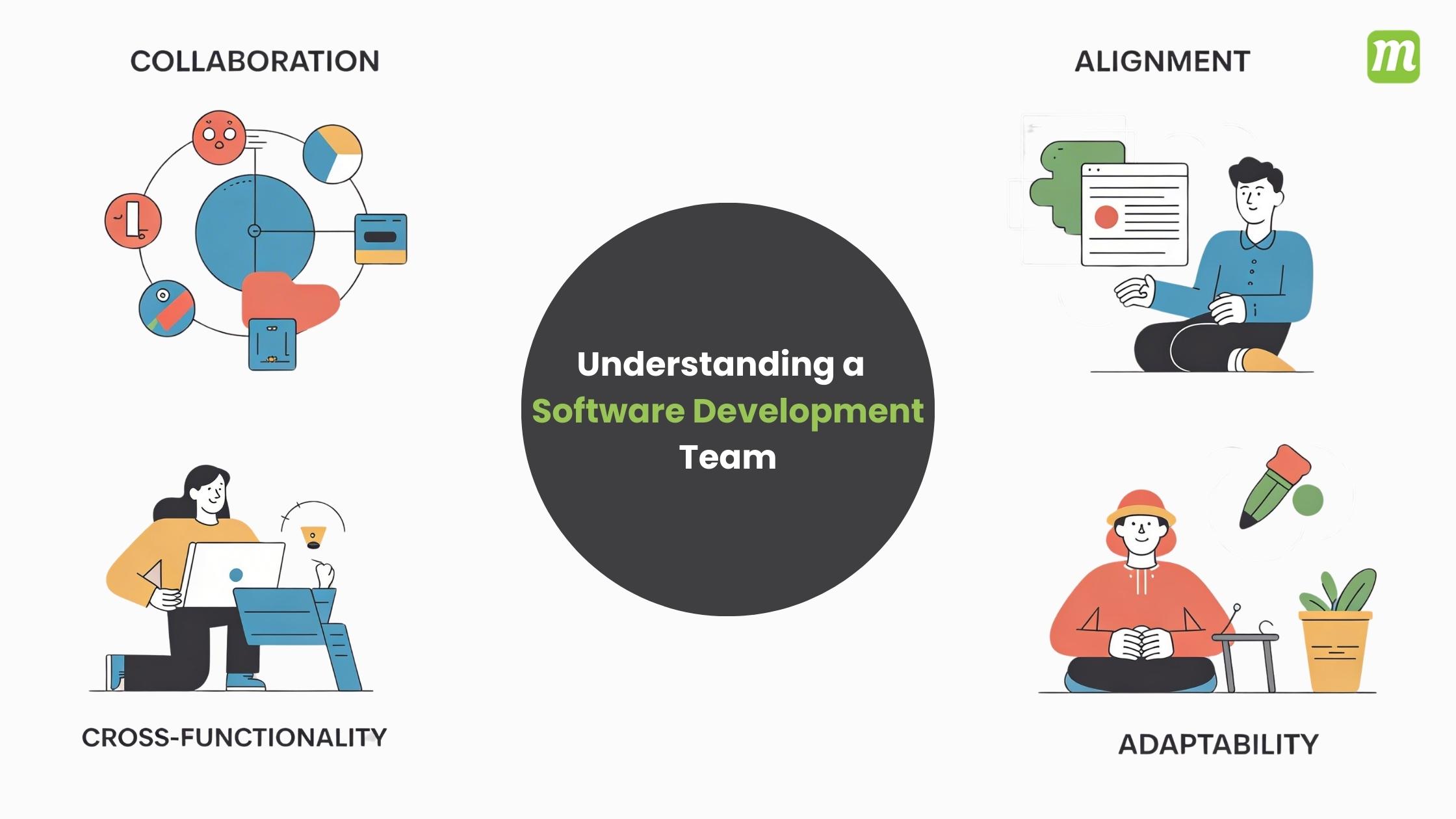
Here is a list of factors that you must pay attention to when creating a successful software development team:
- Collaboration: Your team members should bring into use go-to frameworks such as Agile or Scrum to organize tasks properly and track progress seamlessly. As per a study published by ResearchGate, 70% of businesses reported a sharp increase in team performance after implementing Agile, along with a 35% boost in team collaboration and 25% decrease in time-to-market.
- Alignment: Your dedicated software development team should ensure alignment between technical execution and business goals while emphasizing on-time delivery and high-quality standards.
- Cross-functionality: All the professionals in your team should bring together distinct skill sets to turn your vision into a fully functional software or digital platform.
- Adaptability: Every member of your software development staff augmentation team should be flexible enough to change their roles when required to fulfill specific project needs, organizational structure, and selected methodologies.
Top 3 Types of Software Development Team Structure That Power Successful Solutions
Going with the best software development team structure is pretty important for ensuring the success of your project.

Most companies adopt one of the following foundational models, as each provides different advantages based on your project scope, scaling needs, and technical requirements.
| Team Structure | Description | Key Challenge | Suitable for |
| Generalist | These members of a software development team have broad skill sets and can work on several aspects of development to leverage flexibility over specialization. | They may lack technical expertise for complicated or highly intricate projects. | New startups or small projects that require adaptability with speed. |
| Specialist | Such professionals have exceptional expertise in specific areas such as frontend, backend, and QA that help them deliver top-notch outputs in their respective fields. | They may lead to silos, requiring someone to look after uninterrupted coordination or project management. | Large or complicated projects that require cutting-edge features or compliance. |
| Hybrid | They are a combination of generalists and specialists who come in handy for both adaptability and depth to accomplish fast progress with targeted expertise. | They may require clear communication and strong leadership to connect both types of professionals easily. | Growth-oriented organizations or large-scale projects that prioritize both speed and precision. |
These days, most enterprises choose a hybrid approach to leverage flexibility with in-depth technical expertise to achieve the best results.
How to Build a Software Development Team in 2026 (A Step-by-Step Guide)
When looking for the answer to how to build a software development team in 2026, you must keep in mind to choose the right professional, foster open communication, establish clear goals, leverage everyone’s strengths, and design a system to assign accountability to achieve continuous improvement in the long run.
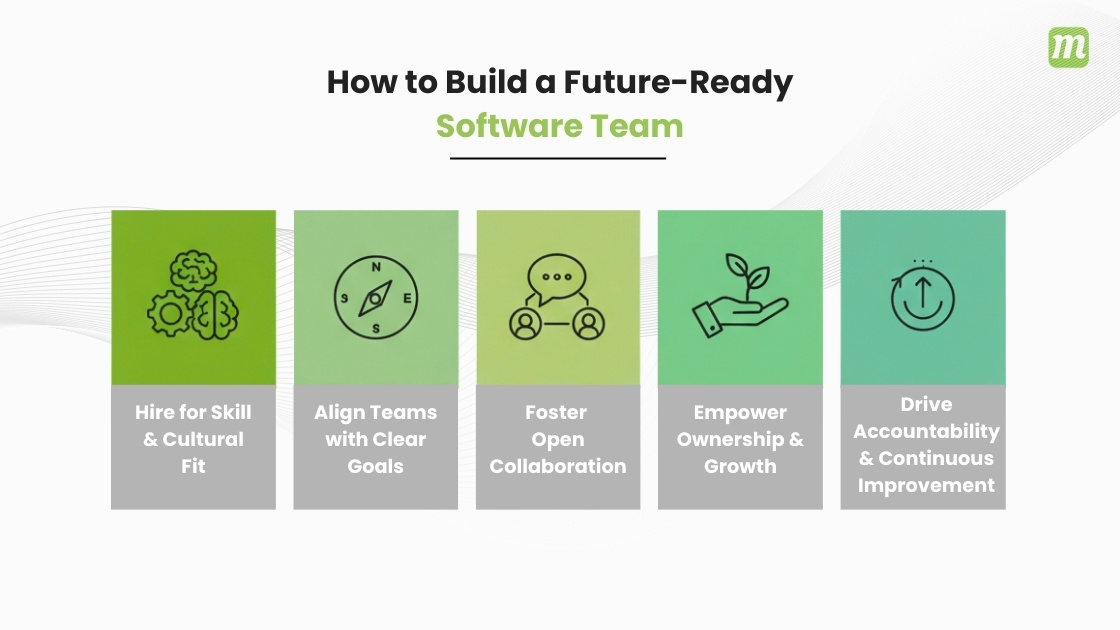
Here is a list of measures you can take while building a software development team:
1. Hire for Skill, Mindset & Cultural Fit
When you think of building a software development team, you should start by hiring not just for technical expertise but cultural fit as well. Make sure to clearly define each role so that every team member understands their responsibilities and how they can contribute to mission-critical projects. Nowadays, AI-powered hiring tools can also turn out to be useful in identifying skill gaps and forecasting where each individual will have the greatest impact.
2. Align Everyone Around Clear Goals & Outcomes
Next, you should let your dedicated software development team know your objectives so that they have a clear idea of your product vision from the start. Define simple collaboration rules, decision-making rules, progress-measuring rules, and most importantly, conflict-resolving procedures to ensure everyone works to achieve common outcomes.
3. Create a Culture of Open Communication & Collaboration
While learning how to build a software development team, it is also important to remember to have an open conversation with your team members and create a safe space where they can share their feedback and ideas without any hesitation. Bear in mind, regular sync-up meetings and brainstorming sessions help keep creativity flowing and prevent silos from occurring.
4. Empower Developers to Take Ownership & Grow
The second last thing you need to have on top of your mind is to leverage each developer’s strengths by giving them tasks that suit their expertise and appreciating their contribution publicly.
Also, do not forget to support ongoing learning through regular mentorship programs and upskilling opportunities so that your team of software development staff augmentation can continue to grow together with your product.
5. Establish Accountability with Continuous Feedback & Improvement
Last but not least, encourage ownership by providing every team member with visibility into day-to-day progress and the end result. Review team performance and project processes regularly using relevant data and insights to make improvements over time and enhance team efficiency down the line.
Now that you learned the answer to how to structure a software development team, it is time to move on to the next section, i.e.,
Why is the Right Software Development Team the Foundation of Your Project Success?
The success of any software project ultimately depends on the strength and structure of the team behind it. The right software engineering teams don’t just write code, they drive the product vision, ensure technical quality, and deliver consistent value throughout the software development lifecycle.

Additionally, when roles and responsibilities are not clearly defined, even well-funded projects can fail down the road. For example, missing a critical role like a product owner in your software development team could result in a solution that lacks direction and fails to meet real user needs. Because a product owner acts as a vision keeper who aligns given business goals with user expectations and guides the team toward value-based outcomes.
Therefore, missing key technical roles at the operational level can slow down progress and limit innovation. Another example we can discuss here is that not including a DevOps engineer in your dedicated software development team may lead to longer release cycles, delayed feature rollouts, and inferior code quality. On the other hand, teams with the right mix of roles can sharply improve efficiency, accelerate releases, and maintain high engineering standards.
Also, balancing experience levels within the team is equally important. Counting only on junior software developers to cut costs can lead to architectural mistakes and slower problem-solving. A healthy team structure brings together senior experts who provide technical leadership and mid-level and junior developers who bring fresh ideas and energy.
So, everything boils down to the point that the right software development team structure ensures clear vision, smooth execution, faster delivery, and better product-market fit. They are the ones who pave the path for innovation, scalability, and long-term project success.
Why Choosing InnovationM’s Software Engineering Teams is Necessary to Accelerate Your Projects?
In today’s digital-first world, the speed and success of your digital transformation initiatives depend heavily on the quality of the software engineering teams driving them. According to a global survey by Forbes Insights, IT executives think that 47% of a dedicated software development team is involved in the development of a digital transformation strategy, while 61% IT professionals are involved in the implementation of that strategy. These numbers highlight the role of a software engineering team in determining the success of your entire digital transformation project.
This is where InnovationM makes a significant difference. Our software development staff augmentation team is built to align with your business goals, product vision, and technical requirements. Whether you are looking for traditional software development or advanced capabilities in AI, data engineering, or IoT, we provide access to niche specialists, experienced developers, and skilled designers who are ready to fast-track your initiatives.
Our software development team brings hands-on experience across diverse industries, including healthcare, retail, manufacturing, and media and entertainment. This cross-domain knowledge helps reduce comprehension time, avoid common pitfalls, and deliver solutions that are both technically strong and business-ready.
We follow a transparent and collaborative hiring approach when it comes to how to build a software development team. Once you share your project requirements with us, we present carefully shortlisted candidates within a few days. Then, you can interview them, evaluate their fit, and make the final decision, ensuring your software development team structure aligns perfectly with your vision and preferences.
For global enterprises, partnering with InnovationM means more than just adding developers. It means building strategic, high-performing software engineering teams that can execute digital initiatives faster, reduce risk, and deliver tangible business outcomes.
The Endnote: Build a Software Development Team That Drives Real Business Impact
Building a software development team is not just about hiring skilled developers, but about creating an environment where collaboration, transparency, and innovation exist. The way you structure your team, define roles, and support daily workflows directly influences product quality, delivery speed, and overall business outcomes.
As AI continues to reshape the software development life cycle, the most successful teams will be those that combine human expertise with intelligent automation. By aligning the right talent, streamlining communication, and using data-driven insights, interested enterprises can speed up development cycles and make smarter decisions.
In the end, a well-structured, fully empowered, and future-ready software development team becomes a strategic asset that not only builds software but also drives considerable growth, adaptability, and business success in the long run.
Apart from building a team, if you also need assistance in how to manage a software development team, you can reach out to our project management experts at InnovationM.
Frequently Asked Questions on Building a Software Development Team
1. Why is a quality assurance tester needed on a software development team?
A quality assurance tester on a software development team ensures the product works as intended by identifying bugs, performance issues, and usability problems before release. This improves product reliability, reduces rework costs, and enhances user satisfaction.
2. Why should I hire dedicated software development team?
A dedicated software development team provides focused expertise, faster development cycles, and better alignment with your business goals. They offer flexibility, scalability, and cost efficiency while allowing you to access specialized skills without the expense of full-time, in-house hiring.
3. How to build a software development team?
To build a software development team, you need to start by defining your project goals, scope, and required tech stack. Identify key roles such as developers, designers, testers, and project managers, and decide who you need for your project. Then, it is advisable to hire skilled professionals, encourage collaboration, and adopt agile practices for continuous improvement.
4. How to structure a software development team?
To structure a software development team, you need to think about your project needs, usually including a product owner, project manager, developer, QA engineer, and designer. You can also leverage agile or cross-functional groups to improve communication, speed up delivery, and ensure accountability across the software development life cycle.
5. How to hire dedicated software development team?
To hire dedicated software development team, you need to clearly define project requirements, budget, and timeline first. Then you can evaluate potential vendors or talent pools based on their experience, technical expertise, communication, and cultural fit. Finally, you should go with conducting interviews, reviewing portfolios, and starting with a pilot project before long-term engagement.
6. What is the role of a software developer?
A software developer designs, codes, tests, and maintains applications based on project requirements. They collaborate with designers, testers, and stakeholders to build functional, secure, and scalable solutions while continuously improving code quality and system performance.
7. What is the 80 20 rule in software development?
The 80 20 rule indicates that 80% of outcomes come from 20% of the efforts. In software development, a small portion of features or bugs often drives most value or issues, helping teams prioritize their work efficiently.
8. What is the 40/20/40 rule of thumb in software engineering?
The 40/20/40 rule suggests allocating roughly 40% of effort to planning and design, 20% to coding, and 40% to testing and refinement. This balance helps reduce defects, improve architecture quality, and ensure more stable and maintainable software.
9. What are the 5 pillars of software development?
The five pillars of software development commonly include planning, design, development, testing, and deployment. Together, these stages ensure structured workflows, high-quality code, reliable performance, and continuous improvement throughout the digital product’s lifecycle.