
AI has come a long way from simply creating text, images, or code. Today, it can also make decisions, take actions, and handle tasks with little human input. This is where the difference between Generative AI and Agentic AI starts to matter.
Generative AI is great at creating things. You can ask it to write an email, summarize a document, create an image, or help with code, and it gives you an answer. Agentic AI takes this a step further. Instead of simply responding to a prompt, it can understand a goal, break it into steps, use different tools, and work toward completing the task with less human involvement.
But does that make Agentic AI better than Generative AI? Not necessarily. Both technologies solve different problems, and in many cases, they work best together. Generative AI can provide reasoning and content creation, while Agentic AI can take that output and turn it into action.
In this guide, we’ll look at the key differences between Agentic AI and Generative AI, where each one fits best, and how businesses can decide which approach makes the most sense for their needs.
What Is Generative AI?
Generative AI is a type of artificial intelligence that creates new content such as text, images, audio, video, and code based on patterns it learns from existing data. Unlike traditional AI, which mainly analyzes or categorizes data, Generative AI creates new content in response to user requests.
For businesses exploring practical applications, Generative AI can support everything from marketing and software development to customer service and data analysis. For example, businesses in the telecommunications industry are already exploring AI for network optimization, customer experience, automation, and other applications. You can explore more examples in our guide to AI use cases in telecom.
How Does Generative AI Work?
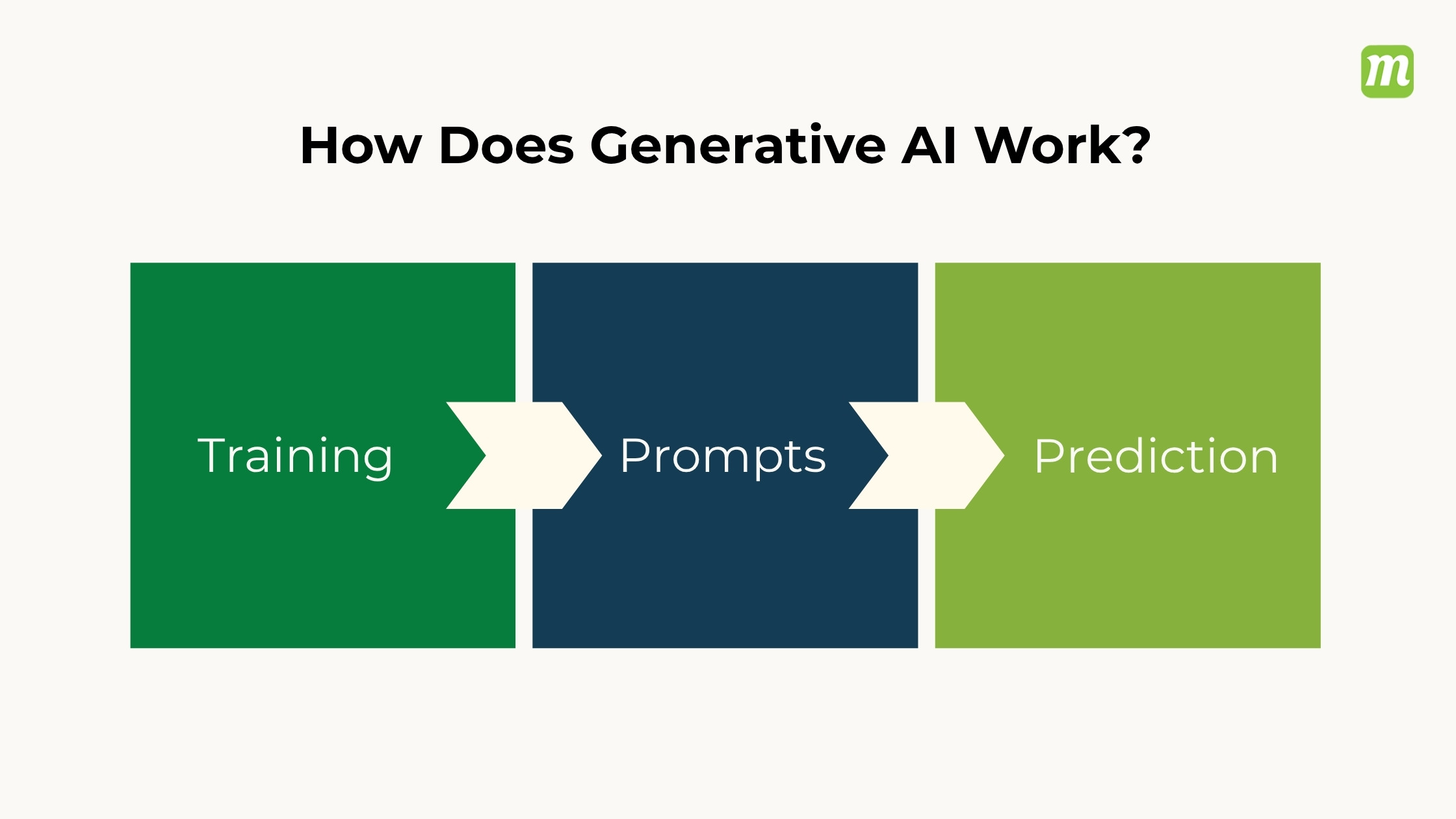
- Training: AI models process massive amounts of data to learn patterns, relationships, and structures.
- Prompts: Users provide instructions or questions, known as prompts.
- Prediction: The model predicts what word, sound, pixel, or piece of code should come next to create a complete response.
Common Examples of Generative AI
- Text: Writing emails, articles, stories, product descriptions, and marketing copy using tools such as ChatGPT or Gemini.
- Images: Creating illustrations, product visuals, or realistic images from written descriptions.
- Code: Writing, explaining, debugging, and improving software code.
Generative AI is also evolving rapidly. As models become more capable and businesses discover new applications, understanding Generative AI trends, future predictions, and business benefits can help organizations plan their AI strategy.
What Is Agentic AI?
Agentic AI is an artificial intelligence system that can operate autonomously to achieve a specific goal with minimal human supervision, rather than simply responding to individual prompts.
Unlike traditional Generative AI, which acts more like a conversational consultant that provides advice or creates content for you to use, Agentic AI acts more like an active digital worker. It takes a goal, plans the steps, uses external tools, makes decisions, and works toward completing the task independently.
For organizations that want to move beyond AI assistants and automate complete workflows, AI Agent Development Services can help turn these concepts into practical business applications.
Key Characteristics of Agentic AI
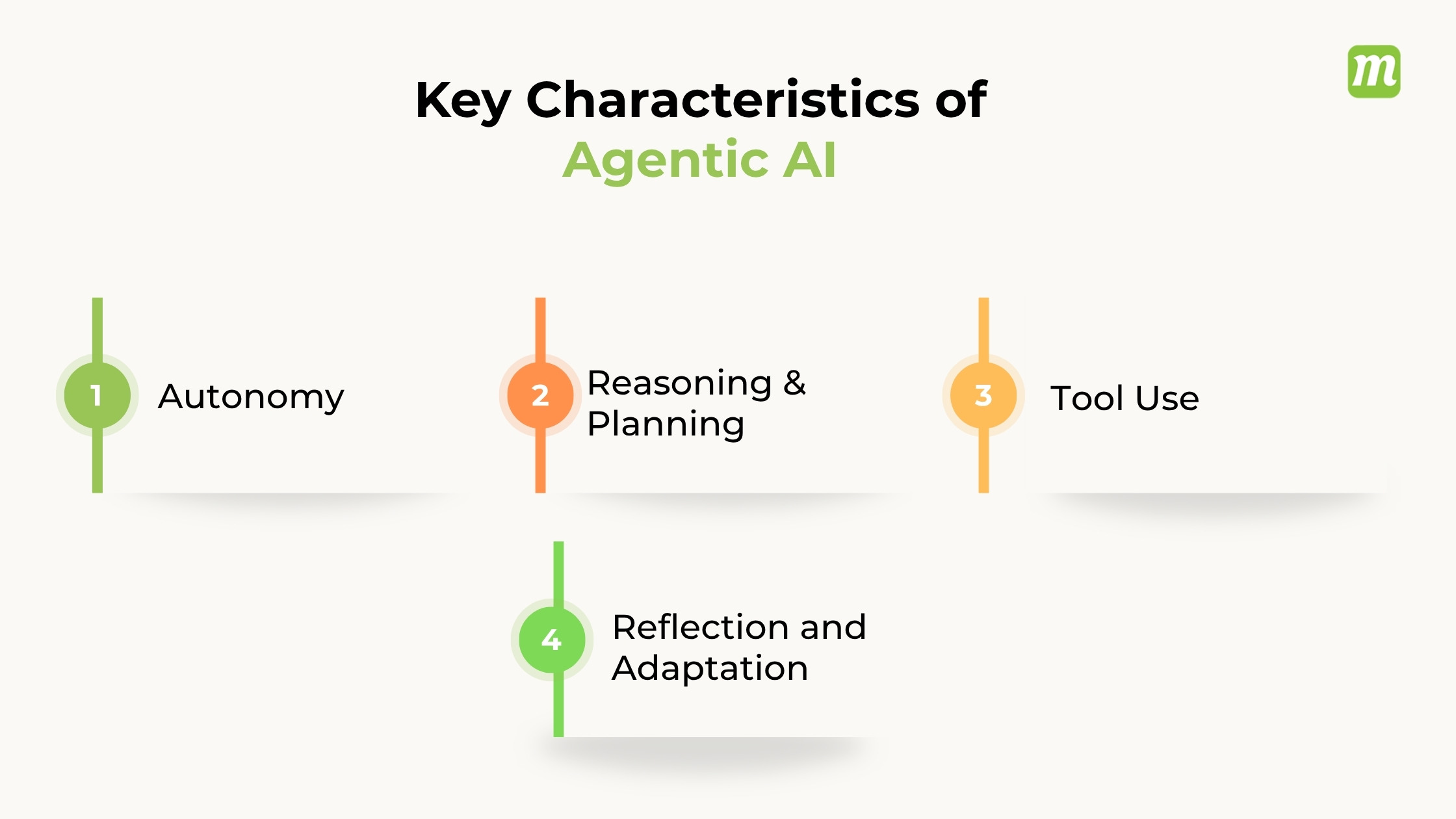
- Autonomy: It can run through workflows and make decisions without requiring step-by-step human instructions.
- Reasoning and Planning: It can break complex objectives into smaller, manageable tasks.
- Tool Use: It can connect with databases, web browsers, APIs, and software applications to gather information or perform actions.
- Reflection and Adaptation: It can evaluate its results, identify errors, and adjust its approach when it encounters an obstacle.
How Does Agentic AI Work?
Agentic AI systems typically follow a continuous cycle known as a perception-action loop:
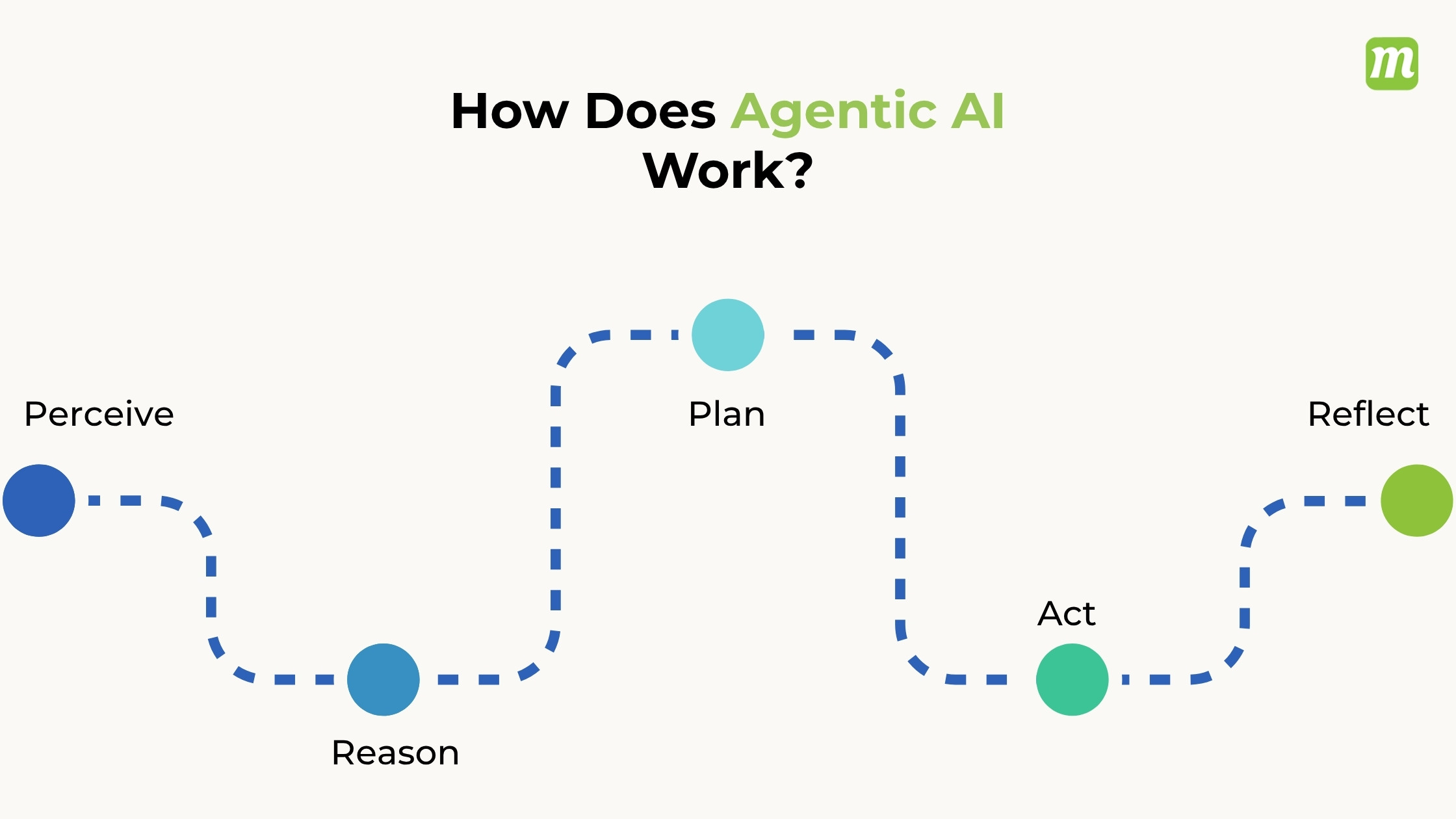
- Perceive: Gather information from the user’s goal and its environment, such as files, APIs, databases, or live systems.
- Reason: Use a large language model (LLM) to analyze the context and determine the next steps.
- Plan: Create a structured sequence of actions.
- Act: Execute tasks using external tools or software integrations.
- Reflect: Evaluate the outcome and adjust the approach when needed.
The growing interest in autonomous AI is reflected in Gartner’s forecast that at least 15% of day-to-day work decisions will be made autonomously through agentic AI by 2028, compared with 0% in 2024. Gartner also predicts that 33% of enterprise software applications will include agentic AI by 2028, up from less than 1% in 2024.
Real-World Examples of Agentic AI
- Customer Support: Instead of a basic chatbot answering static FAQs, an agentic system can access customer accounts, process refunds, and update order statuses.
- Software Development: An AI coding tool can plan a software feature, write the code, run tests, debug issues, and potentially deploy it with appropriate controls.
- Business Operations: An AI assistant can review sales data, create targeted marketing campaigns, draft email content, and schedule posts automatically.
Agentic AI is also finding its way into enterprise application development. For a deeper look at how this technology is being applied, see Beyond Chatbots: How Agentic AI Is Revolutionizing Enterprise Java Applications.
Agentic AI vs. Generative AI: Key Differences
Agentic AI stands apart from standard Generative AI because it can proactively plan, make decisions, and execute multi-step workflows rather than simply responding to individual prompts with generated content.
Core Differences
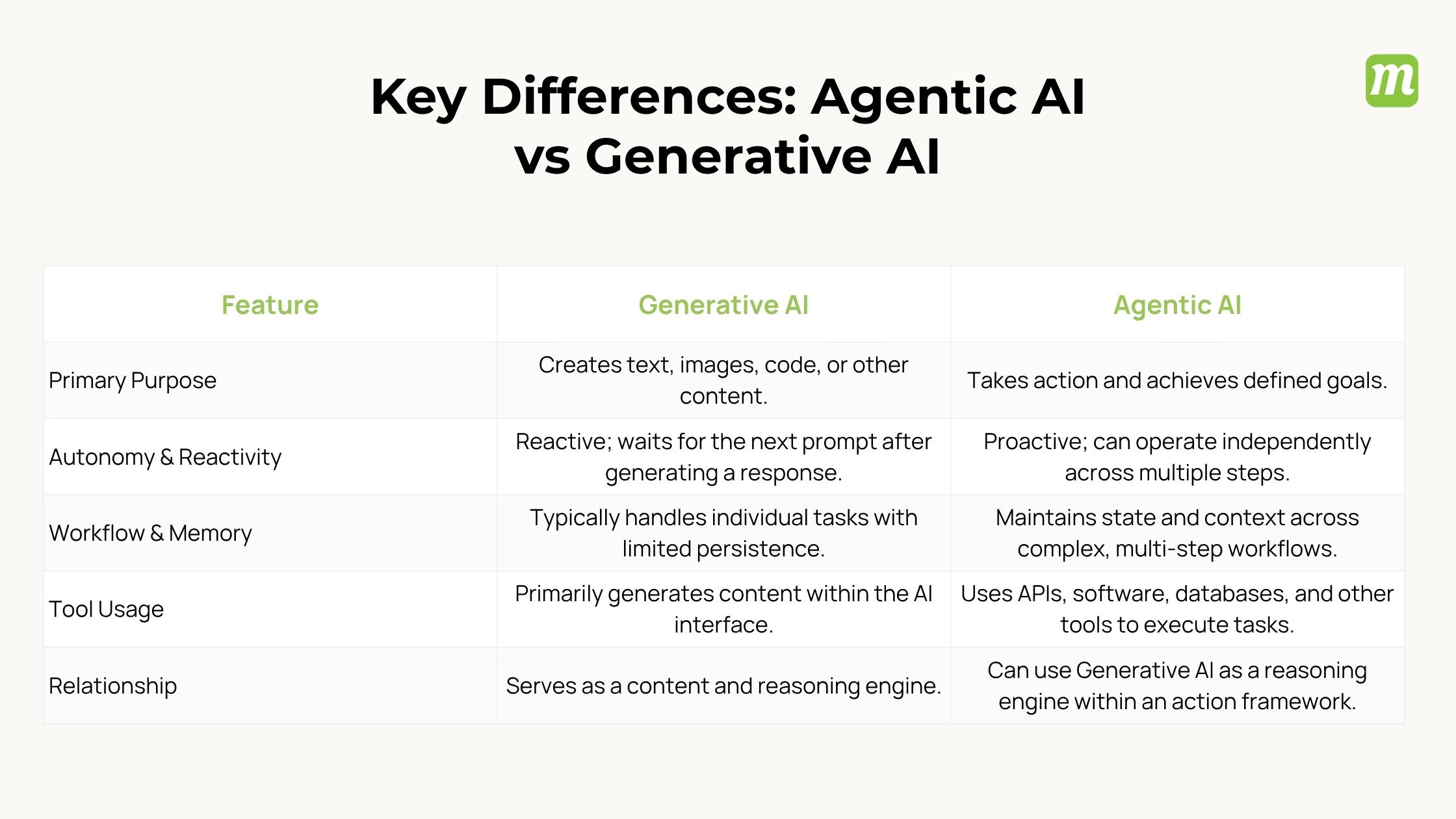
- Primary Purpose: Generative AI focuses on creating content such as text, images, or code. Agentic AI focuses on taking action and achieving defined goals.
- Autonomy and Reactivity: Generative AI is generally reactive; it produces an output in response to a prompt and waits for the next instruction. Agentic AI is more proactive and can operate independently across multiple steps.
- Workflow and Memory: Standard Generative AI typically handles individual requests, while Agentic AI can maintain state and context across complex workflows.
- Tool Usage: Generative AI primarily produces content directly. Agentic AI can actively use external tools, databases, APIs, and software applications to interact with real-world systems.
- Relationship: Agentic systems often use Generative AI models as a reasoning and content-generation engine, wrapping them in planning and execution loops to get actual work done.
| Feature | Generative AI | Agentic AI |
| Primary Purpose | Creates text, images, code, or other content. | Takes action and achieves defined goals. |
| Autonomy & Reactivity | Reactive; waits for the next prompt after generating a response. | Proactive; can operate independently across multiple steps. |
| Workflow & Memory | Typically handles individual tasks with limited persistence. | Maintains state and context across complex, multi-step workflows. |
| Tool Usage | Primarily generates content within the AI interface. | Uses APIs, software, databases, and other tools to execute tasks. |
| Relationship | Serves as a content and reasoning engine. | Can use Generative AI as a reasoning engine within an action framework. |
Agentic AI vs. Generative AI: Which Is Better?
Neither Agentic AI nor Generative AI is strictly “better” because they serve different purposes and are often most effective when used together.
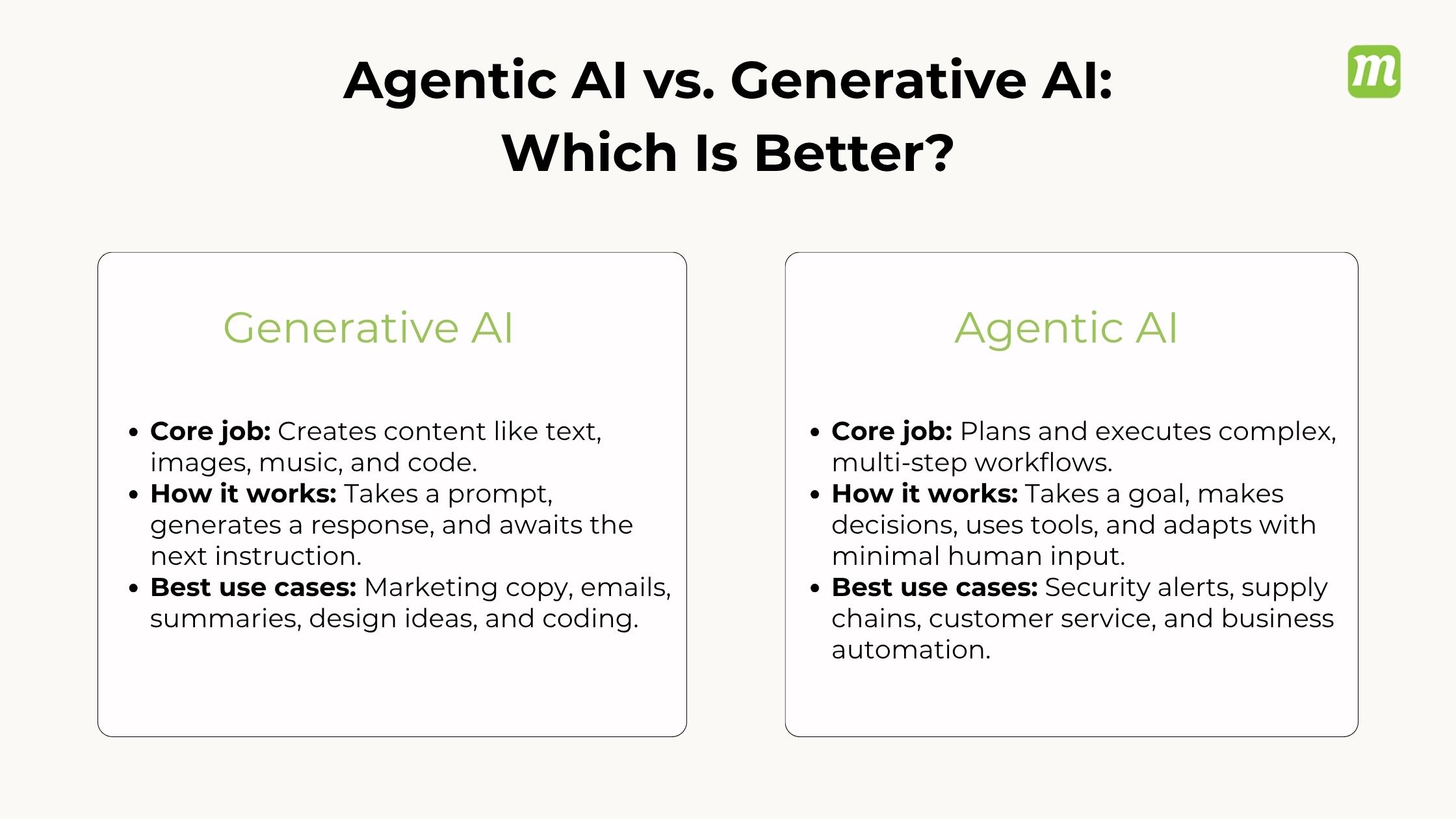
Generative AI is better for creating content and ideas.
Agentic AI is better for planning and taking action.
What Is Generative AI Best For?
- Core job: Creates new content such as text, images, music, and code.
- How it works: It receives a user prompt, generates a response, and typically waits for the next instruction.
- Best use cases: Writing marketing copy, drafting emails, summarizing long articles, generating design ideas, and assisting developers with code.
What Is Agentic AI Best For?
- Core job: Plans and executes complex workflows across multiple steps and tools.
- How it works: It receives a general goal and can act with limited human intervention. It can use APIs, make decisions, evaluate results, and adjust its approach.
- Best use cases: Managing IT security alerts, tracking supply chains, handling multi-step customer service tasks, and automating business workflows.
Which Should Your Business Use?
You don’t necessarily have to choose one over the other. In fact, modern AI systems can use Generative AI as the “brain” for reasoning and content creation, while an agentic layer provides the ability to take action and interact with external systems.
- Use Generative AI when you need a fast draft, summary, explanation, or creative output.
- Use Agentic AI when you want to automate a complete process from start to finish.
When Should Businesses Use Generative AI?
Businesses should consider Generative AI when they want to automate repetitive tasks, scale content creation, improve employee productivity, or accelerate analysis with clear and measurable outcomes.
High-Impact Generative AI Use Cases
- Customer Support: Search for AI chatbot development companies and deploy AI chatbots to handle routine inquiries, provide real-time responses, summarize conversations, and assist support teams.
- Marketing and Sales: Generate personalized email campaigns, draft product descriptions, and scale content marketing.
- Software Development: Accelerate coding, assist developers, and generate repetitive code snippets and documentation.
- Operations and Forecasting: Summarize large internal documents, analyze information, simulate scenarios, and support forecasting.
For organizations looking to build these capabilities, AI Development Services can help with designing and implementing AI-powered solutions based on specific business requirements.
When Should You Implement Generative AI?
- Defined Success Criteria: Target processes with high volumes of repetitive work and clear metrics for success.
- Ready Infrastructure: Make sure your organization has clean data, appropriate governance frameworks, security controls, and alignment with applicable regulations.
When Should Businesses Use Agentic AI?
Businesses should consider Agentic AI when they need to automate complex, multi-step workflows that require autonomous planning, real-time decision-making, and interaction with enterprise systems.
Unlike traditional AI tools or copilots that mainly suggest or generate content, Agentic AI can actively execute tasks and work toward defined business goals.
Interest in autonomous agents is already growing. A Deloitte survey of 2,773 business leaders found that 26% of respondents said their organizations were exploring autonomous agents to a “large or very large extent.”
When Should You Implement Agentic AI?
- High Volume of Repetitive Tasks: Use Agentic AI when teams spend significant time on manual processes such as sorting data, routing customer service tickets, or onboarding suppliers.
- Persistent Operational Bottlenecks: Deploy autonomous agents when cross-team handoffs, approval delays, or administrative work slow down operations.
- Scalability Challenges: Adopt these systems when spikes in customer demand or market activity put pressure on manual workflows.
- Data-Rich Decision Making: Consider Agentic AI when analyzing large streams of structured and unstructured data in real time, such as fraud detection, risk management, or market pricing, requires more speed and scale than manual processes can provide.
Key Business Use Cases for Agentic AI
- Customer Support and Call Centers: Automatically transcribe calls, pull relevant service information, resolve tier-one issues, and document outcomes.
- Marketing and Sales: Orchestrate multi-channel campaigns, make real-time adjustments, and handle lead prospecting using integrated business data.
- Procurement and Compliance: Guide vendor applications, check third-party databases for fraud signals, and flag supply chain risks.
Lesser-Known Industry Use Cases for Generative AI vs. Agentic AI
Generative AI creates content based on user prompts, while Agentic AI acts more autonomously to plan, coordinate, and execute multi-step workflows toward a defined goal.
Generative AI Use Cases
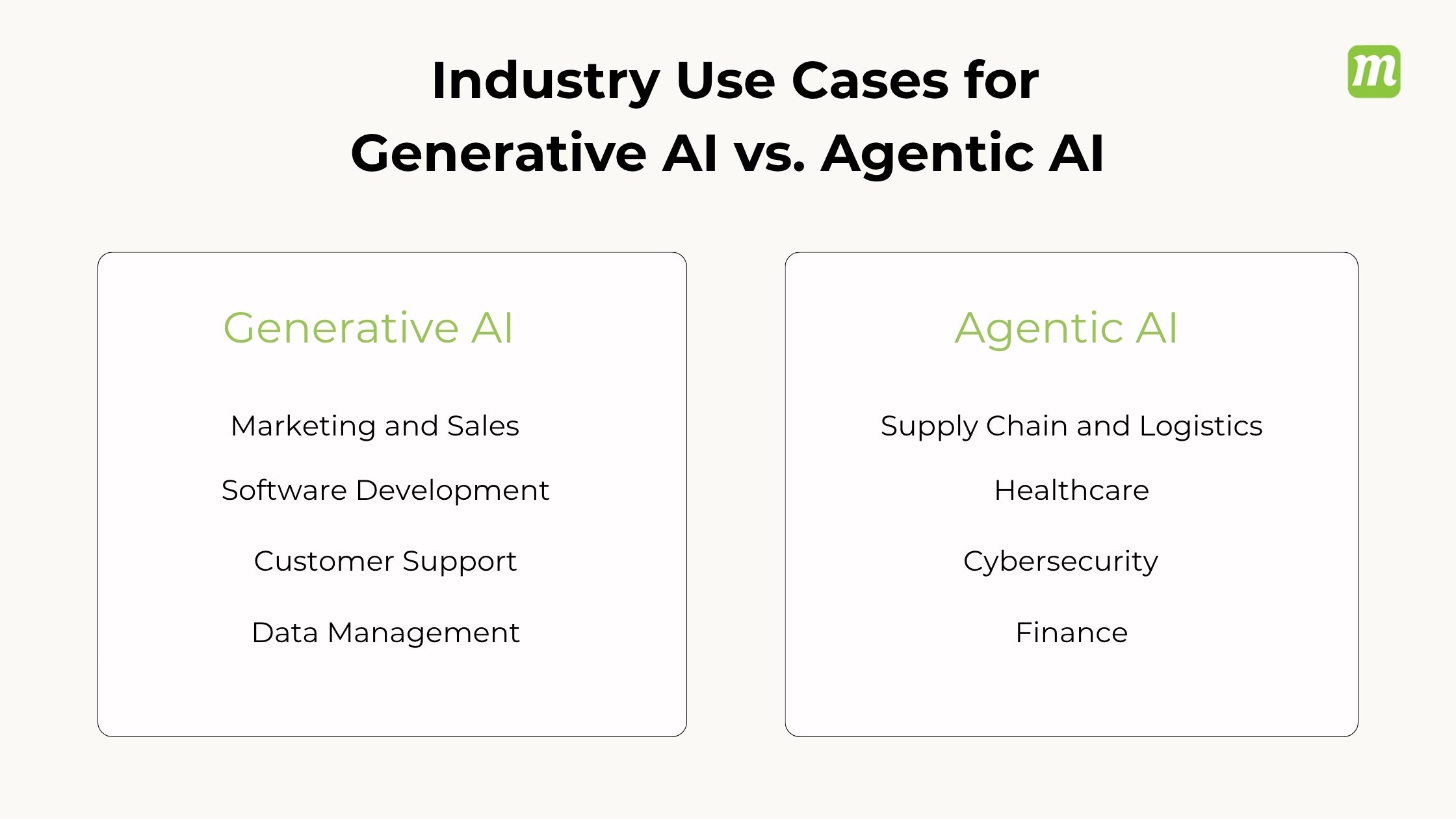
- Marketing and Sales: Drafting blog posts, social media updates, and personalized email copy.
- Software Development: Generating code snippets, functions, and documentation from natural language instructions.
- Customer Support: Powering reactive chatbots that answer specific customer questions on websites.
- Data Management: Summarizing long reports, meeting transcripts, or legal documents into concise insights.
Agentic AI Use Cases
- Cybersecurity: Detecting network anomalies, querying threat intelligence feeds, and taking predefined response actions with appropriate human oversight.
- Healthcare: Monitoring patient data and proactively alerting care teams when predefined conditions change.
- Supply Chain and Logistics: Monitoring traffic, weather, and inventory data to help reroute shipments and optimize delivery times.
- Finance: Continuously analyzing market information to support decisions around portfolios, credit exposure, or other financial workflows, subject to appropriate controls.
Businesses exploring these applications can also evaluate the broader AI ecosystem through our updated guide to Top AI Development Companies in India.
Can Agentic AI and Generative AI Work Together?
Yes. Agentic AI and Generative AI can work together by combining content generation with autonomous task execution.
How Do Agentic AI and Generative AI Work Together?
Generative AI acts as the creative and reasoning engine. It can write text, create visuals, analyze information, and draft code when needed.
Agentic AI acts as the execution layer. It takes a high-level goal, plans the workflow, makes decisions, and calls external tools.
The teamwork: An agentic system can use a Generative AI model as one of its built-in capabilities, generating content dynamically while managing a larger workflow.
Real-World Examples
- Customer Support: An agentic system detects that a shipment is delayed, checks the order status, identifies the problem, uses Generative AI to write a personalized customer email, and updates the support ticket.
- Advertising: Agentic AI analyzes available customer and campaign data to determine the target audience, while Generative AI creates the ad copy and visual concepts.
This combination is one reason businesses are increasingly looking at AI not just as a content-generation tool, but as a way to automate complete workflows.
On a Closing Note
So, Agentic AI vs. Generative AI: which one is better? The simple answer is: it depends on what you want AI to do.
If you need help creating content, generating ideas, summarizing information, or writing code, Generative AI is often the right choice. But if you want AI to handle a complete workflow, make decisions, interact with other systems, and work toward a goal with minimal supervision, Agentic AI can offer much more.
The interesting part is that you don’t always have to choose between the two. Agentic AI and Generative AI can complement each other. Generative AI can handle reasoning and content creation, while agentic systems can use those capabilities to take action and get the job done.
For businesses, the best approach is to start with the problem rather than the technology. Look at the tasks you want to improve, understand how much autonomy they require, and then decide whether Generative AI, Agentic AI, or a combination of both can deliver the most value.
As AI continues to evolve, the combination of intelligence and action is likely to become an increasingly important part of how businesses operate.
Frequently Asked Questions
1. Is Agentic AI Better Than Generative AI?
Agentic AI is not necessarily better than Generative AI; instead, they serve different purposes. Generative AI focuses on creating content, while Agentic AI focuses on taking autonomous actions and completing multi-step workflows.
2. What Is the Main Difference Between Agentic AI and Generative AI?
The main difference is that Generative AI creates content when you prompt it, while Agentic AI can plan and execute multi-step tasks to achieve a defined goal. Neither technology is universally “better” because they are designed for different purposes. Instead of competing, they can work together.
3. Is ChatGPT Generative AI or Agentic AI?
ChatGPT is primarily known as a Generative AI application because it generates responses based on user instructions. However, AI applications can also incorporate agentic capabilities that allow them to plan, use tools, and perform multi-step tasks.
4. Which AI Is Better for Business?
Neither Generative AI nor Agentic AI is strictly better for business. Generative AI is well suited for content creation, analysis, and productivity tasks, while Agentic AI is better suited for autonomous workflows and multi-step business processes. In many cases, combining both can deliver the most value.