
In today’s digital-first world, you must have heard how conversational AI has transformed the customer service sector by simulating human-like interactions to handle tasks like support, booking, and data collection. The good news is that conversational AI has entered the banking and finance industry as well. Yes, you heard that right! Since customers want instant responses, 24×7 availability, and proactive support to check their bank balance, manage transactions, or get personalized financial advice, using conversational AI in banking is a boon for financial institutions across the globe. The best part of conversational AI is that it allows banks to build robust relationships, increase efficiency, and stay ahead in a highly competitive market.
In fact, as per Grand View Research, the global artificial intelligence in banking market size was estimated to be USD 19.87 billion in 2023, which is expected to grow to USD 143.56 billion by 2030. This rapid market growth shows that AI adoption is accelerating across the banking and finance industry. Thus, making an early investment in conversational AI is a wise decision that helps reduce costs, enhance customer experience, and gain an edge over your competitors in the market.
This guide explains conversational AI in banking, core technologies powering it, key benefits, real-world use cases, and implementation strategies. Along with all this, we will also discuss how InnovationM can help build an AI-powered communication solution for your banking business and what the future holds for AI-driven banking experiences. Let’s start:
What is Conversational AI in Banking? A Complete Overview
Conversational AI in banking acts as a 24×7 digital assistant that uses intelligent, voice-powered systems to allow customers to check balances, transfer funds, block cards, or receive personalized financial advice immediately. Behind the scenes, these systems verify the identities of each customer, pull data from central platforms, and create complete audit trails. The best part of this AI solution is that it provides your customers with accurate and on-time help while reducing operational costs at the same time.
Key Technologies Powering Conversational AI in Banking
Now that you have understood the role of conversational AI in banking, it is time to understand state-of-the-art technologies powering it, such as NLP, machine learning, and speech recognition. These technologies work in tandem to enable intelligent, real-time, and personalized customer interactions on a large scale. Let’s take a look at a few of them:
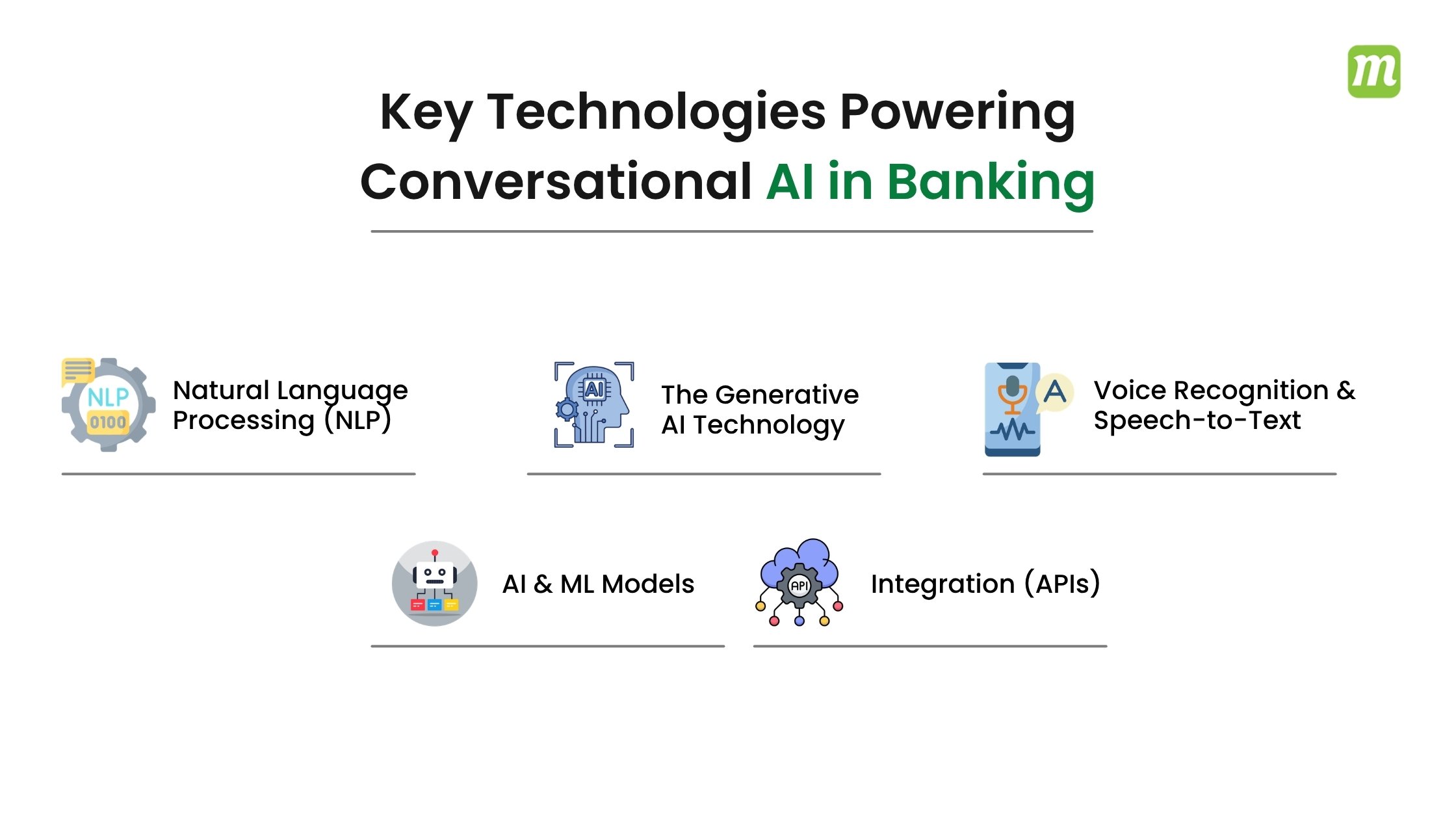
1. Natural Language Processing (NLP)
It is the core technology powering conversational AI in banking, which understands customer intent and figures out the actual meaning from text or speech. As a result, the AI-powered banking interactions feel like conversing with a real human.
2. AI & ML Models
These models learn from past interactions continuously, which helps in improving the accuracy and relevance of delivered responses. Working on these parameters is extremely important to increase the effectiveness of conversational AI in banking and fintech.
3. Voice Recognition & Speech-to-Text
By integrating voice recognition and speech-to-text technologies into your core system, you can enable natural voice interactions through smartphones or smart devices. This way, you can improve accessibility and convenience for your customers in conversational banking.
4. The Generative AI Technology
The biggest benefit of using generative AI technology is that it adds context-aware and human-like conversational capabilities to your banking system. Due to this, banks are able to provide richer, more engaging customer experiences by leveraging conversational AI in banking.
5. Integration (APIs)
API is a set of rules that contributes to the functioning of AI in banking, including all the technologies we discussed above. It connects AI solutions to core banking systems, CRMs, and mobile applications to ensure conversational AI in financial services works without interruption across various channels.
Top Benefits of Conversational AI in Banking for Modern Financial Institutions
Conversational AI in fintech provides a wide range of benefits that are not just limited to banking automation.
These benefits are as follows:
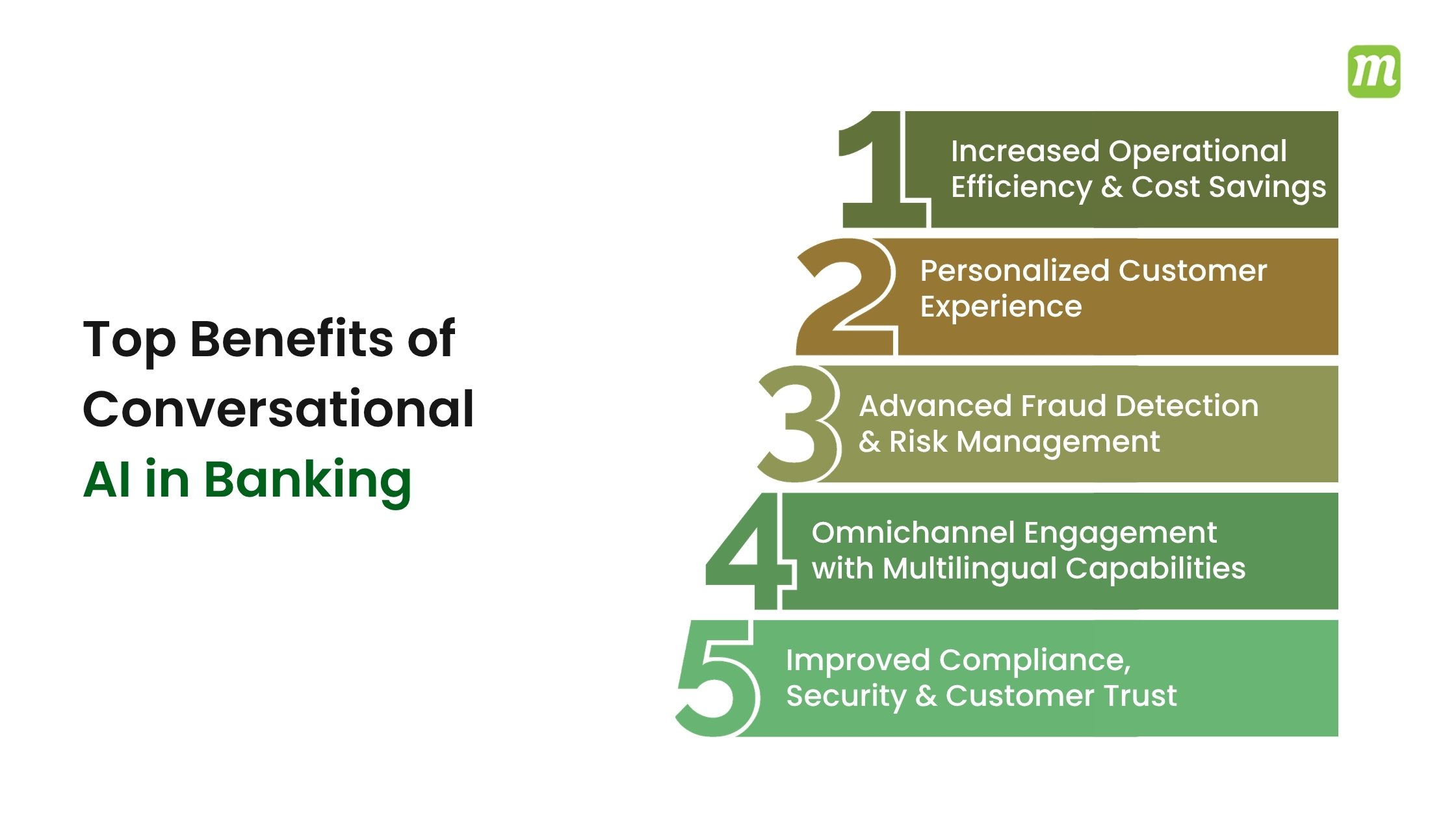
1. Personalized Customer Experience
Using conversational AI in banking helps enhance customer experience along with its closely associated elements, such as trust, speed, and personalization. Since this AI solution can operate 24×7 across different channels, customers can get expected help immediately. The good news about using AI in banking is that it also adapts based on context and emotional aspects, resulting in more relevant and human-like conversations.
Just so you know, in a recent survey of 7,000 global participants, more than 7 in 10 customers (almost 72%) said that personalization is very important for them. In addition to that, 8 in 10 banking leaders (almost 77%) said that personalization contributes to increased customer retention.
2. Advanced Fraud Detection & Risk Management
Coming to the next conversational AI benefits in banking, advanced conversational platforms can help enhance fraud detection and minimize fraud risk by leveraging real-time account access with intelligent monitoring. Just to let you know, 61% of bank executives say that fraud risk detection will add the highest possible value to the banking business, followed by cybersecurity at 52%.
3. Improved Compliance, Security & Customer Trust
When implementing conversational AI in banking industry, it helps in maintaining compliance. It records transcripts of conversations for audit and reporting purposes, while also ensuring customers get a secure platform for desired conversations. Maintaining this level of transparency in the banking and fintech industry helps in building unwavering trust among customers.
4. Increased Operational Efficiency & Cost Savings
One of the main benefits of conversational AI in banking is that it minimizes the load on human agents by handling a large number of routine inquiries. AI-powered solutions have the ability to increase your bank’s operational efficiency while keeping call volumes and operational costs to a minimum. These solutions help human agents work more effectively by providing contextual responses and conversation summaries.
5. Omnichannel Engagement with Multilingual Capabilities
One important piece of information you must remember about conversational AI agents is that they work across multichannel touchpoints that are connected to the same backend system. That’s not all! These AI agents also support several languages, which empowers fintech companies to serve different types of customers.
6. Scalable Infrastructure Driving Continuous Innovation
Last but not least, conversational AI benefits in banking include robust support for innovation in customer engagement. Wondering how? Well, after continuous interactions with customers, banks can gather highly relevant data about their habits and preferences, paving the way for more personalized offers, precise advice, and new product ideas.
Real-World Use Cases of Conversational AI in Banking Every Banking Leader Should Know
Since conversational AI fulfills multiple types of requirements, here we have shared a long list of conversational AI use cases in banking that you must learn and implement in your financial institution:
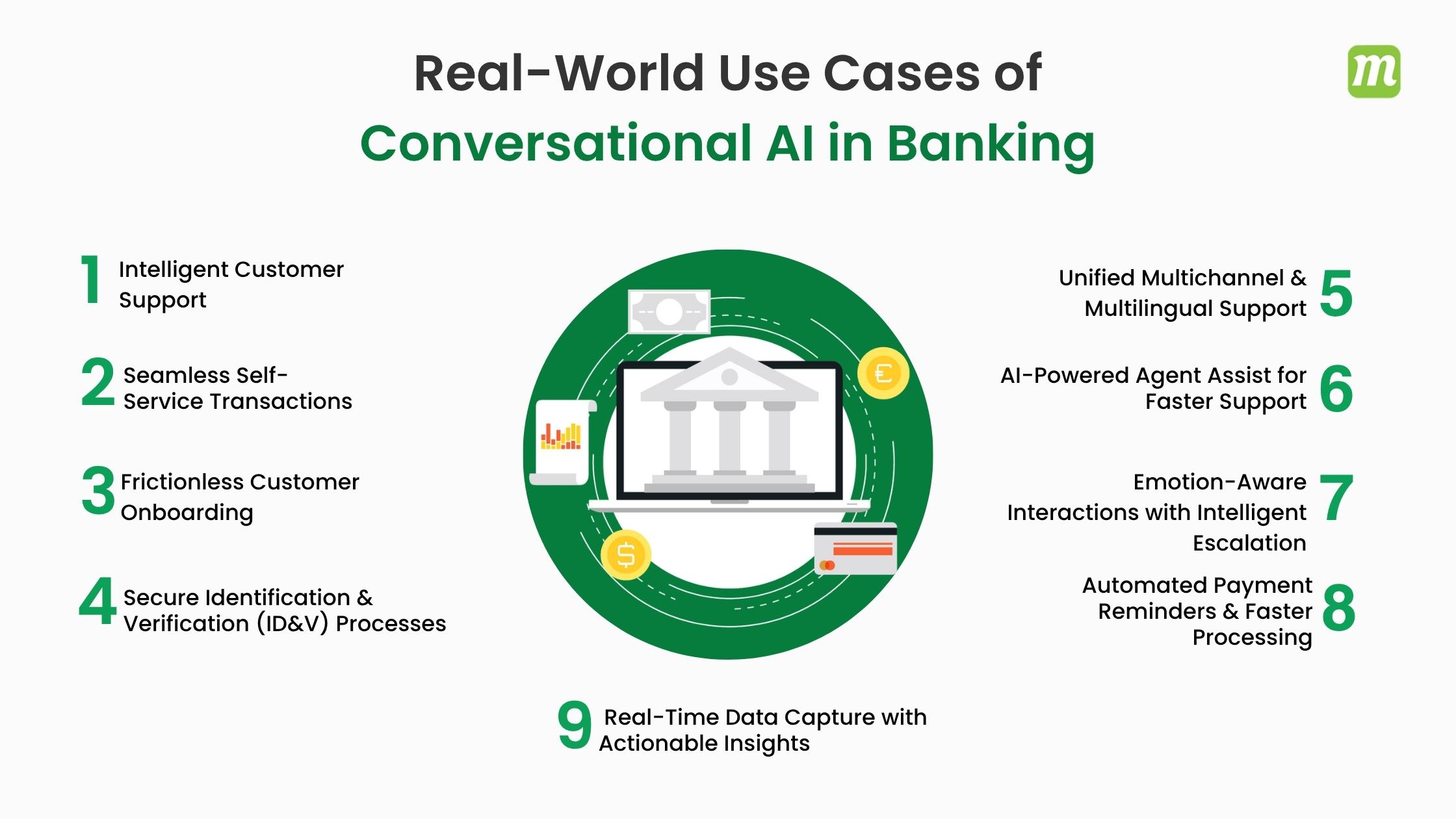
1. Intelligent Customer Support
The experts at the best AI app development company state that adopting AI in banking helps in handling routine customer inquiries, such as account balances, product details, and transaction history. Once the user is validated by the AI system, these systems can access real customer data to give fast and precise responses to deliver a top-notch banking experience.
What else? When a question is highly complicated, AI in banking hands over the conversation to a real human agent along with the context, so that the customers do not need to share their concern again and again. This particular process helps banks boost their support efficiency throughout the customer journey and elevate customer satisfaction to a higher level.
2. Seamless Self-Service Transactions
Implementing conversational AI in banking provides powerful support for self-service tasks. For example, customers can initiate payments, activate cards, or set up recurring transfers by simply telling the AI model what they wish to do. The proven conversational AI model identifies the intent and then performs the action itself or guides the customer step by step.
3. Frictionless Customer Onboarding
The next conversational AI use cases in banking include the development of digital assistants. These assistants are capable of guiding new customers through onboarding steps, like opening an account, validating identity, and choosing the right product. As AI is connected to the backend systems of fintech organizations, it can collect required information, start activation workflows, and streamline the whole onboarding process.
4. Secure Identification & Verification (ID&V) Processes
The most surprising thing you can learn about conversational AI in banking is that it can streamline the identification and verification process by guiding customers through validation steps in a natural conversational flow. AI in banking is such a smart technology that can ask questions, carry out documentation, and process uploads, all within the same voice or chat interface. Consequently, the friction reduces and makes authentication feel more natural and intuitive.
5. AI-Powered Agent Assist for Faster Support
When it comes to key use cases of conversational AI in banking, you will be glad to know that AI supports human agents as well. For instance, when a call or chat is in progress, the artificial intelligence technology listens, transcribes, and recommends the most suitable resources or answers in real time. This technology also garners context before handing over to real human agents, so agents can know who they are talking to and what their concern is. With the use of AI systems, agents become more effective, lower handling time, and help ensure consistency down the line.
6. Unified Multichannel & Multilingual Support
Another conversational AI use cases in banking is that it can operate across multiple touchpoints, be it voice, web chat, SMS, WhatsApp, or mobile apps. This versatility of conversational AI models gives customers the independence to use whichever channel they like. As conversational AI also supports various languages, interested fintech firms can offer consistent, native language service to a wider customer base. These communication capabilities are also relevant to artificial intelligence in telecommunications, where AI can support customer interactions across multiple channels.
7. Emotion-Aware Interactions with Intelligent Escalation
Some platforms, powered by conversational AI in banking, analyze sentiments in customers’ messages perfectly. Take, for instance, if AI detects frustration, confusion, or any other serious concern in customers’ messages, it can instantly escalate the matter to a real human agent, ensuring that the critical issues get quick attention.
8. Automated Payment Reminders & Faster Processing
By taking advantage of AI in banking, fintech companies can send proactive reminder notifications to customers about their upcoming payments through chat. Besides this, artificial intelligence technology can also assist with payment processing directly in the conversation without taking the user to another page or screen.
9. Real-Time Data Capture with Actionable Insights
Lastly, as every customer interaction is logged, conversational AI systems create transcripts and summaries that can be utilized not just for compliance but to fetch insights about common customers’ queries, challenges, and product issues. These insights play a crucial role in optimizing AI solutions and improving future interactions.
How to Implement Conversational AI in Banking Successfully?
To implement conversational AI in banking, all you need to do is follow the sequence below to shift from experiment to production stage:
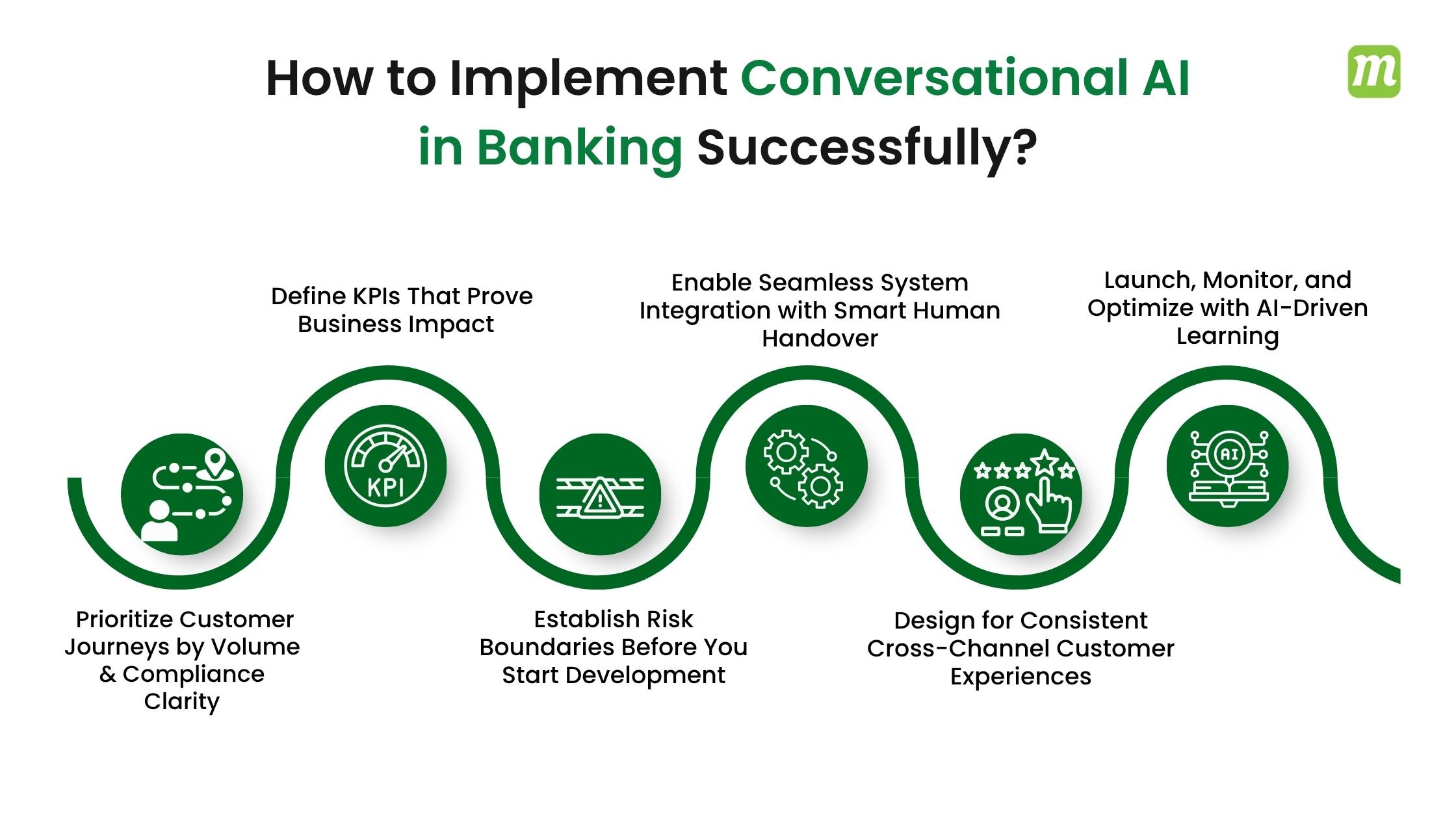
Step 1: Prioritize Customer Journeys by Volume & Compliance Clarity
The first and foremost thing you need to do is recognize and rank the customer journeys where conversational AI in banking can create tangible value. Once done, you need to focus on conversations with high volume, repeatable logic, and well-interpreted compliance requirements, including general account inquiries, payment status calls, and standard updates of customers’ loan status.
Step 2: Define KPIs That Prove Business Impact
For each journey, you need to determine the outcomes that you wish to improve; whether you want to achieve shorter wait times, higher first-contact resolution, greater customer satisfaction, or lower cost per contact. A recent McKinsey AI survey reveals that fintech companies that connect AI initiatives to pre-determined KPIs scale more effectively compared to those that do not.
Step 3: Establish Risk Boundaries Before You Start Development
The next thing you need to do is work with the best risk, compliance, and legal teams to set clear rules and limits before implementing AI in banking. Make it crystal clear which customer types or transaction values must be handled by a human, what data the AI model is allowed to access, and which disclosures must abide by tightly controlled scripts. Documenting these things as soon as possible gives everyone a deeper understanding of where AI fits and where humans get involved.
Step 4: Enable Seamless System Integration with Smart Human Handover
After that, it is advisable to integrate conversational AI in banking into your current ecosystem, including:
- CRM and contact center
- Core banking platforms
- Fraud tools
- Customer-facing banking applications
Once done, you should first identify what data is needed at each step of a customer journey, such as account balances, recent transactions, or loan application progress. Then, your AI system securely connects to internal systems via APIs to fetch this data and records updates (events) back into the system for reporting, tracking, and analytics purposes.
Further, when customer interactions shift from AI to human agents, those agents should get full context, including transcript, intent, sentiment aspects, and captured data.
Step 5: Design for Consistent Cross-Channel Customer Experiences
An important piece of information you must know is that customers who start in your mobile application and shift to voice want to have a connected banking experience. That’s where a unified platform comes into the picture. With such platforms at your disposal, your bank can eliminate silos and ensure that it has conversation context across each touchpoint so that customers do not need to repeat themselves and agents always know the entire story.
Step 6: Launch, Monitor, and Optimize with AI-Driven Learning
Finally, you need to keep in mind that you shouldn’t launch conversational AI in banking at once. Start small, test it, and check if it works before expanding. After launching your desired AI solution, make sure to continuously track how well it performs in terms of accuracy, speed, etc., and its impact on business in terms of customer satisfaction, resolution time, etc. Also, use real user interactions to improve the AI system regularly. In short, treat AI as something you need to keep refining over time to get better results and eventually, better return on investment.
How can InnovationM Help You Build a Conversational AI Solution for Your Bank?
InnovationM can help you build a powerful conversational AI solution for your bank by leveraging advanced platforms that integrate seamlessly across web, mobile, and messaging channels. Using natural language processing (NLP), sentiment analysis, and machine learning technologies, these solutions deliver personalized, real-time customer interactions while continuously improving with user behavior.
By automating routine queries through AI chatbots and voice bots, AI development for banking and finance allows organizations to enhance their efficiency, reduce operational costs, and free up human agents for high-value tasks. Resultantly, customer experience improves, and their loyalty increases to a great extent.
As per Gartner, 80% of traditional financial institutions that are operating for a long time risk becoming irrelevant or uncompetitive by 2030 if they fail to modernize. Thus, in an era where fintechs and digital-first players are reshaping the industry, banks that treat conversational AI as a strategic investment will be in the position to stay competitive in the market, drive ground-breaking innovation, and lead the future of banking.
The Future of Conversational AI in Banking: Top Trends Shaping the Next Era
Take a quick look at how conversational AI in banking is evolving with trends like hyper-personalization, voice-first interactions, and GenAI. These advancements will redefine customer engagement, operational efficiency, and the overall digital banking experience across the globe.
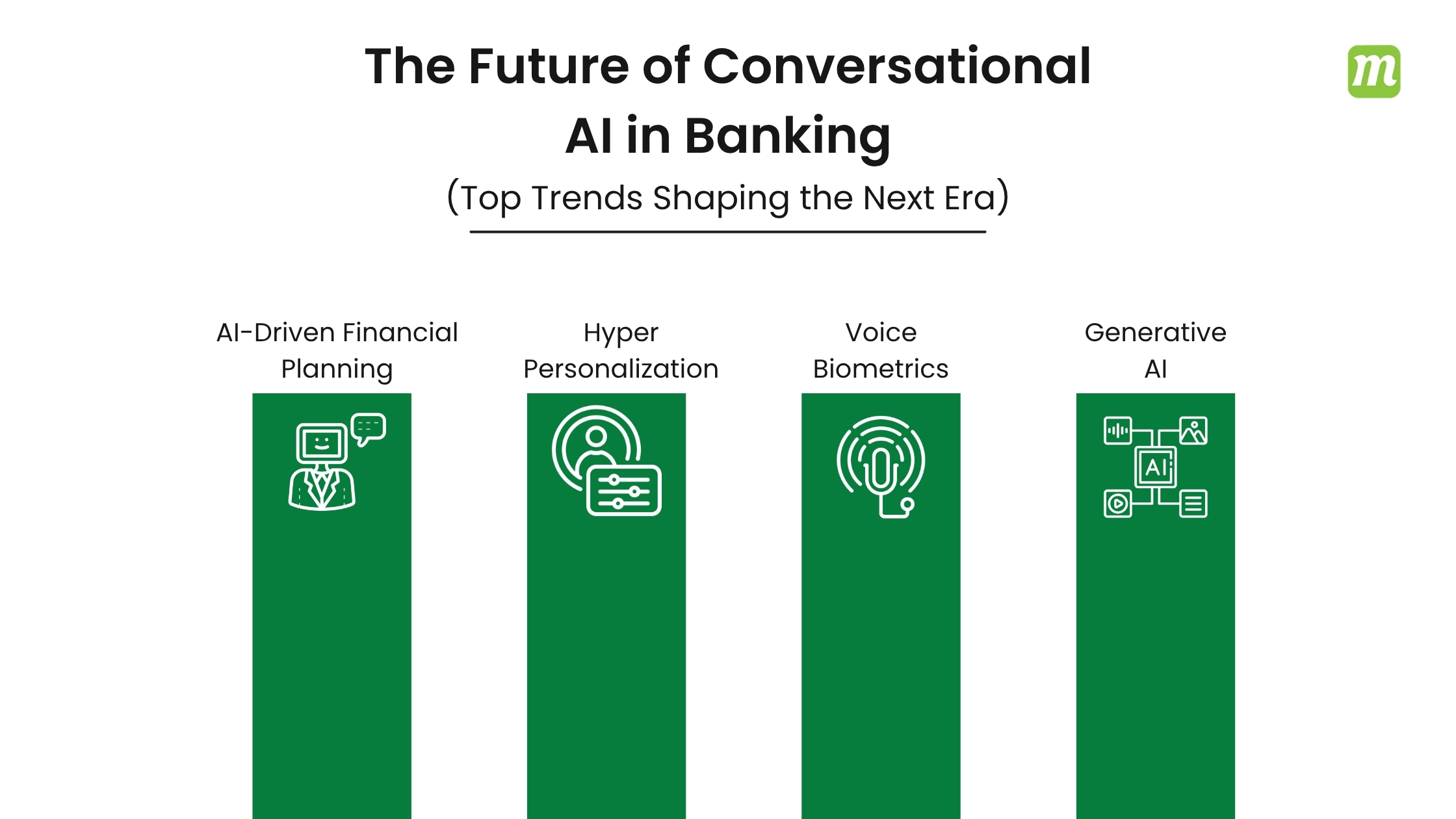
1. AI-Driven Financial Planning & Robo Advisors
With automated and intelligent guidance at customers’ disposal, they can make well-informed decisions about their savings, investments, and loans, leading to increased engagement and confidence in conversational AI solutions in banking.
2. Hyper Personalization
If you approach a top AI development company in India, they can make the best use of conversational AI technology to let your bank perform personalized conversations as per every person’s behavior, preferences, and financial history. This translates into more meaningful and engaging customer experiences, which increases overall sales of different banking products.
3. Voice Biometrics
One of the future conversational AI use cases in banking will be a secure authentication method using human voice. The main benefit of implementing this trend is that it takes transaction safety to the next level while offering a smooth user experience in conversational banking.
4. Generative AI
Another technology that is making waves in the field of conversational AI in banking is GenAI. Yes, by making use of advanced generative models in conversational AI, fintech companies can pave the path for rich, context-aware, and human-like conversations that feel quite natural and intuitive. Doing this enhances customer interactions big time, according to the best AI development company out there.
Stay Relevant or Fall Behind: Why Conversational AI Is Non-Negotiable
Conversational AI in banking is no longer a future investment; it is a present-day necessity. Because this technology has immense potential to transform how banks engage with customers, streamline operations, and deliver instant, personalized support across multiple channels. By making the most of conversational AI benefits in banking and integrating it into hundreds of thousands of customers’ journeys, you can achieve significant ROI through reduced costs, faster resolutions, and improved compliance.
In an increasingly competitive fintech market, organizations that fail to adopt AI in banking risk losing relevance down the line. Thus, conversational AI is not only helpful in enhancing customer satisfaction but also in creating new revenue opportunities that are essential for long-term growth.
Ready to accelerate your banking transformation using AI? Reach out to InnovationM to build powerful, AI-driven conversational solutions customized to your bank’s unique needs.
Frequently Asked Questions
1. What is the difference between a chatbot vs conversational AI?
A chatbot usually follows predefined rules and scripted responses to respond to simple queries. On the other hand, Conversational AI is a virtual assistant that understands context, learns from interactions, and delivers more human-like, personalized conversations in complex situations.
2. How does AI improve customer experience in banking?
AI in banking improves customer experience by offering instant support, personalized recommendations, 24×7 assistance, and faster query resolution. This cutting-edge technology analyzes customer behavior and preferences to deliver customized interactions that improve their satisfaction, engagement, and overall banking convenience.
3. How is conversational AI used in banking?
Conversational AI is used in banking to enable virtual assistants, customer support automation, account inquiries, transaction updates, loan guidance, and onboarding. Apart from that, this digital assistant also powers real-time communication across channels like mobile apps, websites, and messaging platforms.
4. What are the benefits of AI in banking and finance?
The benefits of AI in banking and finance include improved operational efficiency, reduced costs, enhanced security, data-driven decision-making, and personalized service delivery. Besides that, it automates repetitive tasks, minimizes human errors, and helps financial institutions provide faster, smarter, and more reliable customer experiences.
5. How does AI improve fraud detection in financial services?
AI detects fraud by analyzing large volumes of transaction data in real time, which helps identify unusual patterns and anomalies. Also, advanced machine learning models continuously learn from new threats that help detect fraud faster, reduce false positives, and strengthen overall security. Here, a false positive refers to a test result that is wrongly classified as positive because of faulty testing methods or procedures.
6. What are the top use cases of conversational AI in banking?
Top use cases of conversational AI in banking include digital banking assistance, customer support automation, fraud alerts, transaction tracking, loan and credit assistance, account management, and personalized financial advice. These applications of AI in banking help financial institutions improve efficiency while delivering seamless and responsive customer experiences.
7. What is the future of conversational AI in banking?
The future of conversational AI in banking involves hyper-personalization, voice-first banking, advanced predictive insights, and deeper integration with financial ecosystems. The use of this particular technology in banking will enable more proactive, secure, and human-like interactions, transforming how customers interact with banks.