








Chat with us!
Chatbot
InnovationM

Our AI assistant chatbot

bell icon
Book a discovery call with the sales team!

Let's connect for a quick conversation to learn more about your requirements and see if we're a good fit.

Schedule a Discussion →

AI development services

AI development services cover the end-to-end process of designing, building, integrate, testing, and deploying custom artificial intelligence solutions to solve business problems

InnovationM provides end-to-end AI development services to help businesses design, build, integrate, deploy, and optimize production-ready AI solutions. We work across machine learning, Generative AI, large language models (LLMs), AI agents, natural language processing (NLP), computer vision, predictive AI, and intelligent automation.

Whether you are building a new AI-powered product, adding AI capabilities to an existing application, or moving an AI proof of concept into production, our teams combine AI engineering with software development , cloud, data, and enterprise integration capabilities to build solutions around your business requirements.

Why InnovationM for AI Development?

Business-first AI development

We start with the business problem, not the model. Our teams evaluate your objectives, users, workflows, available data, existing technology, and expected outcomes to determine where AI can create measurable value.

From AI PoC to production

A successful proof of concept does not automatically become a production application. We help organizations address the engineering challenges that emerge during productionization, including data pipelines, model evaluation, application integration, security, scalability, monitoring, and ongoing optimization.

AI engineering + software engineering

An AI model is only one part of an AI application. We build the surrounding application, APIs, databases, user interfaces, workflows, integrations, and infrastructure needed to make AI useful within your existing technology environment.

Model-agnostic architecture

We work with leading foundation models, open-source models, machine learning frameworks, and cloud AI platforms. The model is selected according to the requirements of the application—including performance, accuracy, context, privacy, latency, scalability, deployment environment, and cost.

Designed for continuous improvement

AI systems change over time as models, data, users, and business requirements evolve. We can support evaluation, monitoring, retraining, model updates, infrastructure optimization, and feature enhancement throughout the AI application's lifecycle.

AI development for real business challenges

InnovationM provides end-to-end AI development services to help enterprises solve complex, real-world business challenges. We solve real business challenges by building end-to-end AI solutions that transition enterprises from limited, experimental pilots to scalable, production-ready systems.

Professionals reviewing business documents with AI-powered data extraction overlays
Trusted by World Health Organization, FASTag, EY, Airtel, IndiGo, Volkswagen, Samsung, British Council, OYO, Hindustan Times, and PVR

Turn AI challenges into business opportunities

Talk to Our Experts

AI software development expertise we have

We provide AI development services across traditional machine learning and modern Generative AI architectures.

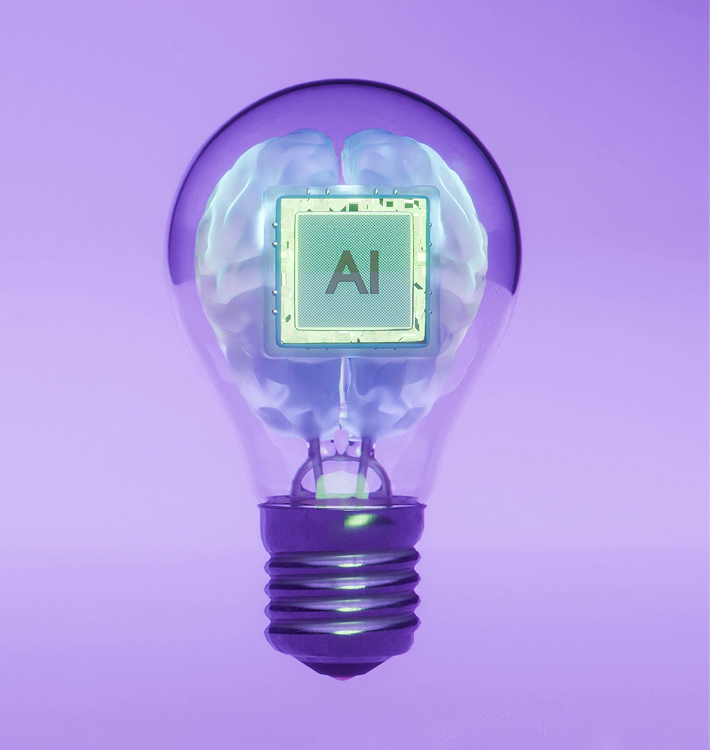
AI circuit brain representing AI software development expertise
Machine Learning & Deep Learning Development

We design and develop machine learning and deep learning solutions for prediction, classification, forecasting, recommendation, anomaly detection, and decision support.

Depending on the use case, models can work with structured business data, sensor data, text, images, or other unstructured information.

Our approach considers data availability, model performance, explainability, latency, infrastructure, and the cost of operating the solution.

  • Machine Learning Development
  • Deep Learning Development
  • Predictive Modeling
  • Classification & Regression
  • Forecasting
  • Anomaly Detection
  • Recommendation Systems
  • Model Training & Evaluation
  • Model Optimization

Generative AI can help businesses interact with knowledge, automate content-heavy processes, analyze documents, support employees, and build new AI-powered product experiences.

InnovationM develops LLM applications for enterprise assistants, AI copilots, document intelligence, knowledge systems, customer support, content workflows, and intelligent automation.

AI agents can extend beyond conversational interfaces by interacting with tools, applications, data sources, and business workflows.

InnovationM develops AI agents that can understand goals, retrieve information, use approved tools, execute multi-step tasks, and hand work back to users when human intervention is required.

For enterprise applications, we consider permissions, tool access, workflow boundaries, observability, failure handling, and human approval when designing agentic systems.

  • AI Agent Development
  • Agentic AI
  • Enterprise AI Agents
  • AI Workflow Automation
  • Tool-Using Agents
  • Multi-Step AI Workflows
  • Human-in-the-Loop AI

We build AI applications that understand and generate human language across text and voice interfaces.

These solutions can support customer service, employee assistance, virtual support, knowledge retrieval, voice applications, and natural-language interfaces for business systems.

We can connect conversational AI with enterprise knowledge bases, APIs, databases, CRM systems, and workflows to provide context-aware experiences.

  • Natural Language Processing (NLP)
  • Conversational AI
  • AI Chatbots
  • Virtual Assistants
  • Voice AI
  • Speech AI
  • Enterprise Knowledge Assistants

Computer vision enables applications to interpret images and video, while Document AI can turn unstructured documents into usable business information.

InnovationM develops solutions for automated inspection, defect detection, object recognition, video analytics, document classification, information extraction, and intelligent document processing.

Depending on the workflow, we can combine OCR, computer vision, machine learning, document understanding, Generative AI, and business rules.

  • Computer Vision
  • Document AI
  • OCR
  • Image Recognition
  • Object Detection
  • Defect Detection
  • Video Analytics
  • Intelligent Document Processing
  • Information Extraction

Predictive AI helps organizations identify likely outcomes and make proactive decisions using historical and real-time data.

We develop predictive models for demand forecasting, risk prediction, predictive maintenance, anomaly detection, and other business scenarios.

Recommendation systems use behavioral, transactional, and contextual data to determine relevant products, content, services, or next-best actions.

  • Predictive AI
  • Predictive Analytics
  • Forecasting
  • Recommendation Engines
  • Risk Prediction
  • Predictive Maintenance
  • Anomaly Detection

Industry - Specific AI Development

AI solutions need to account for industry-specific data, workflows, customer expectations, security requirements, and operational constraints.

Choosing the right AI approach

When traditional machine learning makes sense

Machine learning can be effective when the problem involves structured data and the goal is prediction, classification, forecasting, scoring, or anomaly detection.

When RAG makes sense

RAG can be useful when an LLM needs to work with private, frequently changing, or domain-specific information without relying solely on its pretrained knowledge.

When fine-tuning makes sense

Fine-tuning may be appropriate when an application needs consistent specialized behavior that cannot be achieved effectively through prompting, retrieval, or application-level controls alone

When conventional software is better

Not every automation problem needs AI. If a workflow is deterministic and can be reliably handled through rules or conventional software, that may be the better solution. The objective is not to maximize the amount of AI in an application. It is to build the most appropriate solution for the business problem.

When AI agents make sense

AI agents can be useful when a system needs to interpret a goal, make decisions across multiple steps, retrieve information, use tools, and interact with other applications.

AI technology stack

We use AI frameworks, foundation models, cloud platforms, databases, development tools, and MLOps technologies according to the requirements of each project.

AI & Machine Learning Frameworks

TensorFlow,PyTorch,Transformers,Hugging Face,LangChain,LlamaIndex,Haystack

TensorFlow PyTorch Transformers Hugging Face LangChain LlamaIndex Haystack

Foundation Models

OpenAI GPT,Claude,Gemini,Llama,Mistral,DeepSeek,Qwen

OpenAI GPT Claude Gemini Llama Mistral DeepSeek Qwen

Cloud Platforms

AWS,Microsoft Azure,Google Cloud Platform (GCP)

AWS Microsoft Azure Google Cloud Platform (GCP)

Vector Databases

Pinecone,Weaviate,Milvus,ChromaDB,FAISS

Pinecone Weaviate Milvus ChromaDB FAISS

Databases

PostgreSQL,MongoDB,MySQL,Redis,Elasticsearch

PostgreSQL MongoDB MySQL Redis Elasticsearch

DevOps & MLOps

Docker,Kubernetes,MLflow,Kubeflow,Jenkins,GitHub Actions

Docker Kubernetes MLflow Kubeflow Jenkins GitHub Actions

Programming Languages

Python,JavaScript,TypeScript,Java,C++,Go

Python JavaScript TypeScript Java C++ Go

Enterprise Integrations

REST APIs,GraphQL,CRM,ERP,CMS,third-party enterprise applications,cloud services,custom business systems

REST APIs GraphQL CRM ERP CMS third-party enterprise applications cloud services custom business systems

AI models we work with

We work with leading foundation models and AI platforms and select models based on the requirements of the application.

Depending on the use case, we can integrate models directly, build RAG applications around them, customize model behavior, or evaluate whether fine-tuning provides a worthwhile advantage.

Ready to start your AI development project?

Contact us

Related case studies

InnovationM brought strong engineering discipline to a complex software initiative. They understood both the technology and the business problem, helping us move from an initial concept toward a solution that could operate in a real production environment.

Client Name

Role · Company

About InnovationM

InnovationM is a digital transformation and software engineering company founded in 2010 and headquartered in Noida, India.

Our capabilities span AI consulting, AI development, machine learning, Generative AI, software engineering, and digital product development.

We help organizations build new AI-powered products, enhance existing applications with AI capabilities, and move validated AI concepts toward production-ready implementations.

Our AI engineering capabilities include custom chatbots, NLP applications, intelligent automation, AI agents, enterprise AI applications, and Generative AI solutions.

InnovationM has worked with organizations and brands including British Council, Airtel, Domino's, Saregama, and Grant Thornton.

Our AI Development Process

We use a structured AI development process that helps validate assumptions early and reduce the risk of building an AI solution that performs well in a demonstration but struggles in production.

1

Discovery & Use-Case Definition

We understand your business objectives, users, workflows, data, existing applications, and technical constraints.

We then identify practical AI opportunities and establish measurable objectives for the solution.

2

AI Strategy & Architecture

We define the architecture, technology stack, model strategy, data requirements, integration approach, security considerations, and development roadmap.

For Generative AI projects, architecture decisions may include model selection, RAG, vector search, prompt strategy, agent design, tool use, evaluation, and guardrails.

If you need help identifying AI opportunities or defining a broader AI roadmap, our AI Consulting Services can support the strategy phase.

3

Rapid Prototyping & Proof of Concept

We validate the highest-risk technical assumptions before moving into full development.

A prototype can help determine:

  • Whether available data is sufficient
  • Whether the selected model can achieve the required performance
  • Whether retrieval produces useful results
  • Whether AI fits into the existing workflow
  • Whether expected latency and operating costs are practical
4

Data Preparation & Model Development

We prepare the data and AI components required by the solution.

Depending on the project, this may involve data preparation, labeling, feature engineering, model training, fine-tuning, RAG implementation, prompt development, or evaluation dataset creation.

5

Application Development & Integration

We develop the application layer around the AI capabilities and connect the solution with existing technology.

Integrations can include:

  • APIs
  • Databases
  • CRM systems
  • ERP systems
  • CMS platforms
  • Cloud services
  • Enterprise applications
  • Authentication systems
  • Internal workflows

For broader enterprise connectivity requirements, our AI Integration Services can support this stage.

6

Testing & AI Evaluation

AI applications require both conventional software testing and AI-specific evaluation.

We can evaluate functionality, performance, security, integration reliability, model behavior, response quality, retrieval accuracy, and failure scenarios based on the requirements of the application.

7

Deployment & MLOps

We deploy AI applications to the required cloud, on-premises, or hybrid environment.

MLOps practices can support model deployment, versioning, monitoring, reproducibility, evaluation, and lifecycle management.

8

Continuous Optimization

AI performance can change as data, models, user behavior, and business requirements evolve.

1

Discovery & Use-Case Definition

We understand your business objectives, users, workflows, data, existing applications, and technical constraints.

We then identify practical AI opportunities and establish measurable objectives for the solution.

2

AI Strategy & Architecture

We define the architecture, technology stack, model strategy, data requirements, integration approach, security considerations, and development roadmap.

For Generative AI projects, architecture decisions may include model selection, RAG, vector search, prompt strategy, agent design, tool use, evaluation, and guardrails.

If you need help identifying AI opportunities or defining a broader AI roadmap, our AI Consulting Services can support the strategy phase.

3

Rapid Prototyping & Proof of Concept

We validate the highest-risk technical assumptions before moving into full development.

A prototype can help determine:

  • Whether available data is sufficient
  • Whether the selected model can achieve the required performance
  • Whether retrieval produces useful results
  • Whether AI fits into the existing workflow
  • Whether expected latency and operating costs are practical
4

Data Preparation & Model Development

We prepare the data and AI components required by the solution.

Depending on the project, this may involve data preparation, labeling, feature engineering, model training, fine-tuning, RAG implementation, prompt development, or evaluation dataset creation.

5

Application Development & Integration

We develop the application layer around the AI capabilities and connect the solution with existing technology.

Integrations can include:

  • APIs
  • Databases
  • CRM systems
  • ERP systems
  • CMS platforms
  • Cloud services
  • Enterprise applications
  • Authentication systems
  • Internal workflows

For broader enterprise connectivity requirements, our AI Integration Services can support this stage.

6

Testing & AI Evaluation

AI applications require both conventional software testing and AI-specific evaluation.

We can evaluate functionality, performance, security, integration reliability, model behavior, response quality, retrieval accuracy, and failure scenarios based on the requirements of the application.

7

Deployment & MLOps

We deploy AI applications to the required cloud, on-premises, or hybrid environment.

MLOps practices can support model deployment, versioning, monitoring, reproducibility, evaluation, and lifecycle management.

8

Continuous Optimization

AI performance can change as data, models, user behavior, and business requirements evolve.

Our engagement models

Fixed price

A defined scope and predictable set of requirements with an agreed project cost and delivery plan.

Time & materials

A flexible model where engineering resources can be scaled based on project requirements and development needs.

Dedicated team

A dedicated group of engineers working as an extension of your organization and focused on your product or engineering roadmap.

Team augmentation

Add specialized software engineers to your existing team to address skill gaps, increase capacity or accelerate delivery.

Questions, answered

We don't
predict
the future.
We build what
comes next.

Share your goals, challenges, or ideas, we'll help you turn them into scalable digital solutions.