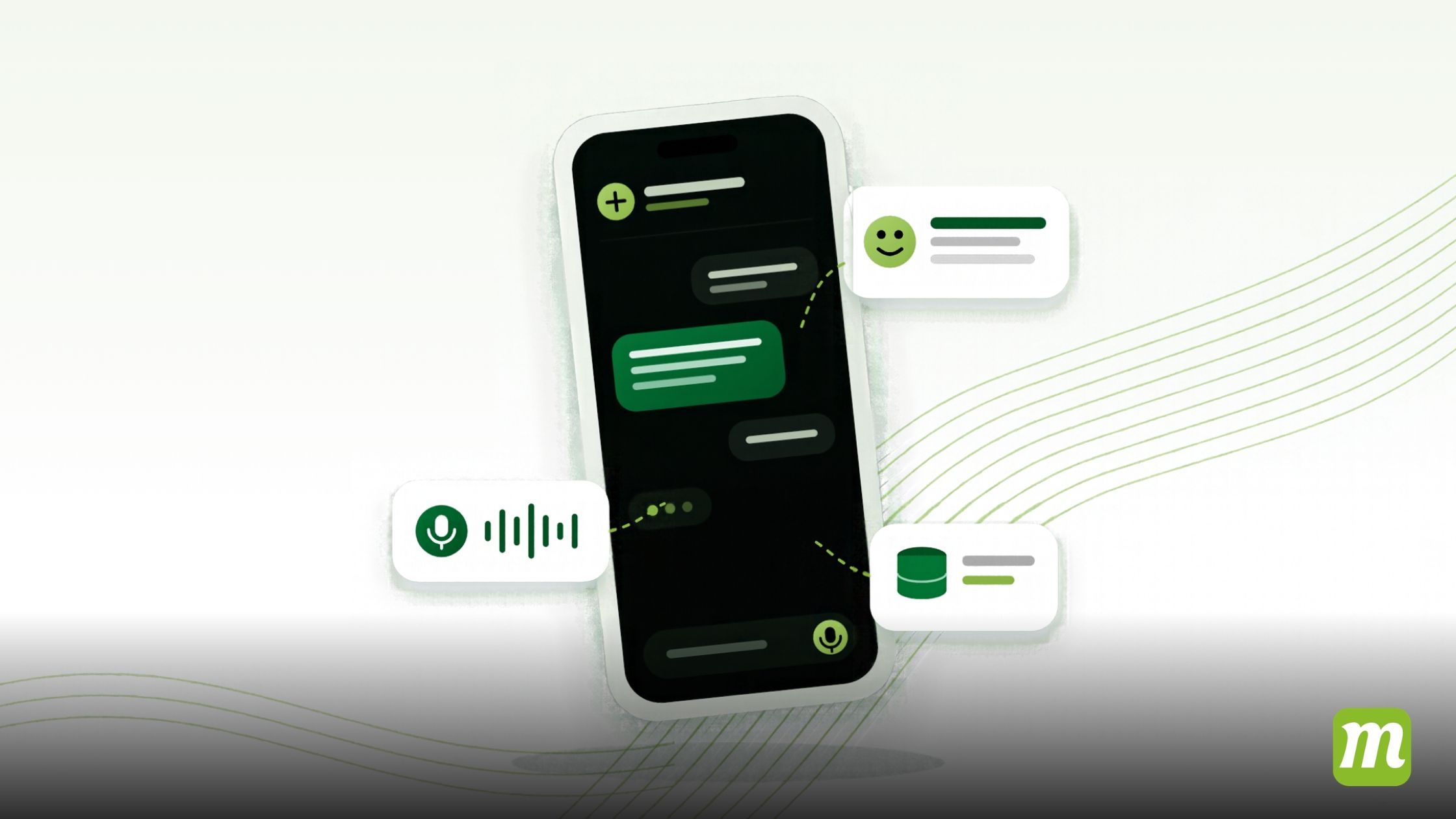
Conversational AI is the technology that lets software understand what people say or type in everyday language and respond in a way that moves the conversation forward. It powers the voice assistant that books a delivery slot, the chat window that tracks an insurance claim and the internal assistant that resets an employee’s password. This guide explains what conversational AI is, the components that make it work, and where it delivers value for businesses in the USA.
Key Takeaways
- Conversational AI combines natural language processing, machine learning and, increasingly, large language models (LLMs) to hold human-like conversations by text or voice.
- A typical system has five working parts: input capture (including speech recognition), language understanding, dialogue management, connections to business data, and response generation.
- Modern assistants ground their answers in approved company content through retrieval-augmented generation (RAG) and can complete tasks through APIs.
- Gartner projected that conversational AI in contact centers would cut agent labor costs by $80 billion in 2026, which explains why support is usually the first use case.
- Results depend less on the model and more on conversation design, integrations, guardrails and ongoing tuning.
What is conversational AI?
Conversational AI is a set of technologies that enables computers to understand, process and respond to human language in a natural, back-and-forth exchange. SAP describes it as the chatbots and voice assistants that automate communication and deliver personalized experiences to customers and employees at scale.
The phrase covers a wide range of products. A simple website chat that answers shipping questions counts, and so does a voice agent on a hospital’s phone line or an assistant inside Microsoft Teams that files IT tickets. What they share is the ability to interpret intent from free-form language rather than requiring users to click through fixed menus.
Conversational AI is also broader than a chatbot. A chatbot is one interface, usually text-based. Conversational AI includes voice, messaging apps, smart speakers and in-product assistants, often running on the same underlying understanding layer. The difference is covered in more depth in conversational AI vs chatbots.
How does conversational AI work?
Conversational AI works by turning a user’s words into structured meaning, deciding what to do with that meaning, and producing a useful reply or action, all within a second or two. Each turn of the conversation passes through a pipeline of components.
- Input capture. Text arrives directly from a chat window or messaging app. For voice, automatic speech recognition (ASR), also called speech-to-text, converts audio into text. Accuracy here matters a great deal, because every later step depends on it.
- Natural language understanding (NLU). The system identifies the user’s intent (for example, “reschedule appointment”) and extracts entities such as dates, account numbers or product names. In LLM-based systems, the model handles much of this interpretation and copes well with unusual phrasing.
- Dialogue management. This component tracks context across turns, decides the next step and asks clarifying questions when information is missing. It also enforces business rules, such as verifying identity before discussing an account.
- Knowledge and system access. The assistant retrieves information from knowledge bases, CRM records, order systems or APIs. Many current systems use retrieval-augmented generation, which fetches relevant passages from approved documents before the model writes an answer.
- Response generation. The system composes a reply, either from templates or generated by an LLM, and for voice converts it back to audio with text-to-speech (TTS).
Around this pipeline sit analytics and learning loops. SAP lists continuous learning and feedback as a core component, since real conversations reveal the questions the original design missed.
What technologies power conversational AI?
Several technologies combine to make conversational AI work, and most production systems mix more than one.
- Natural language processing (NLP): the broad field of techniques for analyzing and generating human language, including tokenization, classification and entity recognition.
- Machine learning and deep learning: models trained on example conversations to recognize intents and predict appropriate responses.
- Large language models: models such as GPT, Claude, Gemini and Llama that understand context, summarize and generate fluent text, which has made assistants far more flexible than earlier intent-only bots.
- Speech technology: ASR and TTS engines for voice channels, tuned for low latency so phone conversations feel natural. NVIDIA’s overview of conversational AI describes this speech-to-language-to-speech pipeline in detail.
- Retrieval and vector search: vector databases and search indexes that let an assistant find the right policy or product detail among thousands of documents.
- Integration and orchestration: APIs and workflow tools that let the assistant check an order, update a record or open a ticket.
Rules-based vs AI-driven conversational systems: how do they differ?
Rules-based systems follow scripted decision trees, while AI-driven systems interpret meaning and context, and most enterprise assistants now use a hybrid of the two.
Scripted flows are predictable and cheap to run, which suits short transactions such as a password reset or a delivery status check. They break down when users phrase things in unexpected ways. AI-driven assistants handle the variety of real language and can answer open questions from documentation. A hybrid design keeps sensitive steps, such as payments or identity checks, inside controlled flows while letting the LLM handle open-ended questions.
Why does conversational AI matter for businesses?
Conversational AI matters because it lets organizations answer customers and employees instantly, at any hour, without adding headcount at the same rate as demand.
In customer service the economics are clear. Gartner projected that conversational AI deployments in contact centers would reduce agent labor costs by $80 billion in 2026, noting that labor can account for up to 95% of contact center costs. Even partial automation helps: Gartner found that collecting a caller’s name, policy number and reason for calling up front could cut up to a third of an agent’s time on that interaction.
The outlook is moving further. Gartner also predicts that agentic AI will autonomously resolve 80% of common customer service issues without human intervention by 2029, leading to a 30% reduction in operational costs. That shift from answering to acting is covered in agentic conversational AI.
Benefits beyond cost include:
- 24/7 availability across chat, voice and messaging channels
- Consistent, policy-accurate answers
- Better hand-offs, since agents receive the conversation history and collected details
- Conversation data that shows what customers actually struggle with
- Multilingual support without hiring for every language
Where is conversational AI used?
Conversational AI is used wherever people ask repeated questions or make routine requests in high volume. Common examples include:
- Customer support: order tracking, billing questions, returns and account changes.
- Healthcare: appointment scheduling, prescription refill requests and patient intake, with privacy controls for HIPAA.
- Banking and insurance: balance inquiries, card controls and claims status updates.
- IT and HR help desks: password resets, software requests and policy questions for employees.
- Sales and ecommerce: product guidance, lead qualification and meeting booking.
A practical example is voice AI on a busy phone line, where callers state their need in their own words instead of navigating a menu. See how that works in voice AI assistants reducing call wait times for a regional health network. For a wider view of where returns tend to be strongest, read conversational AI use cases that pay off.
What makes a conversational AI system work well in production?
A production-ready conversational AI system is grounded in trusted data, connected to the systems where work happens, and measured on resolved requests rather than message volume.
- Grounding: answers drawn from approved sources, with citations where possible, to reduce made-up responses.
- Guardrails: clear limits on topics and actions, plus identity verification for sensitive requests.
- Human handoff: a smooth route to a person, carrying the full context.
- Latency: fast responses, especially on voice, where pauses feel awkward.
- Monitoring: dashboards for containment, satisfaction and failed intents, feeding regular improvements.
Teams that want a single support bot can begin with AI chatbot development and extend to voice and other channels later.
Partner with InnovationM
InnovationM builds conversational AI systems for businesses in the USA, from LLM-powered chat assistants to voice agents and internal help desk tools. Its teams handle conversation design, NLP and LLM engineering, RAG over enterprise knowledge, speech integration and connections to CRM, help desk and contact center platforms, then monitor and tune assistants after launch.
If you are exploring where conversational AI fits in your organization, InnovationM’s conversational AI development services are a good place to start, or you can talk to the team about a specific use case.
Final Thoughts
Conversational AI has moved from scripted bots to assistants that understand context, look up real information and complete tasks. The technology stack is now widely available, so the differences between a frustrating bot and a useful one come down to design choices: which conversations to automate, which data to trust, how to hand off to people, and how carefully the system is measured after launch. When you are ready to compare approaches, build vs buy conversational AI is the logical next read.
FAQs
What is conversational AI in simple terms?
Conversational AI is software that understands everyday language, typed or spoken, and responds helpfully. It uses natural language processing, machine learning and often large language models to interpret what a person wants and reply or act on it, much like a knowledgeable assistant would.
What are the main components of conversational AI?
The main components are speech recognition for voice input, natural language understanding to detect intent, dialogue management to track context, connections to business data and systems, and response generation, which includes text-to-speech for voice. Analytics and feedback loops improve the system over time.
Is ChatGPT an example of conversational AI?
Yes. ChatGPT is a general-purpose conversational AI built on a large language model. Business assistants use similar models but add grounding in company data, integrations with internal systems, guardrails and human handoff so they answer accurately and act within defined permissions.
How is conversational AI different from a chatbot?
A chatbot is one type of conversational AI, usually text-based and often limited to scripted flows. Conversational AI is the broader category, covering voice assistants, multichannel virtual assistants and AI agents that understand context across turns and complete tasks in business systems.
Can conversational AI work over the phone?
Yes. Voice-based conversational AI uses speech-to-text to understand callers, an AI layer to interpret intent and decide next steps, and text-to-speech to reply. It can replace touch-tone menus, verify callers, answer questions and route complex calls to the right agent with context.
Is conversational AI accurate enough for business use?
It can be when it is designed properly. Accuracy improves greatly when answers are grounded in approved content through retrieval-augmented generation, sensitive steps follow controlled flows, outputs are tested against real questions before launch, and conversations are monitored and refined afterward.