Choosing the right conversational AI development company in USA involves more than finding a team that can build a chatbot. Businesses need intelligent assistants that understand user intent, retrieve relevant information, connect with existing systems, and complete tasks across digital and voice channels. They also need reliable testing, security controls, and ongoing support after deployment.
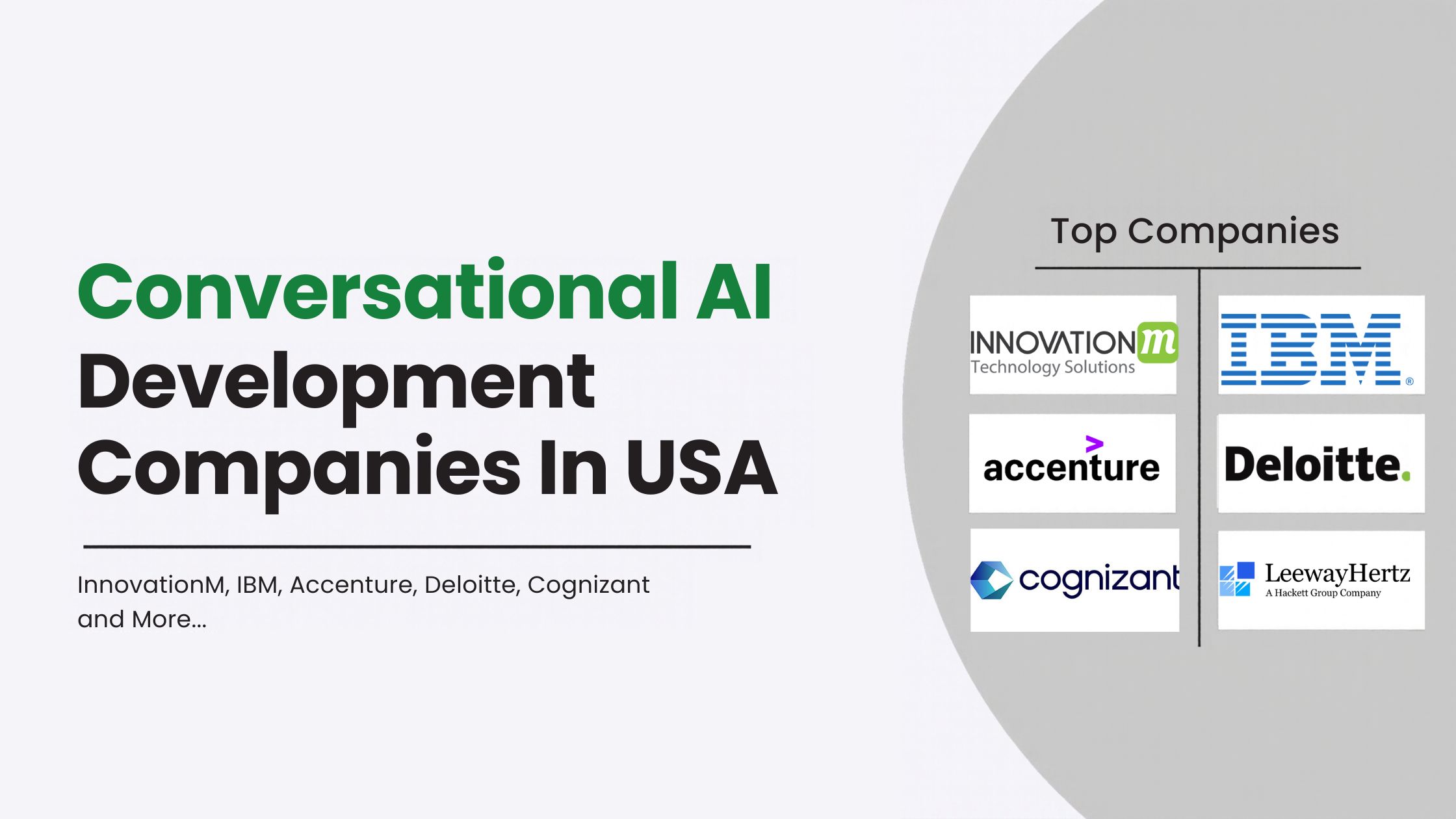
The top conversational AI development companies serving the USA offer different capabilities and delivery models. Global consulting firms such as IBM, Accenture, Deloitte, and Cognizant support large-scale enterprise technology initiatives. Specialist engineering companies focus on custom AI assistants, generative AI applications, voice experiences, and integrations with business workflows.
This article explores ten conversational AI development companies that US businesses can consider when evaluating potential technology partners. It compares their core capabilities, areas of expertise, and potential project suitability to help businesses make informed decisions.
Key Takeaways
- Conversational AI development requires more than language-model integration. Conversation design, enterprise data access, security, evaluation, and human handoff are essential for production-ready solutions.
- Large consulting companies may suit multi-region enterprise transformation programs, while specialist engineering firms can be suitable for focused AI product development.
- Businesses should evaluate providers based on technical expertise, integration capabilities, relevant project experience, and post-launch support.
- Gartner reported that only 24% of surveyed service and support leaders had demonstrated positive financial returns across their AI use cases in 2026, highlighting the importance of measurable business outcomes.
- Selecting a development partner with experience in LLMs, retrieval-augmented generation (RAG), voice AI, and enterprise integrations can help businesses build more useful conversational experiences.
How We Selected the Conversational AI Development Companies
We prepared this list by reviewing the companies included in our research and considering their relevance to conversational AI, chatbot development, generative AI, voice assistants, and enterprise AI implementation.
The selection considers the following factors:
- Relevant technical capabilities: Experience with conversational AI, natural language processing, LLMs, generative AI, chatbots, and voice assistants.
- Software engineering expertise: Ability to develop custom applications and integrate AI capabilities into existing products and systems.
- Enterprise integration: Experience connecting AI applications with business data, APIs, CRM platforms, and operational workflows.
- Service relevance: Availability of services related to AI development, conversational experiences, automation, and custom software engineering.
- Business suitability: The types of projects and organizations each company may be suited to support.
The companies are presented as an editorial shortlist, not as an independently audited ranking. Their order does not represent a verified comparison of project outcomes or customer satisfaction.
Why Does Choosing the Right Conversational AI Company in USA Matter?
A conversational assistant may perform well during a demonstration but struggle when it needs to answer questions using live business information, follow company policies, or complete tasks across multiple systems. Choosing the right development partner can influence how effectively the solution handles these real-world requirements.
According to a July 2026 Gartner survey, only 24% of service and support leaders demonstrated positive financial returns across their AI use cases. This finding highlights the importance of evaluating AI projects against measurable business objectives rather than relying only on demonstrations or technical capabilities.
A capable conversational AI development partner should help businesses:
- Connect AI assistants with approved business data and existing applications.
- Design conversations around customer and employee requirements.
- Reduce inaccurate responses through testing and evaluation.
- Protect sensitive information through appropriate security controls.
- Escalate complex requests to human support teams.
- Monitor assistant performance and improve the solution after deployment.
Market Trends in Conversational AI in 2026
The US conversational AI market is experiencing significant growth as businesses invest in AI-powered customer interactions and workflow automation. According to MarketsandMarkets, the US market is projected to grow from $3.61 billion in 2025 to $9.20 billion by 2030, representing a CAGR of 16.9%.
This growth reflects a broader shift from basic chatbots toward intelligent, task-oriented assistants. Key trends shaping this expansion include:
- AI-powered agents: Assistants that execute tasks and automate business workflows.
- Generative AI and voicebots: More natural, context-aware interactions across chat and phone channels.
- Omnichannel support: Consistent customer experiences across websites, mobile apps, messaging platforms and contact centers.
- Human handoff and AI governance: Better escalation processes, data privacy and human oversight.
- Measurable business outcomes: Greater focus on customer satisfaction, resolution rates, productivity and return on investment.
As adoption grows, businesses need conversational AI solutions that combine intelligent automation, enterprise integrations, security and industry-specific capabilities.
How do the top conversational AI development companies compare?
| Company | Provider type | Conversational AI focus | Potential project fit |
|---|---|---|---|
| InnovationM | Digital engineering company | Custom chat and voice assistants, LLM applications, RAG, AI agents and enterprise system integrations | Businesses seeking custom conversational AI development and end-to-end engineering support |
| IBM Consulting | Global consultancy and enterprise AI provider | Enterprise virtual assistants, watsonx solutions, AI governance and hybrid-cloud implementation | Large and regulated enterprises using or considering the IBM ecosystem |
| Accenture | Global consulting and technology services firm | Contact center transformation, AI strategy, platform integration and managed services | Multinational businesses modernising customer service operations |
| Deloitte | Global consulting and professional services firm | AI strategy, governance, risk management and enterprise implementation | Organisations that need AI transformation alongside risk and compliance support |
| Cognizant | Global IT services company | AI assistants, enterprise integration, data engineering, testing and managed AI operations | Enterprises planning large-scale AI implementation and ongoing support |
| LeewayHertz | Custom AI development company | Generative AI chatbots, custom LLM applications, RAG and AI agents | Businesses developing custom AI assistants and knowledge-based applications |
| Master of Code Global | Conversational AI specialist | Conversation design, chat and voice assistants, and customer experience platform integrations | Brands building advanced conversational customer experiences |
| BlueLabel Labs | Digital product development company | AI features and conversational experiences for mobile and web products | Product companies adding AI-powered experiences to digital applications |
| NineTwoThree AI Studio | AI product development company | Chatbots, AI agents, NLP and custom AI application development | Mid-market businesses developing AI products and workflow assistants |
| Bitcot | Software development and automation company | Chatbots, workflow automation and software integrations | Healthcare organisations and small to mid-sized businesses automating customer workflows |
Top 10 Conversational AI Development Companies in the USA
InnovationM
InnovationM is a digital engineering company headquartered in Noida, India, that serves businesses across international markets, including the United States. With 15+ years of experience in software engineering and mobile development, the company helps businesses build scalable digital products and integrate modern technologies into their existing systems.
InnovationM provides AI engineering capabilities covering conversational AI, chatbot development, generative AI, AI agents, natural language processing, large language models, and retrieval-augmented generation (RAG). Its engineering capabilities also support the integration of AI solutions with business applications, enterprise systems, and data sources.
InnovationM brings cross-industry experience across healthcare, banking and fintech, retail and eCommerce, telecommunications, travel and hospitality, education, logistics, and media and entertainment. This industry experience helps the company understand sector-specific workflows, customer expectations and business requirements when developing conversational AI solutions, including intelligent chatbots, voice assistants and AI-powered customer support systems.
The company focuses on developing solutions around business requirements, user experience, performance, and security.
Key Conversational AI Capabilities
- Custom AI chatbot and conversational assistant development.
- LLM-powered application development.
- Retrieval-augmented generation (RAG) solutions.
- AI agent development and workflow automation.
- Natural language processing and speech AI.
- Integration with enterprise applications and business systems.
- AI solution development, testing, and ongoing improvement.
Potential Project Fit
Businesses looking for a digital engineering partner to develop custom conversational experiences and integrate AI capabilities into existing digital products or business workflows.
Location: Noida, India
Official Website: InnovationM
Relevant Services: AI capabilities
IBM Consulting
IBM Consulting is the professional services and consulting division of IBM. It provides technology consulting, enterprise AI implementation, and digital transformation services to organizations across different industries.
Its enterprise AI capabilities are closely connected with IBM’s watsonx portfolio, which includes tools for developing, deploying, and managing AI applications and assistants.
For conversational AI projects, IBM can be relevant to organizations that want to integrate intelligent assistants into broader enterprise technology environments. Its consulting capabilities can support initiatives involving data management, automation, hybrid cloud, and AI governance.
Key Conversational AI Capabilities
- Enterprise AI consulting and implementation.
- AI assistants and virtual agent solutions.
- Integration with enterprise data and technology environments.
- AI governance and lifecycle management.
- Business process automation.
- Hybrid cloud and enterprise technology integration.
Potential Project Fit
Large organizations exploring conversational AI as part of broader enterprise AI, automation, or hybrid-cloud initiatives.
Location: Armonk, New York, USA
Official Website: IBM Consulting
Accenture
Accenture is a global professional services company offering consulting, technology, and business operations services. Its AI-related work includes strategy, implementation, and business transformation initiatives across industries.
For conversational AI projects, Accenture may be relevant to organizations that want to combine AI implementation with customer experience transformation, contact center modernization, and enterprise technology integration.
Its broad consulting and technology capabilities can support projects that involve multiple business functions, systems, and geographic markets.
Key Conversational AI Capabilities
- AI strategy and transformation.
- Customer experience modernization.
- Contact center technology implementation.
- AI-enabled workflow transformation.
- Enterprise application integration.
- Technology consulting and managed services.
Potential Project Fit
Large and multinational organizations planning conversational AI as part of broader customer experience or business transformation programs.
Location: Dublin, Ireland
Official Website: Accenture
Deloitte
Deloitte is a global professional services network providing consulting, technology, risk advisory, and business transformation services.
Its AI-related capabilities are relevant to organizations that need to consider governance, risk management, compliance, and organizational change alongside technology implementation.
For conversational AI initiatives, Deloitte’s broader advisory capabilities may help businesses address issues such as data governance, responsible AI practices, regulatory requirements, and operational readiness.
Key Conversational AI Capabilities
- AI strategy and transformation consulting.
- AI governance and risk management.
- Enterprise technology implementation.
- Responsible AI practices.
- Business process and operating-model transformation.
- Organizational change management.
Potential Project Fit
Organizations with complex governance, compliance, and enterprise transformation requirements.
Location: London, United Kingdom
Official Website: Deloitte
Cognizant
Cognizant is a technology services and consulting company headquartered in Teaneck, New Jersey. It provides services across technology consulting, software engineering, data, AI, and business process services.
Its broader technology capabilities make it relevant to organizations looking to integrate AI into established enterprise applications, data environments, and operational processes.
For conversational AI initiatives, businesses can evaluate Cognizant’s capabilities in AI engineering, enterprise integration, software development, and technology operations.
Key Conversational AI Capabilities
- AI and data engineering.
- Enterprise application integration.
- AI-enabled process modernization.
- Software engineering and technology consulting.
- Business process services.
- Managed technology services.
Potential Project Fit
Enterprises seeking to integrate AI capabilities into existing technology environments and broader business operations.
Location: Teaneck, New Jersey, USA
Official Website: Cognizant
LeewayHertz
LeewayHertz focuses on custom software and AI application development. Its areas of work include generative AI, large language models, and AI agents, making it relevant to businesses exploring custom conversational applications.
The company works on AI-powered applications designed around specific business requirements. Organizations considering LeewayHertz should evaluate its proposed architecture, enterprise data integration approach, security practices, and methods for monitoring AI performance.
Key Conversational AI Capabilities
- Generative AI application development.
- Custom LLM-based solutions.
- AI agent development.
- RAG-based applications.
- Enterprise knowledge assistants.
- Custom software engineering and integration.
Potential Project Fit
Businesses that need custom AI assistants, generative AI applications, or LLM-powered solutions tailored to specific workflows.
Location: San Francisco, California, USA
Official Website: LeewayHertz
Master of Code Global
Master of Code Global specializes in conversational experiences, including chatbots and voice assistants. Its focus on conversation design makes it relevant to businesses looking to improve customer interactions through messaging and voice channels.
The company works on conversational solutions that can support customer engagement and service experiences. Businesses evaluating this provider should examine its experience with their preferred customer experience platforms, knowledge sources, and integration requirements.
Key Conversational AI Capabilities
- Conversational AI and chatbot development.
- Voice assistant development.
- Conversation design.
- Generative AI-enabled customer experiences.
- Customer experience platform integration.
- Custom conversational solutions.
Potential Project Fit
Businesses developing customer-facing chat or voice experiences that require specialized conversation design and platform integration.
Official Website: Master of Code Global
BlueLabel Labs
BlueLabel Labs is a digital product development company offering product strategy, software development, and AI-related capabilities. Its product engineering background makes it relevant to businesses looking to incorporate intelligent features into existing digital products.
For conversational AI initiatives, organizations can evaluate how the company approaches AI integration within mobile applications, web platforms, and other software products.
Businesses should also review its experience with conversational interfaces, data integration, and the development of AI-powered product features.
Key Conversational AI Capabilities
- AI-enabled digital product development.
- AI strategy and consulting.
- Web and mobile product engineering.
- Integration of AI features into software products.
- Product design and development.
- Custom software engineering.
Potential Project Fit
Product companies exploring conversational features within existing consumer or business applications.
Location: New York, USA
Official Website: BlueLabel Labs
NineTwoThree AI Studio
NineTwoThree AI Studio develops AI-powered products and software solutions. Its areas of work include AI development, generative AI, and AI agents, making it relevant to businesses exploring custom AI applications and assistant-based workflows.
Companies considering NineTwoThree should evaluate its ability to develop solutions around their business requirements, connect assistants with relevant data sources, and support multi-step workflows through AI-powered applications.
Key Conversational AI Capabilities
- AI product development.
- Generative AI applications.
- AI agents and automation.
- Chatbot and conversational interfaces.
- Custom software development.
- AI consulting and implementation.
Potential Project Fit
Mid-sized businesses and product companies seeking a development partner for focused AI applications, assistants, and workflow automation.
Location: Massachusetts, USA
Official Website: NineTwoThree
Bitcot
Bitcot is a software development and digital transformation company offering application development and technology services. Its AI and automation capabilities can be relevant to businesses exploring assistants that connect with existing applications and operational workflows.
For conversational AI projects, businesses should evaluate the company’s ability to support the complete solution lifecycle, including application integration, user experience, security, testing, deployment, and post-launch maintenance.
Key Conversational AI Capabilities
- AI chatbot and application development.
- Workflow automation.
- Custom software development.
- AI integration with business systems.
- Digital product development.
- Application engineering.
Potential Project Fit
Businesses looking to combine AI-assisted interactions with application development and workflow automation.
Location: San Diego, California, USA
Official Website: Bitcot
How Do You Choose the Right Conversational AI Development Company?
Choosing a development partner requires understanding your business requirements and comparing each company’s technical capabilities with your project needs. Consider the following factors before making a decision.
Evaluate Relevant Project Experience
Review the company’s experience with projects similar to your intended use case. A customer support chatbot, employee knowledge assistant, and voice-based appointment system require different technical approaches.
Ask prospective providers:
- Have you developed conversational AI solutions for similar business requirements?
- Can you demonstrate a working production deployment?
- What role did your team play in design, development, and integration?
- Can you share relevant case studies or client references?
Review LLM and RAG Capabilities
Many enterprise conversational AI solutions use large language models to understand questions and generate responses. However, businesses often need assistants to retrieve information from approved internal sources.
Retrieval-augmented generation (RAG) is one approach that provides relevant information to a language model before it generates a response. It can help assistants use business documents, knowledge bases, and other approved information sources.
Google Cloud provides RAG reference architectures that explain different approaches to designing and deploying RAG applications.
Ask providers how they manage data indexing, access permissions, source freshness, retrieval quality, and unsupported responses.
Check Voice and Multichannel Capabilities
If your project includes voice interactions, evaluate the provider’s experience with speech recognition, text-to-speech, response generation, latency, interruptions, and human handoff.
Also consider whether the assistant needs to operate across websites, mobile applications, messaging channels, and contact center systems.
Microsoft’s Azure Speech documentation provides an overview of speech-to-text, text-to-speech, speech translation, and voice interaction capabilities.
Prioritize Security and Governance
Conversational AI systems may process customer information, business documents, and other sensitive data. Before development begins, understand how the provider will manage data access, privacy, retention, model usage, and audit requirements.
The NIST Generative AI Risk Management Profile provides guidance for identifying and managing risks associated with generative AI systems.
Discuss security controls, user permissions, data handling, and governance requirements with every shortlisted company.
Understand Testing and Performance Evaluation
A successful demonstration does not guarantee that an assistant is ready for production. Ask how the development company evaluates response accuracy, relevance, security, and reliability.
Important evaluation areas include:
- Answer accuracy and relevance.
- Unsupported or fabricated responses.
- Retrieval quality and source attribution.
- User intent recognition.
- Data security and access restrictions.
- Response time and system availability.
- Human handoff and failure recovery.
Define measurable acceptance criteria before development starts. These may include task completion, response quality, successful escalation, and user satisfaction.
Consider Post-Launch Support
Conversational AI applications require ongoing monitoring and improvement as business information, user behavior, and underlying models change.
Clarify who will maintain integrations, update knowledge sources, monitor performance, review failures, and handle technical issues after launch.
Also ask providers to separate initial development costs from model usage, hosting, third-party services, and ongoing maintenance.
Should You Build a Custom Conversational AI Solution or Buy a Platform?
The decision depends on the level of customization your project requires. A conversational AI platform can provide ready-made components for building and managing assistants. A development company can design a solution around your data, workflows, user experience, and existing technology.
| Consideration | Buy a Platform | Hire a Development Company |
|---|---|---|
| Initial setup | Often faster when requirements fit the platform | Requires discovery, design, and development |
| Custom workflows | Depends on available platform features | Can be tailored to specific business processes |
| System integration | Depends on available connectors and APIs | Can be designed around existing systems |
| Customization | Limited by platform capabilities | Greater flexibility in solution design |
| Maintenance | Platform provider maintains the core product | Responsibilities depend on the service agreement |
| Best suited for | Standardized use cases and faster configuration | Custom experiences and complex integrations |
Many organizations combine both approaches. They use a platform or model provider for foundational capabilities and work with an engineering company to design, integrate, and maintain the complete assistant.
Before deciding, compare the total cost of ownership, integration requirements, data controls, customization limits, and ongoing maintenance responsibilities.
Partner with InnovationM for Conversational AI Development
InnovationM is a digital engineering company that helps businesses develop AI-powered applications and integrate AI capabilities into existing digital products and business systems.
With 15+ years of software engineering and mobile development experience, InnovationM brings engineering, design, and quality assurance capabilities to software development projects. Its AI capabilities include conversational AI, chatbot development, generative AI, AI agents, LLM development, RAG, speech AI, and AI integration.
Businesses exploring conversational AI can begin by defining their intended users, business tasks, data sources, communication channels, and existing systems. This helps establish the right technical approach and measurable project objectives.
Explore InnovationM’s AI capabilities or contact the team to discuss your conversational AI requirements.
Final Thoughts
The right conversational AI development company in USA depends on your business requirements, technical environment, and long-term objectives.
IBM, Accenture, Deloitte, and Cognizant may be relevant for organizations planning broader enterprise transformation initiatives. Specialist providers such as InnovationM, LeewayHertz, Master of Code Global, BlueLabel Labs, NineTwoThree AI Studio, and Bitcot may be worth considering for custom AI applications and focused conversational AI projects.
Before selecting a partner, compare its relevant project experience, LLM and RAG capabilities, integration approach, security practices, evaluation methods, and post-launch support.
A clearly defined discovery phase or pilot can help validate the proposed solution before committing to a larger conversational AI implementation.
Frequently Asked Questions
What are the top conversational AI development companies in the USA?
Some companies serving US businesses in this category include InnovationM, IBM Consulting, Accenture, Deloitte, Cognizant, LeewayHertz, Master of Code Global, BlueLabel Labs, NineTwoThree AI Studio, and Bitcot. They differ in their technical capabilities, delivery models, and suitability for enterprise or specialist projects.
What does a conversational AI development company do?
A conversational AI development company designs, develops, integrates, and maintains chat or voice-based assistants. Its services may include conversation design, natural language processing, LLM integration, RAG, speech technology, business-system integration, security controls, testing, deployment, and post-launch monitoring.
What is the difference between a chatbot and conversational AI?
A traditional chatbot often follows predefined rules, menus, or decision trees. Conversational AI uses technologies such as natural language processing and language models to interpret user intent and generate more flexible responses. Modern systems may also retrieve information from business data and perform tasks through connected tools and APIs.
How much does conversational AI development cost?
The cost depends on the assistant’s complexity, communication channels, integrations, data requirements, security needs, and ongoing support. A focused website assistant generally requires less development work than a multilingual voice assistant connected to multiple enterprise systems. Ask providers to separate development, infrastructure, model usage, third-party services, and maintenance costs.
How long does it take to build a conversational AI assistant?
The development timeline depends on the number of use cases, communication channels, integrations, and approval requirements. A limited proof of concept may take less time than a production system supporting multiple departments, languages, or regulated workflows. Ask for a phased timeline covering discovery, prototyping, integration, testing, deployment, and optimization.
What technologies are used to build conversational AI?
Common technologies include large language models, natural language processing, retrieval-augmented generation, vector databases, speech recognition, text-to-speech, APIs, and cloud infrastructure. The right combination depends on the use case, data environment, security requirements, and expected user experience.
How do I evaluate a conversational AI development company?
Review the company’s relevant project experience, technical capabilities, integration approach, security practices, testing methods, and post-launch support. Ask for a demonstration or case study related to your use case, and agree on measurable acceptance criteria before starting development.