The advent of AI technology in the media and entertainment industry has fuelled groundbreaking innovations in the last few years. Content creation, high-level personalization, and audience engagement are just a few. In fact, as per Grand View Research, the global AI in media and entertainment market size was calculated to be USD 25.98 billion in 2024, which is expected to grow to USD 99.48 billion by 2030.
This clearly indicates how the market of AI adoption in the media & entertainment industry is expanding due to the ability of this technology to transform how content is created, distributed, and consumed. From AI-generated music and gaming to real-looking visual effects, AI is revolutionizing how audiences interact with media on their smartphones, laptops, tablets, and other digital devices out there.
In this blog, we will take a detailed look at the impact of AI in media and entertainment sector, explore its key benefits and top use cases, examine real-world examples, and learn about future industry trends shaping the next era of digital experiences.
Let’s get started without further ado:
The Transformative Impact of AI in Media and Entertainment Industry
The impact of AI in media and entertainment industry seems to be very transformative. From content creation to audience engagement, AI empowers companies to operate smarter, faster, and more creatively while delivering highly personalized customer experiences.
One of the biggest shifts is in content creation and personalization. Platforms like Netflix use machine learning algorithms to analyze viewing behavior and recommend tailored content. AI also identifies viral user-generated content, supports virtual influencers, and allows the creation of computer-generated actors, resulting in greater creative possibilities.
Using AI in entertainment also helps in enhancing the customer experience through chatbots, voice recognition, and AI assistants. For example, Amazon Alexa and Google Assistant ensure hands-free control of entertainment systems, leading to improved convenience for end-users.
Key Impacts of AI:
- Highly personalized recommendations for music, video, and gaming platforms
- AI-powered animation, editing, and music composition
- Automated content moderation and proofreading
- Targeted advertising and data-driven marketing
- Social media trend analysis for smarter engagement strategies
Overall, AI improves creativity, increases efficiency, reduces costs, and optimizes marketing performance. Let’s now jump onto the next section, i.e., AI benefits in media and entertainment industry:
Top 6 AI Benefits in Media and Entertainment Sector
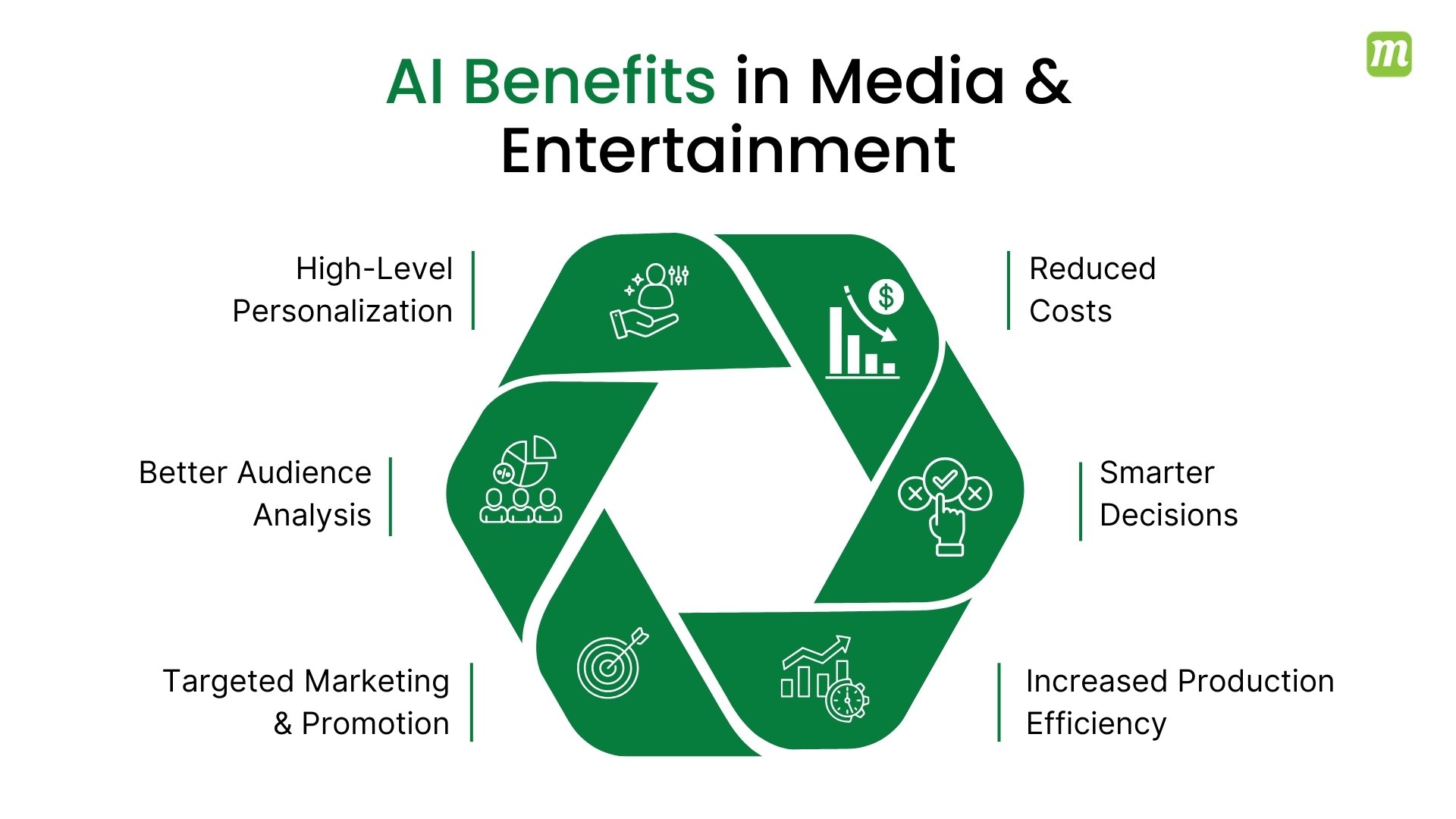
The utilization of artificial intelligence in entertainment is transforming this industry by enhancing personalization, streamlining production, improving analytics, and optimizing costs. Below are the most impactful AI-driven benefits that are reshaping the media and entertainment industry:
1. High-Level Personalization
AI analyzes user behavior, viewing history, and preferences to create and deliver highly customized movie, music, and show recommendations. This increases engagement, boosts retention rates, and strengthens long-term customer loyalty across digital platforms.
2. Better Audience Analysis
Another way “how is AI used in entertainment” industry is in audience analysis. Yes, AI-driven analytics evaluate viewer behavior, sentiment, and feedback to generate actionable insights. These insights further help creators refine storytelling, enhance user experiences, and create content that perfectly resonates with their target audience.
3. Targeted Marketing & Promotion
The artificial intelligence technology also studies social media trends and customer data to design precise, data-driven marketing campaigns. Doing this helps ensure that specific content reaches the right audience segment, which will improve conversion rates and maximize marketing return on investment.
4. Increased Production Efficiency
One of the main AI benefits in entertainment industry is that it assists in automating video editing, voiceovers, tagging, and post-production workflows. By reducing manual intervention, media companies accelerate production timelines, optimize resources, and bring high-quality content to market faster.
5. Smarter Decisions
Coming to the next benefit, i.e., AI detects patterns in customer behavior and brand perception through predictive analytics and sentiment analysis. This enables in-house executives of media and entertainment enterprises to make informed decisions in content development, pricing, and promotion.
6. Reduced Costs
Last but not least, one of the key AI benefits in media and entertainment field is that it reduces operational expenditure by automating repetitive tasks and enhancing resource utilization. Right from leveraging AI-generated content to energy-efficient data center management, media organizations can minimize labor and infrastructure costs while increasing productivity.
8 Best AI Use Cases in Entertainment Industry
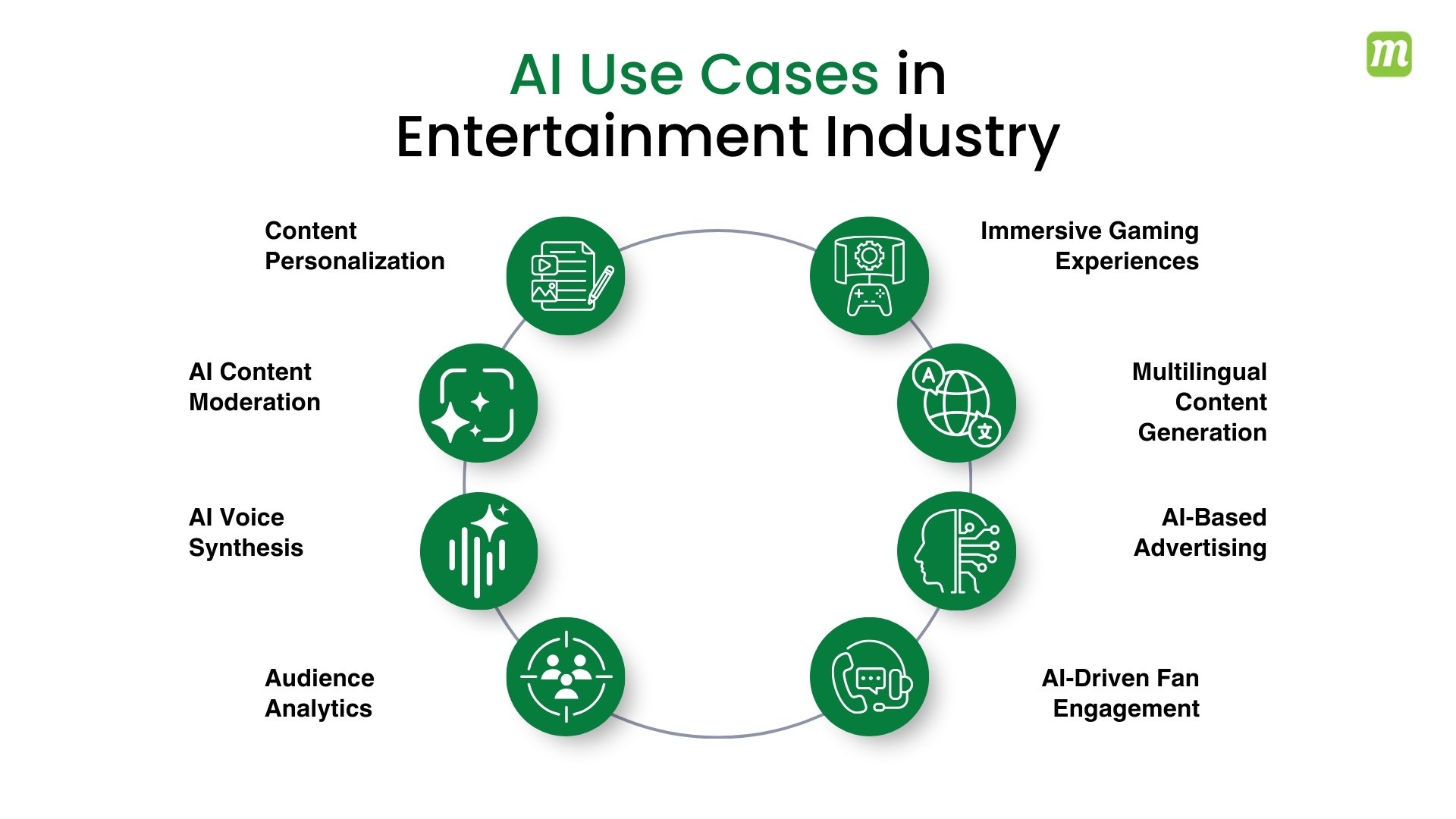
Artificial Intelligence is revolutionizing the media and entertainment industry by eliminating operational constraints, automating repetitive workflows, and enabling data-driven creativity. Beyond script and image generation, using AI in entertainment sector helps enhance personalization, production efficiency, audience insights, and immersive experiences. Here is a list of AI use cases in entertainment industry that are driving groundbreaking innovation.
1. Content Personalization & Recommendations
Implementing personalization is necessary to ensure audience retention and achieve revenue growth. Research indicates that almost 96% of media and entertainment companies take advantage of personalization in their marketing campaigns. AI-powered recommendation engines analyze watch history, likes, engagement time, and behavioral patterns to create a customized content feed for each user.
Streaming platforms, like Netflix, YouTube, and Spotify, leverage machine learning to increase session duration and reduce churn. By delivering highly relevant movies, music, and ads, AI in entertainment not only enhances user satisfaction but also monetization through targeted promotions and higher engagement rates. For example, if a user has just finished watching a crime-based Hollywood movie, Netflix will likely suggest similar crime-based cinemas for them to binge-watch.
2. AI-Powered Content Moderation & Compliance
With the rapid growth of digital content, moderation has become a massive operational challenge for media and entertainment company owners. The global content moderation solutions market was worth USD 9.65 billion in 2025 and is expected to reach a value of USD 33.05 billion by the end of 2035.
One of the best AI use cases in media industry is that it automates the detection of nudity, hate speech, violence, and copyright violations using computer vision and natural language processing technologies. It also categorizes, tags, and rates content on a large scale. This automation ensures regulatory compliance, protects brand reputation, and reduces the burden on human moderation teams. Platforms like TikTok, YouTube, and Meta use automation to implement community standards easily.
3. AI Voice Synthesis & Automated Dubbing
AI-driven voice synthesis is transforming global content distribution to a great extent. Traditional dubbing often struggles with poor lip-sync and lost emotional characteristics. Modern AI models generate natural-sounding voices, preserve tone, and synchronize dialogue with lip movements in multiple languages.
Such AI use cases in entertainment industry enable faster, cost-effective localization without hiring separate voice actors for every region. As a result, studios can release films and shows simultaneously across global markets, expanding the overall reach while maintaining performance authenticity and audience immersion.
4. Audience Analytics & Sentiment Analysis
The next use case of AI in media and entertainment industry is that it converts raw audience data into actionable insights. By analyzing social media conversations, reviews, streaming behavior, and drop-off rates, AI tools learn about fan sentiment and predict content performance. Such information helps digital media companies refine their marketing strategies, optimize production budgets, and forecast demand.
Integrated AI analytics platforms bring together data from CRMs, help desks, and other digital channels to provide predictive insights and real-time information through dashboards. Similar data-driven approaches are increasingly being adopted through AI in telecom, where operators analyze customer behavior, network data, and service patterns to improve decision-making.
5. Interactive & Immersive Gaming Experiences
AI is redefining game development by enhancing realism and reducing production costs. According to a global game developer survey carried out by Statista in 2024, 41% of respondents said that they used AI tools for game development.
Just to let you know, AI powers intelligent NPCs (Non-Player Characters), real-time dialogue systems, AR/VR customization, and dynamic difficulty adjustment. Using artificial intelligence in entertainment industry also assists in code improvement and environment generation. These capabilities of AI technology enable software developers to build immersive, real-life-like gaming experiences faster while optimizing development resources.
6. Multilingual Content Generation & Subtitling
There is no denying the fact that subtitling and translation are extremely time-consuming and costly processes. AI-powered NLP (Natural Language Processing) models come in handy to generate real-time subtitles with contextual accuracy and emotional alignment.
These systems, powered by AI in entertainment industry, translate content into multiple languages at the same time, making global releases faster and more scalable. Thus, by automating translation workflows, media companies can tap into new markets efficiently while maintaining linguistic consistency and cultural relevance.
7. AI-Based Advertising & Inventory Management
AI enhances advertising performance through predictive inventory management and dynamic pricing. By analyzing historical trends, audience behavior, and traffic patterns, AI use cases in entertainment industry help forecast demand for ad inventory and optimize placement.
Apart from that, contextual and behavioral targeting ensure the desired ads reach the most relevant audiences at the right time. This intelligent automation maximizes revenue across large content catalogs (like products, data, or media) while minimizing manual intervention, resulting in efficient and data-driven monetization strategies.
8. AI-Driven Fan Engagement & Conversational Support
Post-launch engagement is essential for continuing the hype among fans, be it for a new album or just a music video. AI chatbots and virtual assistants handle routine fan inquiries across websites, social media, messaging apps, and voice channels without any hiccups. They provide instant responses related to ticket sales, tour dates, refunds, and order tracking.
Beyond customer support, AI use cases in media industry, like an AI agent assist tool, also help internal teams retrieve information quickly, improving response times and operational efficiency big time. This reduces overall workload on the in-house team while ensuring seamless, 24/7 fan interaction.
In case you are looking to build an AI-powered solution designed for content creation, audience engagement, or media distribution, it is wise to collaborate with a globally trusted AI development company that can transform your vision into an engaging, scalable, and high-impact digital experience.
How is InnovationM Reshaping the Media & Entertainment Industry with Advanced AI Solutions?
At InnovationM, we deliver strategically designed AI solutions tailored to the evolving demands of media and entertainment enterprises. Our AI/ML consulting services empower organizations to make smarter decisions, strengthen audience engagement, and optimize content strategies to achieve value-driven outcomes.
We build robust Proof of Concepts (PoCs) and Minimum Viable Products (MVPs) that validate real-world AI impact before full-scale deployment. Our generative AI capabilities automate repetitive tasks such as content creation and data processing, allowing creative teams to focus on revolutionary innovation specifically.
By fine-tuning large language models to media-specific terminology and audience behavior patterns, we enhance personalization, improve analytics accuracy, and drive meaningful audience connections using our AI in media and entertainment services.
Top AI Applications in the Media & Entertainment Industry
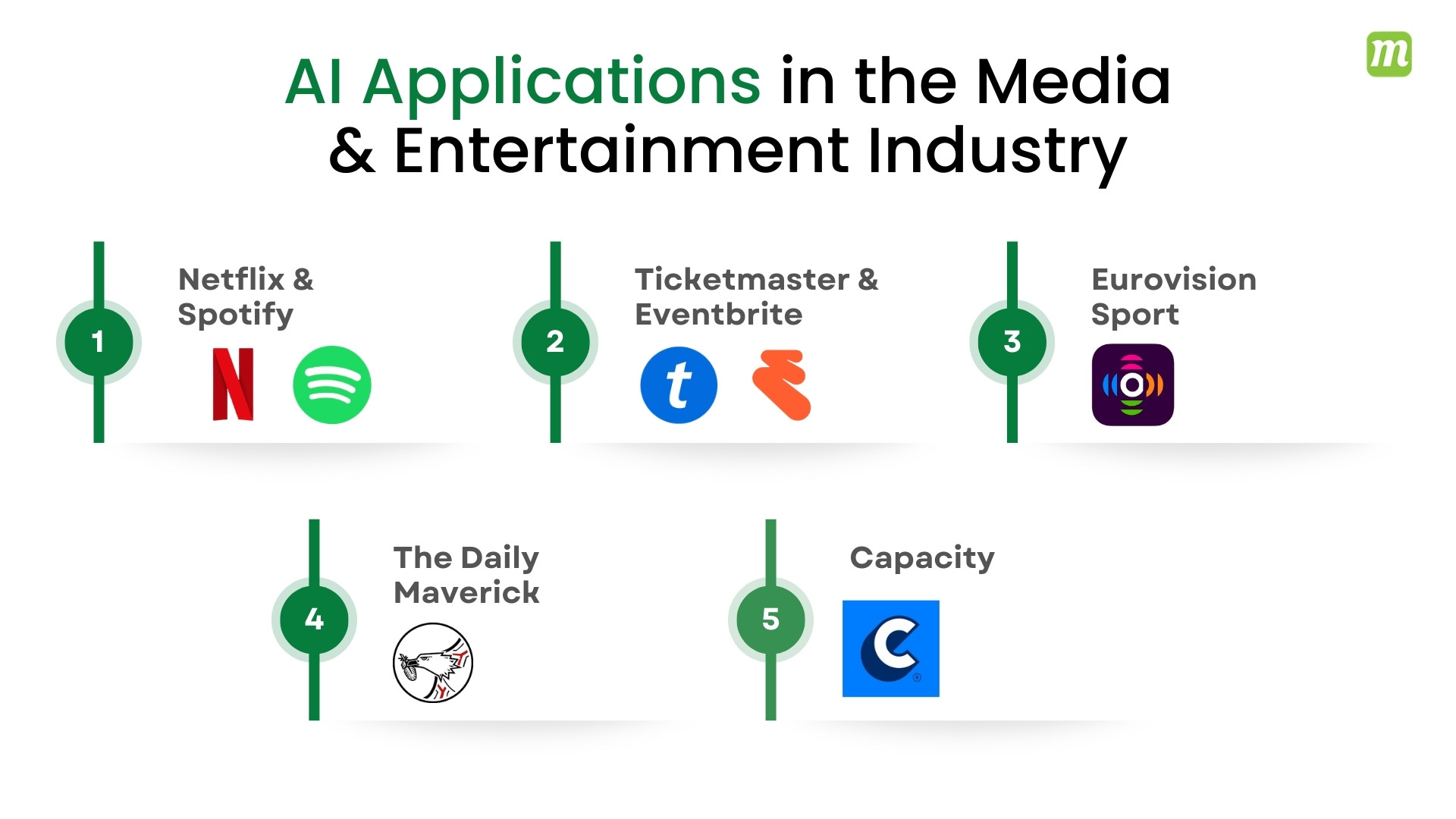
Artificial Intelligence is no longer a technology to experiment with in the media and entertainment field. Rather, it is an operational, revenue-driven, and customer-focused tech stack. From streaming and publishing to sports broadcasting and ticketing, AI use cases in entertainment industry enable smarter decisions, faster workflows, and highly personalized audience experiences. Below are some real-world examples demonstrating how industry leaders leverage AI to create tangible impact.
1. Netflix & Spotify: Intensively Personalized Streaming & Discovery
Netflix and Spotify have taken content discovery to the next level using AI-driven personalization engines. Netflix analyzes watch history, ratings, browsing patterns, and engagement time to recommend highly relevant content, optimize streaming quality in real time, auto-tag scenes, and even generate thumbnails to improve click-through rates.
Spotify goes a step further by implementing artificial intelligence in entertainment industry with AI-powered playlist creation, which works through prompt-based search. Users can type requests like “relaxing sleep music” and receive a well-curated playlist in a few seconds. These AI systems increase engagement, reduce churn, and position platforms not just as content libraries, but as intelligent entertainment companions tailored to individual tastes.
2. Ticketmaster & Eventbrite: Intelligent Pricing & Fraud Prevention
Ticketing platforms like Ticketmaster leverage the AI benefits in entertainment industry by implementing dynamic pricing models that adjust ticket costs based on demand, seat location, and buyer behavior, just like airline ticket booking systems. AI also helps detect bots and fraudulent transactions using behavioral pattern recognition.
On the other hand, Eventbrite applies AI to auto-generate compelling event summaries based on event type, audience, and location. Interested event organizers can also customize tone and messaging to improve their overall marketing reach. Thus, utilizing these AI capabilities together results in better monetization, improved trust, and optimized event visibility.
3. Olympic Games & Eurovision Sport: AI-Enabled Live Translation & Accessibility
Global broadcasting demands speed, scale, and accessibility. The Olympic Games employ AI for automatic caption generation, speech-to-text transcription, and real-time audio descriptions, improving engagement for global audiences.
Similarly, Eurovision Sport has tested AI-generated live translated commentary, dubbing sports broadcasts from French to Portuguese in real time. Through speech recognition and computer vision technologies, using AI in entertainment industry makes live events more immersive and accessible, eliminating language barriers and expanding global fan engagement without compromising broadcast quality.
4. The Daily Maverick & Penguin Random House: AI in Publishing & Analytics
The Daily Maverick uses AI to summarize long-form content into concise bullet points, reducing hours of manual work to seconds while improving accessibility through AI-powered audio narration. However, you must know that, as per Statista, 28% of global media publishers believe that using AI in media and entertainment, like news gathering, would be a risky decision for their organization.
At the same time, Penguin Random House leverages AI for dynamic pricing and sales optimization. By analyzing historical data, trends, and reader behavior, this publisher strategically prices titles to maximize revenue and boost readership.
5. Capacity: Integrated AI Ecosystems for Media Businesses
AI platforms like Capacity provide media and entertainment companies with white-label AI solutions that unite analytics, customer support, and operational automation. Through conversational AI chatbots, businesses can manage inquiries across email, websites, social media, WhatsApp, and voice channels.
Beyond customer support, Capacity’s AI in entertainment solution integrates with CRMs and enterprise tools to deliver predictive insights and real-time analytics. Hence, by automating repetitive workflows and centralizing business intelligence, media companies can create smarter, scalable ecosystems that enhance both operational efficiency and audience satisfaction.
Emerging Future Trends in the Media and Entertainment Industry
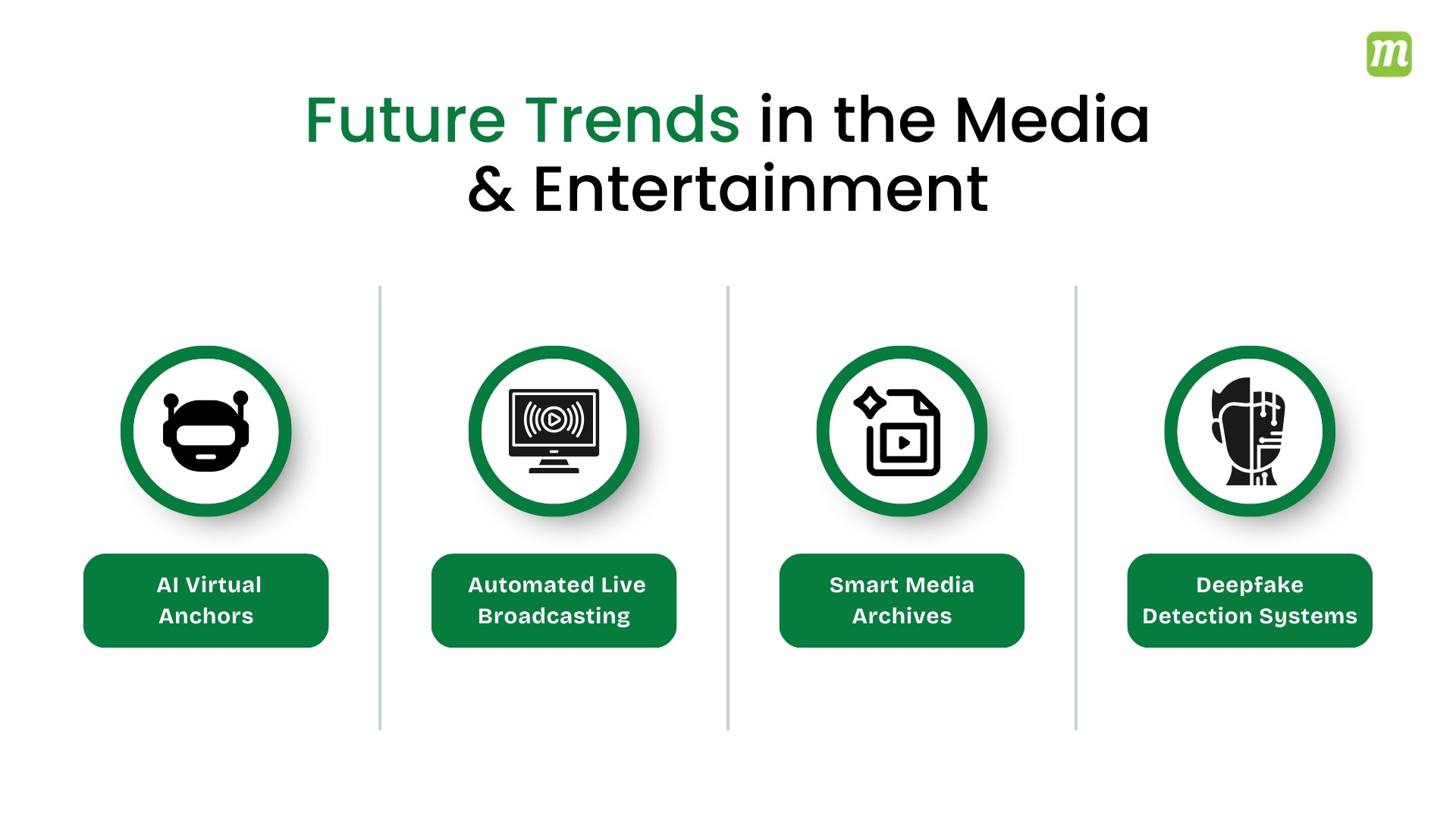
The future of the media and entertainment industry will be shaped by immersive technologies, AI-driven personalization, automation, and digital trust. As consumer expectations evolve, entertainment companies will leverage smart, AI-powered systems to deliver richer experiences, safer platforms, and more efficient operations. Now that you know “how is ai used in entertainment,” it is important to learn key trends that will power the next phase of media and entertainment industry transformation.
1. AI Virtual Anchors
AI-generated avatars and virtual news anchors are becoming more realistic and scalable as time goes by. These digital presenters can deliver news in multiple languages, adapt tone for different demographics, and operate round the clock. This trend of artificial intelligence in entertainment and media sectors enhances accessibility, reduces production costs, and introduces innovative methods to engage global audiences.
2. Automated Live Broadcasting
AI automation in live broadcasting will enhance real-time production workflows down the road. From instant closed captioning and speech recognition to dynamic sports graphics and data overlays, AI improves accessibility and overall viewer engagement. Interested broadcasters can deliver high-quality live experiences faster while minimizing manual intervention and operational complexity.
3. Smart Media Archives
AI-enabled tagging, categorization, and metadata generation will simplify media archive management. Advanced search capabilities, powered by AI in media and entertainment industry, allow media companies to retrieve historical footage, audio, and digital assets instantly. Doing this preserves valuable content libraries, improves operational efficiency, and opens new monetization opportunities from archived materials.
4. Deepfake Detection Systems
As deepfake technology advances, AI-based detection systems will play an important role in maintaining media authenticity. The cutting-edge verification tools, based on advanced AI use cases in entertainment industry, will identify manipulated visuals and synthetic content easily. This will help most media and entertainment brands safeguard credibility, prevent misinformation, and build audience trust in digital media.
The Bottom Line: Lead the Future of Media with AI-Driven Innovation
Artificial Intelligence is no longer a supporting technology in media and entertainment field; it is the driving force behind the next evolution. From extensively personalized streaming and immersive experiences to automated production and advanced audience analytics, AI in media and entertainment sector is changing the way content is created, distributed, and consumed.
As the media continues to shape culture, influence opinions, and connect global communities, the responsibility to innovate ethically and inclusively becomes even greater. AI provides the ability to enhance diverse voices, discover creative potential, and deliver deeply personalized experiences that resonate across different demographics.
For media enterprise owners and C-suite leaders who wish to dominate the market, it is advisable to build intelligent, scalable, and future-ready digital products by partnering with a leading AI development company.
Take, for instance, if you are planning to develop an AI-powered music learning app like Padhanisa or any next-generation media and entertainment platform, now is the time to act. Connect with InnovationM to transform your vision into a practical, result-oriented AI solution that drives engagement, growth, and lasting competitive advantage.
Frequently Asked Questions on AI in Entertainment
1. How is AI transforming the media and entertainment industry?
AI is transforming the media and entertainment industry by enabling personalized content recommendations, automated video editing, intelligent content creation, audience analytics, and targeted advertising. Using AI in entertainment field helps companies enhance viewer engagement, streamline production workflows, and maximize revenue through data-driven decision-making.
2. What are the key benefits of AI in media and entertainment?
The key benefits of AI in media and entertainment include improved content personalization, faster production cycles, cost reduction, predictive analytics, enhanced content moderation, and smarter advertising strategies. AI benefits in media and entertainment companies focus on the delivery of engaging, relevant, and high-quality digital experiences.
3. What are the top use cases of AI in the entertainment industry?
Top AI use cases in entertainment industry include recommendation engines (like Netflix-style suggestions), AI-powered content creation, virtual production, deepfake technology, automated subtitles and dubbing, sentiment analysis, and AI-driven marketing campaigns.
4. How does AI improve content personalization in streaming platforms?
AI improves content personalization in streaming platforms by analyzing user behavior, watch history, preferences, and engagement patterns. Machine learning algorithms generate tailored recommendations for each user that increase viewer retention, satisfaction, and subscription.
5. Can AI reduce production costs in the media industry?
Yes, AI in media and entertainment significantly reduces production costs by automating repetitive tasks such as video editing, script analysis, visual effects enhancement, and content tagging. It also improves operational efficiency and shortens time-to-market, helping studios and broadcasters optimize their budgets.
6. Which companies provide the best AI development services for the media and entertainment industry?
Several companies provide AI development services for the media and entertainment industry, including Accenture, Tata Consultancy Services, Infosys, Capgemini, and InnovationM. These companies specialize in AI-driven content personalization, audience analytics, intelligent automation, recommendation systems, and end-to-end digital transformation for media enterprises.