
Software development has become an expensive affair in certain countries like the United States, Switzerland, Australia, and Western European nations due to premium talent demand, rigorous regulatory compliance, and high living standards of technical professionals. But that doesn’t mean you can’t build your dream app if you own or operate a business in those countries. Yes, you heard that right! Some nations, such as India, Vietnam, Philippines, Indonesia, Malaysia, Ukraine, Poland, Lithuania, Romania, Hungary, Belarus, Brazil, Argentina, Mexico, Colombia, and Chile, offer affordable offshore software development services.
Thus, if you want to cut your offshore software development cost by up to 50% without compromising quality, it makes sense to partner with a top offshore software development company in India – InnovationM. The best part of this collaboration is that you will get instant access to a global pool of specialized talent, experience faster time-to-market, and allow your executives to focus on just the core operations of your business. And these are the reasons why the offshore software development market size has grown at an exponential rate in recent years. In fact, as per Research and Markets, the offshore software development market size will rise from $178.32 billion in 2025 to $204.32 billion in 2026 at a growth rate of 14.6%.
In this blog, we will have a detailed discussion about offshore software development, its working models, benefits, hiring strategies, team structure, collaboration workflows, pricing across different regions, and how to choose the right outsourcing development partner to ensure your business success in the long run.
Understanding Offshore Software Development and How It Works
Offshore software development is all about collaborating with IT engineering teams located in territories outside your own country to get cutting-edge software applications, platforms, and managed services. These areas often include the Asia-Pacific, Eastern Europe, and Africa regions.
Most companies hire offshore software developers to fulfill multiple requirements, including:
- Getting access to specialized tech talent
- Expanding product development teams
- Reducing operational costs
- Supporting round-the-clock operations
Which Businesses Benefit Most from Offshore Software Development Services?
Offshore software development helps businesses accelerate innovation, reduce operational costs, and access global technology expertise. Right from startups to enterprises, organizations across different industries leverage software outsourcing services to scale efficiently and speed up their digital transformation initiatives. Here is a list of businesses that benefit most from such services:
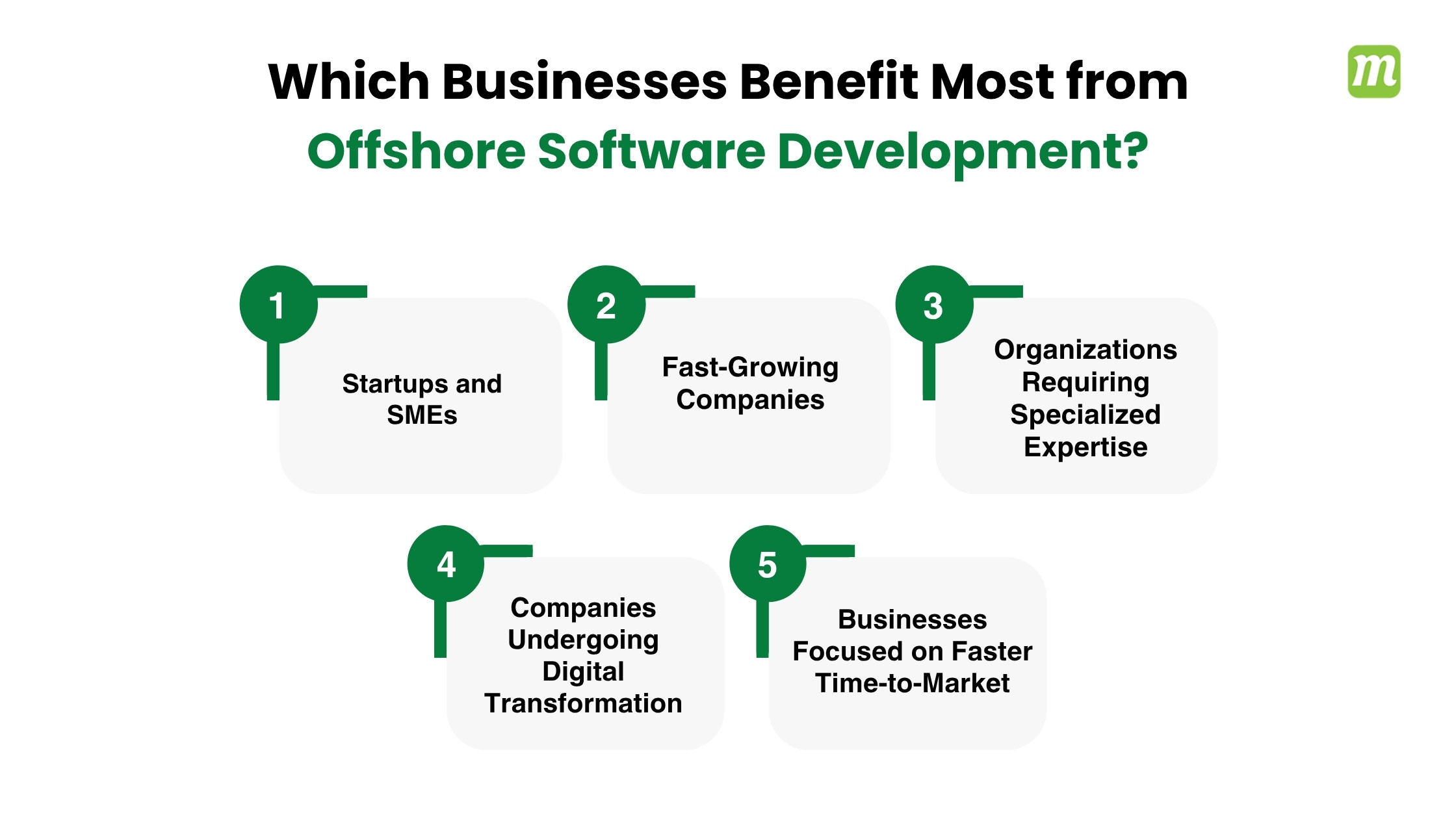
1. Startups and SMEs
Offshore outsourcing services help startups and small and medium-sized enterprises access skilled developers at a cost-effective rate. This enables them to build and scale digital products without making significant investments.
2. Fast-Growing Companies
Businesses experiencing rapid growth can quickly expand their development teams using offshore software development services and increase their capabilities without committing to the long-term costs of local hiring.
3. Organizations Requiring Specialized Expertise
Large enterprises that require niche technical skills can leverage offshore outsourcing services to access global talent across cutting-edge technologies and specialized domains.
4. Businesses Focused on Faster Time-to-Market
Companies in competitive industries can accelerate product development through an offshore IT services provider, as it ensures continuous development across different time zones.
5. Companies Undergoing Digital Transformation
Traditional businesses adopting state-of-the-art technologies use offshore software development services to drive innovation, modernize systems, and stay competitive in the market while optimizing their operational costs.
Popular Offshore Software Development Models That Drive Faster and Smarter Product Delivery
Different offshore software development models offer different levels of flexibility, scalability, and control depending on your business needs. Therefore, choosing the right engagement model makes sense as it will help you accelerate your product delivery, optimize costs, and improve development efficiency.
| Engagement Model | Description | Best For | Key Advantages |
| Dedicated Team Model | A long-term offshore team works only on your projects as an extension of your in-house team. | Ongoing product development and increasing engineering capacity | High flexibility, robust collaboration, and scalable resources |
| Project-Based Model | An offshore IT services provider manages the complete project with predefined scope, timeline, and deliverables. | Clearly defined projects with fixed requirements | Predictable cost and timelines with lower operational cost |
| Staff Augmentation Model | Offshore developers merge with your existing internal team to fill skill or capacity gaps. | Short-term scaling or specialized skill requirements | Faster hiring, flexibility, and smooth integration |
| Managed Services Model | The outsourcing development partner fully manages specific functions, systems, or operations with agreed Service Level Agreements (SLAs). | Large enterprises looking for greater operational efficiency and long-term support | Minimal operational burden, continuous support, and predictable delivery |
| Hybrid Offshore Model | Combines onshore leadership with a remote software development team for balanced collaboration and cost efficiency. | Big enterprises that require strategic alignment and global scalability | Better communication, cost optimization, and efficient governance |
Key Benefits of Offshore Software Development That Accelerate Business Growth and Innovation
Offshore software product development empowers businesses in expensive countries to reduce their operational costs, access global technology expertise, and expedite digital innovation. Apart from cost savings, this software development technique also enables organizations to scale faster, improve development efficiency, and deliver high-quality software products with greater flexibility.
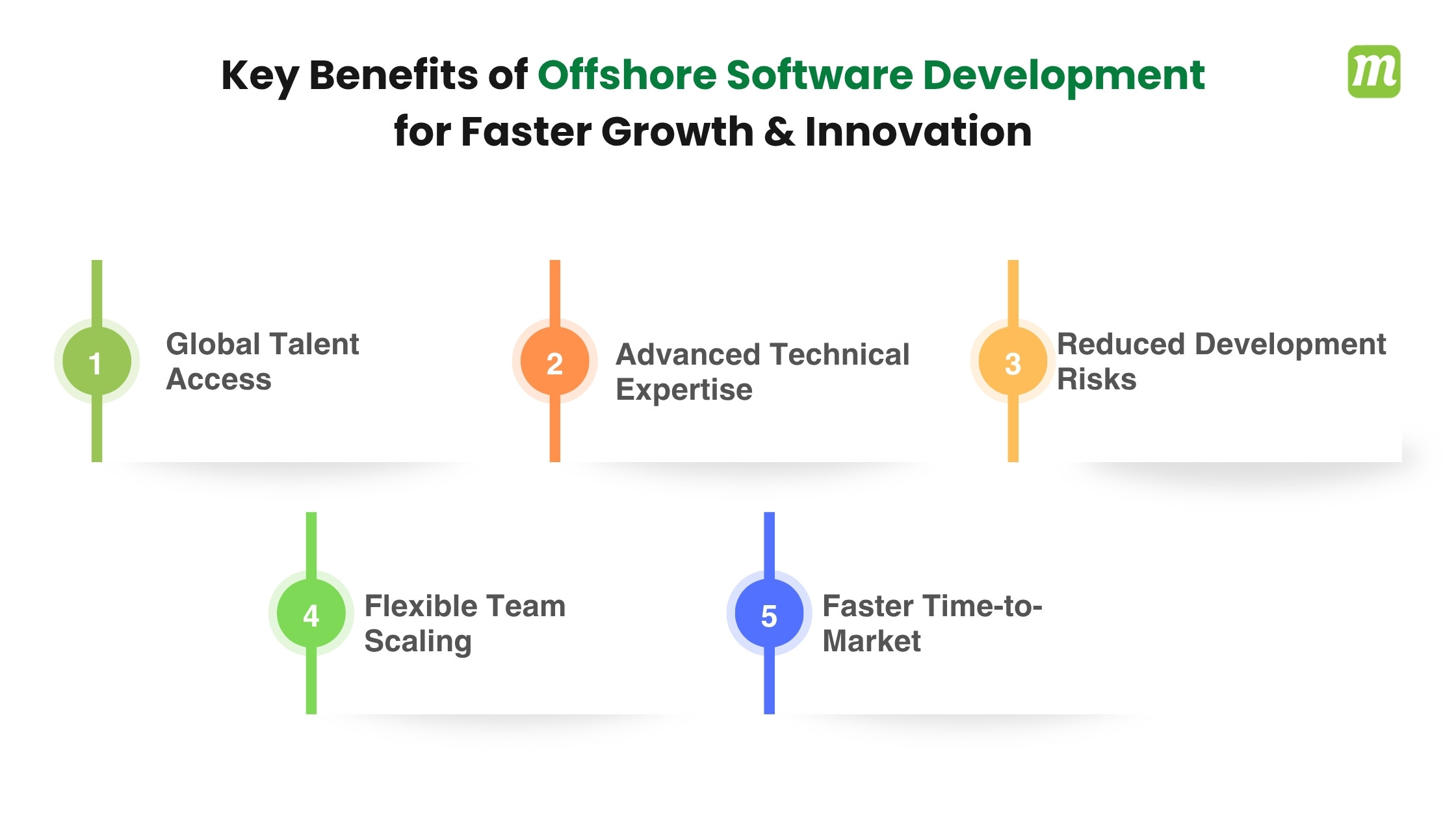
1. Global Talent Access
Availing software outsourcing services gives businesses access to a global pool of skilled developers, engineers, and technology specialists across modern and niche technology stacks. This assists companies in overcoming local talent shortages efficiently.
2. Advanced Technical Expertise
Another set of software development outsourcing benefits includes leveraging hands-on experience in emerging technologies like AI, cloud computing, blockchain, IoT, and data engineering. This enables companies to build innovative, future-ready digital products, keeping scalability scope in mind.
3. Reduced Development Risks
One of the main benefits of offshore software development is that the team in another country follows agile methodologies, strong quality assurance processes, and structured project management practices. This further minimizes risks, improves software reliability, and ensures timely project delivery with better operational control.
4. Flexible Team Scaling
Choosing to work with a proven offshore software development model offers the flexibility to scale teams, expand capabilities, or adapt new technologies quickly without disrupting ongoing business operations. This makes the offshore software development strategy highly suitable for evolving project requirements and growth-focused businesses.
5. Faster Time-to-Market
The best part of working with a dedicated offshore development team is that it enables round-the-clock development, continuous productivity, and faster project execution. This way, enterprises can speed up their software launches and respond to changing market demands with improved development speed and efficiency.
How to Choose the Right Offshore Software Development Company That Fits Your Goals
Selecting the right offshore software development company is extremely important for ensuring successful project execution, scalability, and your organizational growth in the long run. So, it is necessary to find an offshore partner that can align with your technical requirements, communication expectations, security standards, and overall business objectives. Here is a detailed guide on how to choose the right outsourcing development partner for your project, including key considerations for software development outsourcing.
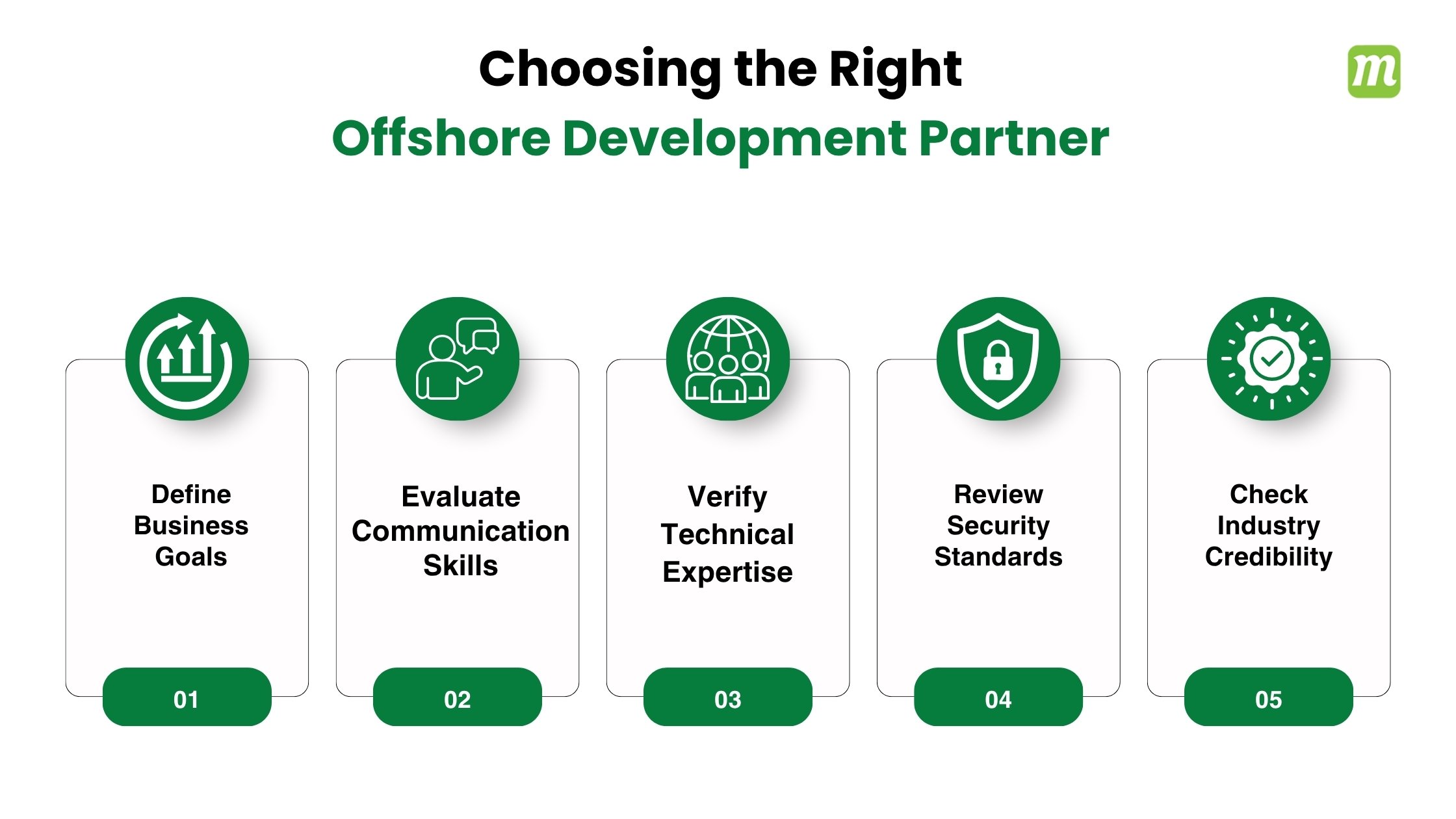
1. Define Business Goals
The first and foremost thing you need to do is to identify your project requirements, technology needs, engagement model, budget, and long-term objectives clearly before searching for an offshore software development company that aligns with your business vision and growth strategy.
2. Evaluate Communication Skills
Next, choose an offshore software development firm with strong English proficiency, transparent communication practices, and responsive collaboration processes. Doing this helps in ensuring smooth coordination, faster decision-making, and efficient management across distributed development teams across the globe.
3. Verify Technical Expertise
After that, you need to evaluate your potential outsourcing development partner’s developer quality, technology capabilities, domain expertise, and experience in delivering similar projects. Implementing this idea will help you ensure that your prospective outsourcing company can handle your project and its technical requirements pretty well.
4. Review Security Standards
In this offshore software development guide, the next thing you need to do is to ensure the offshore development company you want to hire follows modern cybersecurity practices, data protection protocols, compliance standards, and secure development processes. Reviewing these things carefully will help you safeguard sensitive business information and software assets perfectly.
5. Check Industry Credibility
Lastly, all you need to do is check client testimonials, portfolios, case studies, and global project experience to evaluate your potential outsourcing company’s reliability, delivery capabilities, and proven success in building scalable offshore development teams.
The Core Experts Behind Successful Offshore Software Development Team Composition
A successful offshore development team consists of multiple specialists working together to ensure seamless product delivery, scalability, performance, and user satisfaction. Each professional contributes unique expertise to the project that helps companies build high-quality, reliable, and future-ready digital solutions. Below is a list of professionals who are part of a dedicated offshore development team:
1. Project Manager
They manage project scope, timelines, communication, task allocation, and risk management to ensure smooth collaboration and on-time delivery of software development projects.
2. Business Analyst
Being a key resource in an offshore software development team, they analyze business requirements, gather stakeholder expectations, and translate operational goals into clear technical specifications for efficient project execution and development planning.
3. Software Architect
They design scalable software architecture, define technical standards, ensure system security, and guide development teams in building high-performance digital solutions.
4. Front-End Developer
A front-end developer is another important member in a remote software development team who is responsible for building responsive user interfaces, implementing engaging designs, and ensuring seamless user experiences across web and mobile applications.
5. Back-End Developer
A back-end developer is a technical professional who is accountable for developing server-side logic, managing databases, integrating APIs, and ensuring optimal application performance, reliability, and secure handling of essential operations.
6. Full-Stack Developer
They handle both front-end and back-end development tasks, which enables faster delivery and complete end-to-end software solution development across multiple technology layers.
7. QA Engineer
In offshore software development projects, a QA engineer is liable to perform manual and automated testing, identify software defects, validate functionality, and ensure the final product meets quality, usability, and performance standards consistently.
8. UI/UX Designer
A UI UX designer creates intuitive user experiences through wireframes, prototypes, and interface designs while ensuring usability, accessibility, and customer-centric digital product interactions effectively.
9. DevOps Engineer
They manage cloud infrastructure, deployment pipelines, continuous integration processes, and system monitoring to support faster releases, operational stability, and scalable software delivery workflows.
10. Technical Support Specialist
A technical support specialist in an offshore development team provides post-deployment maintenance, resolves technical issues, gathers customer feedback, and ensures continuous software improvements for enhanced user satisfaction and long-term product reliability.
How to Effectively Manage and Collaborate with Offshore Development Teams
The success of offshore software development depends on strong communication, transparent workflows, and efficient collaboration across distributed teams. Also, using the right project management and communication tools will help you improve productivity, streamline coordination, and ensure seamless project execution. For example:
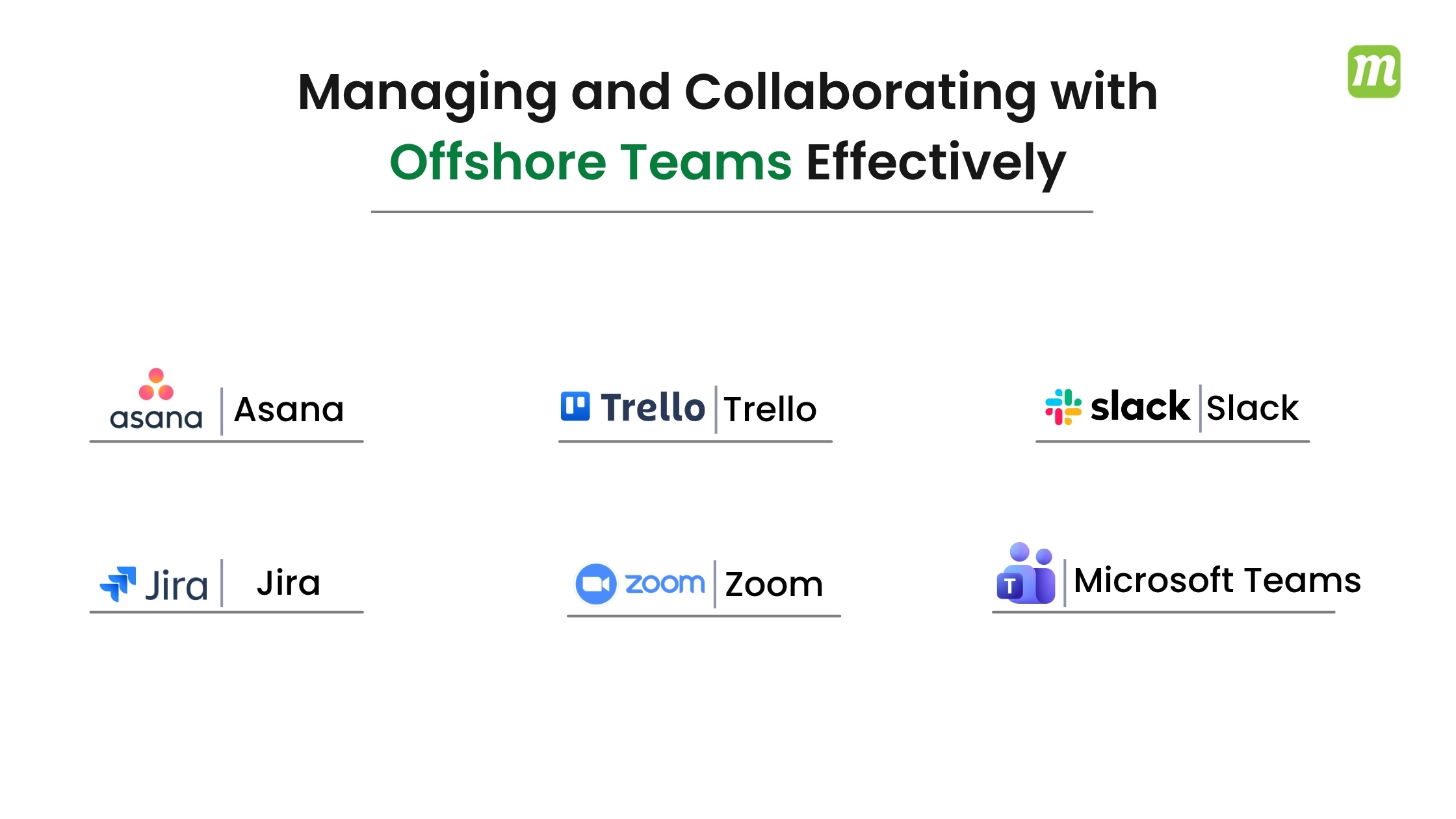
1. Asana
Asana manages tasks, workflows, deadlines, and team collaboration through intuitive project tracking dashboards efficiently.
2. Trello
Trello organizes development workflows visually using flexible boards, task cards, and progress tracking features.
3. Slack
Slack enables instant team communication, file sharing, and seamless collaboration across distributed offshore teams.
4. Jira
Jira supports agile development with sprint planning, issue tracking, reporting, and workflow management capabilities.
5. Zoom
Zoom facilitates virtual meetings, sprint discussions, screen sharing, and real-time offshore team collaboration effectively.
6. Microsoft Teams
Microsoft Teams combines messaging, video conferencing, document collaboration, and productivity tools within one integrated platform.
Cost to Hire Offshore Software Developers Across Different Global Regions
Explore our detailed comparison of offshore software development cost across leading global regions:
| Countries | Estimated Hourly Rates | Strengths | Considerations |
| India | Junior developers: $15 – $25
Mid-level developers: $25 – $40
Senior developers: $40 – $70 |
• Big, skilled talent pool in multiple technologies, like AI, ML, Java
• Top-notch English proficiency
• Long-standing outsourcing infrastructure |
• Huge time zone differences with Western countries
• Quality varies across different offshore software development companies |
| Southeast Asia (Indonesia, Malaysia, Vietnam, Philippines) | Junior developers: $15 – $25
Mid-level developers: $25 – $40
Senior developers: $40 – $60 |
• Growing IT industry, government support
• Competitive rates • Philippines has better English proficiency |
• Smaller talent pool as compared to India or Eastern Europe
• Significant communication challenges in some countries due to cultural differences |
| Eastern Europe (Poland, Ukraine, Hungary, Belarus, Lithuania, Romania) | Junior developers: $25 – $35
Mid-Level developers: $35 – $50
Senior developers: $50 – $100 |
• Highly qualified developers, in-depth STEM expertise
• Closeness to Western Europe, time zone alignment
• European Union data regulations (for EU-based countries), cultural alignment |
• Slightly more expensive rates than Asia
• Political instability in certain countries |
| Latin America (Argentina, Brazil, Colombia, Chile, Mexico) | Junior developers: $25 – $40
Senior developers: $60 – $100 |
• Same or similar time zones as US/Canada, which minimizes communication delays
• Strong cultural fit and good English proficiency
• Skilled developers in cutting-edge technologies, like AI, blockchain, etc. |
• Higher rates than Asia, but it makes sense owing to time zone overlap and expertise
• Political instability in some nations, including Argentina and Venezuela, may affect business continuity |
When Offshore Software Development is the Right Choice (and When It Isn’t)
Offshore software development makes sense when:
- You need to expand engineering faster than US hiring.
- Your bank balance demands capital efficiency.
- You have a stable enough roadmap to justify a 6+ month engagement.
- You can dedicate at least one in-house person to coordinate and lead.
- Your product doesn’t depend on local US user research integrated in the engineering team.
Offshore is the wrong choice when:
- You don’t yet know what you are building, which you can resolve by brainstorming with a small in-house or contractor team first.
- The work requires constant, ambiguous, real-time collaboration with US-based stakeholders.
- You can’t commit to operational discipline, be it clear specs, documented decisions, or regular cadence.
- The total engagement is less than 8 to 10 weeks.
Why Should You Choose InnovationM For Offshore Software Development Outsourcing?
InnovationM helps businesses accelerate digital growth by providing access to skilled global talent, scalable development teams, and end-to-end support for offshore software development outsourcing. With expertise across AI, software engineering, cloud, data, and enterprise applications, we deliver high-quality solutions tailored to your evolving business needs. Beyond that, we also ensure smooth collaboration, increased operational efficiency, and strong project governance for the guaranteed success of your business in the long run.
Just to let you know, companies these days are extremely concerned about cybersecurity and operational reliability. In fact, according to Deloitte, 81% of business executives relied on external vendors to address their cybersecurity requirements in 2022. And the best part of our offshore software development company is that we prioritize secure development practices, transparent communication, and agile delivery methodologies to help you innovate confidently. This way, we reduce your development risks, accelerate product delivery, and scale technology capabilities efficiently.
Start Building Your Offshore Software Development Team Today
Offshore software development has become a strategic growth multiplier for businesses looking to boost their engineering capabilities, expedite product delivery, and access specialized global talent cost-effectively. With the right outsourcing development partner at your disposal, you can build high-performing development teams, improve operational efficiency, and adapt quickly to evolving business demands without compromising quality or innovation.
Just so you know, successful offshore collaborations are built on strong technical expertise, transparent communication, agile execution, and seamless coordination between distributed teams. Thus, businesses that combine offshore development with effective governance and collaborative workflows often achieve faster delivery cycles, better scalability, and long-term success of their digital transformation initiatives.
Ready to scale your business with extremely talented offshore software development teams?
Partner with InnovationM to build secure, practical, and future-ready digital solutions with skilled offshore developers, agile delivery models, and technology expertise tailored to your unique business goals.
Frequently Asked Questions
1. What is offshore software development?
Offshore software development is the practice of onboarding an engineering team in a different country, with a significant time-zone difference from the client, to design, build, and maintain software.
2. How much does offshore software development cost in 2026?
The offshore software development cost depends on the professionals employed for your project. For instance, the average hourly rate of software developers in India ranges from $15 – $70 per hour, depending on their role, seniority, and the technology stack they have expertise in. Similarly, a mid-senior product team of seven engineers would cost somewhere between $30,000 and $45,000 per month, which is nearly 60 to 70% less than the equivalent US-based team.
3. Which country is best for offshore software development?
India remains the leading destination for US companies for offshore software development because of its talent depth, advanced delivery infrastructure, English proficiency, and competitive pricing. Besides that, countries like Poland and Ukraine are preferred for security and systems engineering, while Mexico and Argentina are highly suitable when clients want to ensure time-zone overlap.
4. What is the difference between offshore and nearshore software development?
Offshore software development refers to teams in remote nations, such as India, Eastern Europe, and Southeast Asia, with limited time-zone overlap. On the flip side, nearshore refers to teams in countries closer to the US, like Latin America, for US clients with significant time-zone overlap. Offshore typically offers deeper cost savings, while nearshore provides better real-time collaboration.
5. What is the difference between offshore software development and staff augmentation?
An offshore development team operates as a self-contained unit with its own project management, QA, and delivery accountability. While staff augmentation provides individual engineers who work as additional members of your existing team, with all project management responsibility staying on your side.
6. Is offshore software development a good fit for startups?
Yes, offshore software development is a great idea for startups, particularly for seed and Series A startups looking to establish and grow their business. This approach allows a startup to sustain a full engineering team for 2 – 3x longer on the same capital, provided the roadmap is stable, and the founding team commits to operational discipline.
7. How long does it take to set up an offshore development team?
A well-established offshore software development company can build a team of 5 – 10 engineers within 4 – 6 weeks, including interviews, onboarding, and environment setup. On the other hand, the equivalent in-house US hiring cycle ranges between 6 and 9 months.