
Hiring a software developer is one of the biggest investments you’ll make when building a digital product. Whether you’re launching a startup, expanding an existing platform, or modernizing legacy software, understanding the true cost of hiring developers is essential for planning your budget and avoiding unexpected expenses.
The cost of hiring a software developer isn’t determined by salary or hourly rates alone. Factors such as experience, location, technology stack, hiring model, and hidden costs like recruitment, onboarding, and infrastructure all influence your total investment. A junior freelance developer in India may charge a fraction of what a senior AI engineer in the US commands, while working with a software development company or dedicated development team introduces a different pricing structure altogether.
In this guide, we’ll break down the average cost to hire a software developer in 2026, compare hiring models, explore developer rates across countries and technologies, uncover hidden costs, and share practical tips to help you hire the right talent without overspending.
Why Software Developer Hiring Costs Vary
Software developer hiring costs vary because of differences in geographic location, required experience levels, and specialized technology stacks. Additional factors include the choice between full-time staff or freelance contracts, and hidden recruitment expenses like vetting, onboarding, and lost productivity.
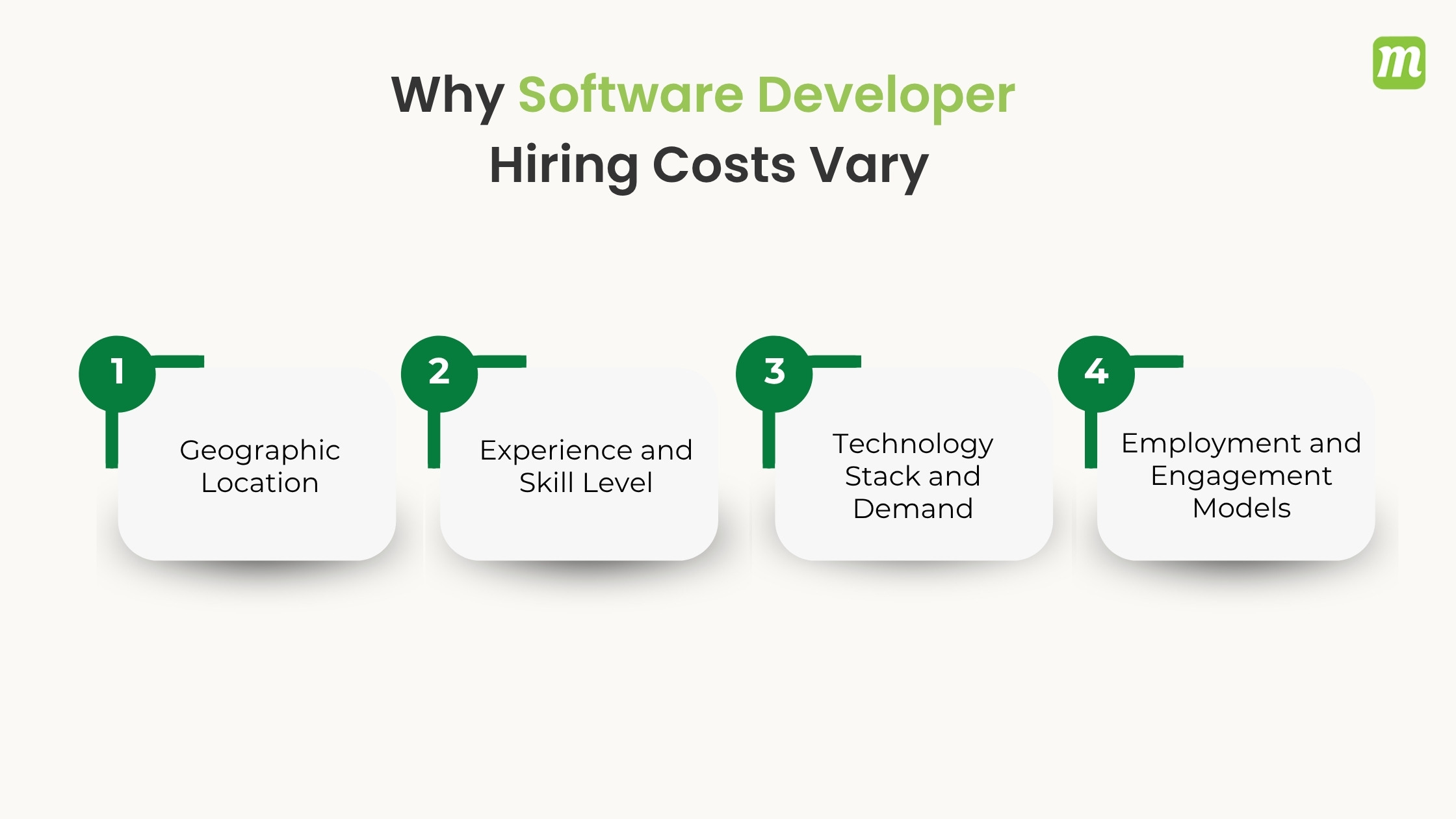
Geographic Location
- Local living costs: Rates change dramatically between regions, metro hubs, and smaller tier cities.
- Global markets: Hiring in North America or Western Europe costs significantly more than sourcing talent through Nasscom guidelines or offshore hubs in South Asia.
Experience and Skill Level
- Junior vs. Senior: Junior developers require lower entry salaries but need more oversight, while senior engineers command higher rates for architectural and leadership capabilities.
- Recruitment overhead: Finding and vetting senior or staff-level talent demands more intensive, costly interview processes.
Technology Stack and Demand
- Niche expertise: Generalists cost less than specialists trained in high-demand fields like artificial intelligence, machine learning, cloud-native design, or cybersecurity.
- Continuous learning: Rare technical stacks require ongoing certifications, driving up expected compensation.
Employment and Engagement Models
- Full-time employees: Require long-term salary commitments, benefits, and local tax overhead.
- Contractors or freelancers: Offer short-term flexibility via hourly or project-based billing.
Average Cost to Hire a Software Developer in 2026
The average cost to hire a software developer in 2026 ranges from $15 to $200+ per hour globally, or ₹4 LPA to ₹30 LPA locally in India depending on experience. Rates shift dramatically based on location, seniority, and tech stack, with US in-house roles averaging $120k–$200k+ annually versus offshore dedicated talent starting around $1,500 to $3,500 per month.
Cost by Experience Level (India & Offshore vs. Western Markets)
- Junior (0–2 years): ₹4 LPA to ₹8 LPA in India; $15–$30/hour globally. Ideal for simple development tasks, bug fixes, and ongoing maintenance, though they typically require guidance from senior team members.
- Mid-Level (2–5 years): ₹8 LPA to ₹15 LPA in India; $30–$60/hour globally. These developers can independently handle most application features, making them a popular choice for startups and growing businesses.
- Senior (5+ years): ₹15 LPA to ₹30+ LPA in India; $80–$180/hour in Western markets. They bring expertise in system architecture, performance optimization, technical leadership, and solving complex business challenges.
Cost by Tech Stack & Specialization
- Front-End / Back-End (Python, Java, Node): ₹7 LPA to ₹18 LPA locally; $25–$60/hour for freelancers. These developers are commonly hired to build websites, APIs, business applications, and scalable backend systems.
- Full-Stack & Mobile (React, Flutter, iOS): ₹10 LPA to ₹20 LPA locally; $40–$90/hour for freelancers. They can manage both user-facing interfaces and backend logic, making them ideal for end-to-end web and mobile app development.
- AI, Machine Learning & Cloud Architecture: ₹12 LPA to ₹25+ LPA locally; $100–$300/hour for specialized contractors. Their higher rates reflect the demand for expertise in AI models, cloud infrastructure, automation, and data-driven applications.
Hiring Models
- Freelancers: Offer the lowest entry cost, with rates ranging from the equivalent of ₹3 LPA to ₹10 LPA or $25–$120/hour. They are best suited for short-term projects, MVPs, bug fixes, and specialized development tasks.
- Full-Time Employees (FTE): Cost ₹6 LPA to ₹20+ LPA in India or $110K–$180K annually in the US, excluding benefits and operational overhead. This model works best for businesses building long-term products with dedicated in-house teams.
- Outsourcing & Agencies: Typically charge $90–$400+ per hour depending on project complexity and agency expertise. While the upfront cost is higher, you gain access to a complete team including developers, designers, QA engineers, and project managers.
Software Developer Rates by Hiring Model
Software developer rates vary by hiring model, ranging from $15–$40/hour for offshore freelancers to $100–$250+/hour for Western agency outsourcing. Rates depend on geography, seniority, and whether you choose freelance, full-time employment, staff augmentation, or software outsourcing. This model can provide access to a complete development team while reducing the overhead associated with building and managing an in-house team.
Freelance Model
- Hourly Rate: $15–$75 (Offshore/Asia) | $50–$150+ (US/Western Europe). Freelancers are the most cost-effective option for businesses that need short-term expertise without the commitment of a full-time hire.
- Best For: Short-term tasks, bug fixes, or MVPs. This model is ideal for startups, prototypes, and one-off development work with clearly defined project requirements.
- Key Traits: Offers maximum flexibility and the lowest hiring overhead, but availability, communication, and quality can vary between freelancers. Platforms like Upwork make it easier to find talent across different skill levels and budgets.
Full-Time Employee (FTE) Model
- Annual Salary Range: ₹6 LPA to ₹20 LPA in India | $70K to $185K+ in the US. In addition to salaries, employers should account for benefits, taxes, equipment, and other operational expenses.
- Best For: Core product development and long-term business growth. Full-time developers provide better product ownership, team collaboration, and continuity over the life of a project.
- Key Traits: Hiring an in-house developer typically increases costs by 25–40% due to benefits and infrastructure. Recruitment and onboarding also take longer, with hiring timelines often ranging from 60 to 90 days.
Contractor / Staff Augmentation Model
- Hourly Rate: $20–$50 (India/Offshore) | $60–$130 (US/Nearshore). This model gives businesses access to experienced developers without the long-term commitments of permanent hiring.
- Best For: Quickly scaling an existing in-house team or filling temporary skill gaps. It’s especially useful for businesses handling large projects or tight development deadlines.
- Key Traits: Augmented developers work as an extension of your internal team, participating in daily meetings and following your workflows. They are usually sourced through staff augmentation providers or Employer of Record (EOR) services.
Software Agency Outsourcing Model
- Hourly Rate / Project Bundles: $40–$150+ per hour (Offshore/Nearshore) | $120–$350+ per hour (US/UK agencies). Pricing varies based on the agency’s expertise, project complexity, and the size of the delivery team.
- Best For: End-to-end software development projects that require design, development, testing, deployment, and ongoing support. Businesses benefit from a complete team without managing individual resources.
- Key Traits: Although agencies have the highest upfront cost, they provide dedicated project managers, QA engineers, designers, and developers under one contract. This reduces management effort and improves delivery reliability for complex projects.
Software Developer Hourly Rates by Country
Software developer hourly rates span from $15 to over $200 globally. North America and Western Europe command the highest fees ($60–$200/hr), whereas nations in South Asia and Latin America offer budget-friendly nearshore and offshore talent ($20–$80/hr) depending on seniority and tech stack.
| Country/Region | Average Hourly Rate (USD) | Key Advantage |
| United States | $70–$200+ | Best for enterprise software and highly specialized projects |
| United Kingdom | $50–$130 | Strong engineering talent for enterprise development |
| Poland | $35–$90 | Popular nearshore destination with competitive pricing |
| Argentina | $35–$80 | Cost-effective option with convenient US time zone overlap |
| India | $15–$65 | High-quality offshore talent with excellent cost efficiency |
| Pakistan & Philippines | $20–$60 | Affordable choice for web, mobile, and maintenance projects |
Software Developer Costs by Technology
Software developer costs vary significantly by technology stack and geographic location. Niche fields like AI/ML and Cloud/DevOps command the highest rates ($45–$90+/hr), while standard frontend or basic mobile app developers charge lower rates ($15–$35/hr). Offshore regions like India offer rates between $20 and $70 per hour.
Cost by Technology Stack (Hourly Rates)
- AI, Machine Learning & Data Science: $45–$95+ per hour. These specialists command premium rates because they build AI models, predictive analytics solutions, and data-driven applications that require advanced technical expertise.
- Cloud, DevOps & Security (AWS/Azure/K8s): $40–$80 per hour. Their expertise in cloud infrastructure, CI/CD pipelines, and cybersecurity helps businesses build secure, scalable, and highly available applications.
- Blockchain & Web3: $40–$85 per hour. Developers in this niche are hired for smart contracts, decentralized applications (dApps), and blockchain-based platforms, where specialized security knowledge is essential.
- Backend & Enterprise (Java, C#, Go, Python): $30–$60 per hour. These developers create the core business logic, APIs, and enterprise systems that power web and mobile applications.
- Mobile Development (Swift, Kotlin, Flutter, React Native): $25–$55 per hour. Rates vary depending on whether you need native iOS/Android development or cross-platform solutions for faster and more cost-effective delivery.
- Frontend Development (React, Vue, Angular): $20–$45 per hour. Frontend developers focus on building responsive, user-friendly interfaces, making them one of the most commonly hired software development roles.
- Legacy/Maintenance (PHP, WordPress, jQuery): $15–$30 per hour. These developers are ideal for maintaining existing websites and applications, making updates, and resolving compatibility or performance issues.
Factors Impacting Rates
- Experience Level: Junior developers typically charge $15–$25/hour, while mid-level professionals charge $22–$35/hour. Senior developers and software architects can command $35–$90+ per hour due to their ability to handle complex technical challenges.
- Hiring Model: Freelancers generally have lower upfront costs, whereas software development agencies charge higher rates because they provide project management, quality assurance, and end-to-end delivery services.
- Geographic Market: Developer rates in North America ($80–$200+/hour) are significantly higher than those in offshore regions like South Asia and Eastern Europe ($20–$80/hour). Many businesses reduce development costs by hiring remote developers without compromising on quality.
Hidden Costs of Hiring a Software Developer
The true cost of hiring a software developer is typically 1.5 to 2.5 times their base salary. Beyond the headline pay rate, expenses accumulate through recruitment, onboarding lag, hardware and software overhead, statutory compliance, and lost productivity from team mentorship.
Recruitment & Sourcing
- Job Advertising & Agency Fees: Sourcing specialized talent involves paid listings, recruiter retainers, or agency cuts (often 15% to 25% of the first year’s salary).
- Internal Interview Time: Hours spent by your existing engineering team reviewing code tests, conducting technical rounds, and interviewing candidates pull them away from active product development.
Onboarding & Ramp-Up
- Productivity Lag: New hires take 3 to 6 months to reach full operational capacity. During this window, you pay full salary for partial output.
- Team Drain: Senior staff must spend significant hours mentoring, conducting code reviews, and unblocking the new developer instead of shipping features.
Infrastructure & Operations
- Hardware & Workstations: High-performance development laptops, monitors, and peripheral accessories.
- Software Licenses: Cloud environments, IDE subscriptions, security tools, and specialized enterprise software access.
Compliance & Benefits
- Statutory Contributions: Mandatory employment overhead, such as Provident Fund (PF), gratuity, and insurance schemes.
- Perks & Retention: Paid time off, health insurance packages, performance bonuses, and continuous learning budgets.
Cost Comparison: In-House vs Freelance vs Agency vs Dedicated Developers
Choosing how to build software depends on balancing budget, control, and team depth. In-house teams offer maximum control at high fixed costs ($80K–$150K+/year per dev); freelancers provide cheap, flexible task-based help ($15–$150/hr); agencies deliver turnkey multidisciplinary teams ($100–$300/hr or $15K–$50K+/project); and dedicated remote developers offer a blended middle-ground model.
| Metric | In-House Developer | Freelance Developer | Development Agency | Dedicated Developers (Staff Augmentation) |
| Cost Structure | High fixed salary + 30% overhead (benefits, taxes, hardware) | Low hourly or per-project rate; pay only for active hours | High fixed project fee or steep hourly retainers ($100–$300/hr) | Predictable monthly subscription or flat per-dev rate |
| Average Rates | $80,000 – $150,000+ per year | $15 – $150+ per hour | $100 – $300+ / hr or $15K–$50K+ / project | $3,500 – $7,000+ per month per dev |
| Hidden Costs | Recruiting, onboarding, retention, idle time | Vetting, management overhead, rework, communication lags | High markup margins, scope change fees | Provider management fee, slight onboarding lag |
| Speed to Start | Slow (2 to 3 months to hire) | Fast (1 to 7 days) | Medium (2 to 4 weeks) | Fast (1 to 2 weeks) |
| Team Depth | Limited to individual skillsets hired | Single person (usually single point of failure) | Full team (PM, design, QA, DevOps, engineers) | Scalable developer(s) backed by vendor resources |
| Best Suited For | Core long-term products and permanent IP | Small MVPs, bug fixes, or discrete tasks | Complex, end-to-end builds from scratch | Scaling an existing team quickly with oversight |
Key Insights by Model
In-House Teams
- Pros: Deepest company alignment, total focus, high long-term institutional knowledge.
- Cons: Most expensive upfront commitment; hardest to scale up or down rapidly.
Freelance Developers
- Pros: Budget-friendly, highly flexible, perfect for specialized short-term execution.
- Cons: Quality varies wildly; requires you to act as the project manager and QA tester.
Development Agencies
- Pros: Comprehensive execution (design, engineering, project management, QA under one roof).
- Cons: Highest upfront cash outlay; less cost-effective for minor iterative updates.
Dedicated Developers
- Pros: Direct management control like an in-house hire, but sourced via an agency at a fraction of local overhead.
- Cons: Relies on third-party remote infrastructure and communication channels.
How to Reduce Software Development Costs Without Sacrificing Quality
To reduce software development costs without losing quality, focus on early planning, build a Minimum Viable Product (MVP), reuse open-source or existing tools for non-core features, and automate repetitive testing and deployment pipelines. Avoid cutting essential quality assurance or architecture upfront, as fixing production bugs costs significantly more.
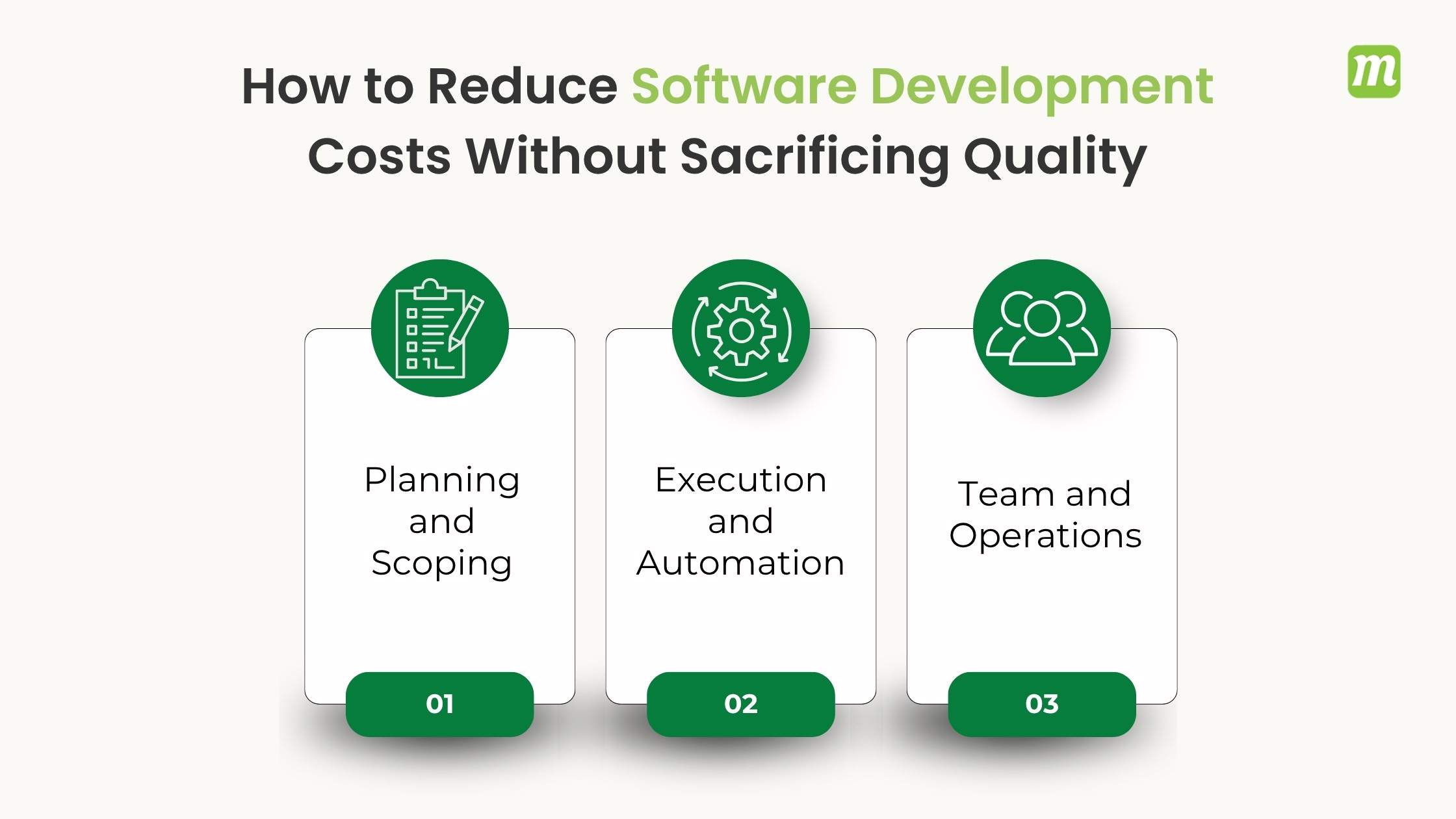
Planning and Scoping
- Define clear, rigid requirements before writing code to prevent expensive scope creep and redesigns.
- Prioritize features using an MVP approach to build only what is necessary for early validation and user feedback.
- Choose boring, proven technology stacks instead of trendy frameworks to reduce risk and leverage existing community knowledge.
Execution and Automation
- Implement CI/CD (Continuous Integration/Continuous Deployment) pipelines to automate builds, testing, and releases.
- Integrate automated unit and regression tests early to catch defects when they are cheap to fix.
- Use open-source components, libraries, and managed cloud services for non-differentiating system needs instead of building from scratch.
Team and Operations
- Balance your core staff with vetted external professionals or strategic outsourcing rather than expanding full-time overhead prematurely.
- Pay for experienced code reviews and technical oversight; one hour of senior guidance often prevents dozens of hours of debugging later.
- Optimize cloud environments and remove idle staging assets or over-provisioned infrastructure resources.
How to Choose the Right Software Developer for Your Budget
To choose the right software developer for your budget, define a small project scope first, match talent levels to your financial limits, and use platforms like Upwork or vetted networks like Toptal to source candidates. Avoid picking the absolute cheapest option; instead, look for business-aligned problem solvers who can deliver measurable value within your set limits.
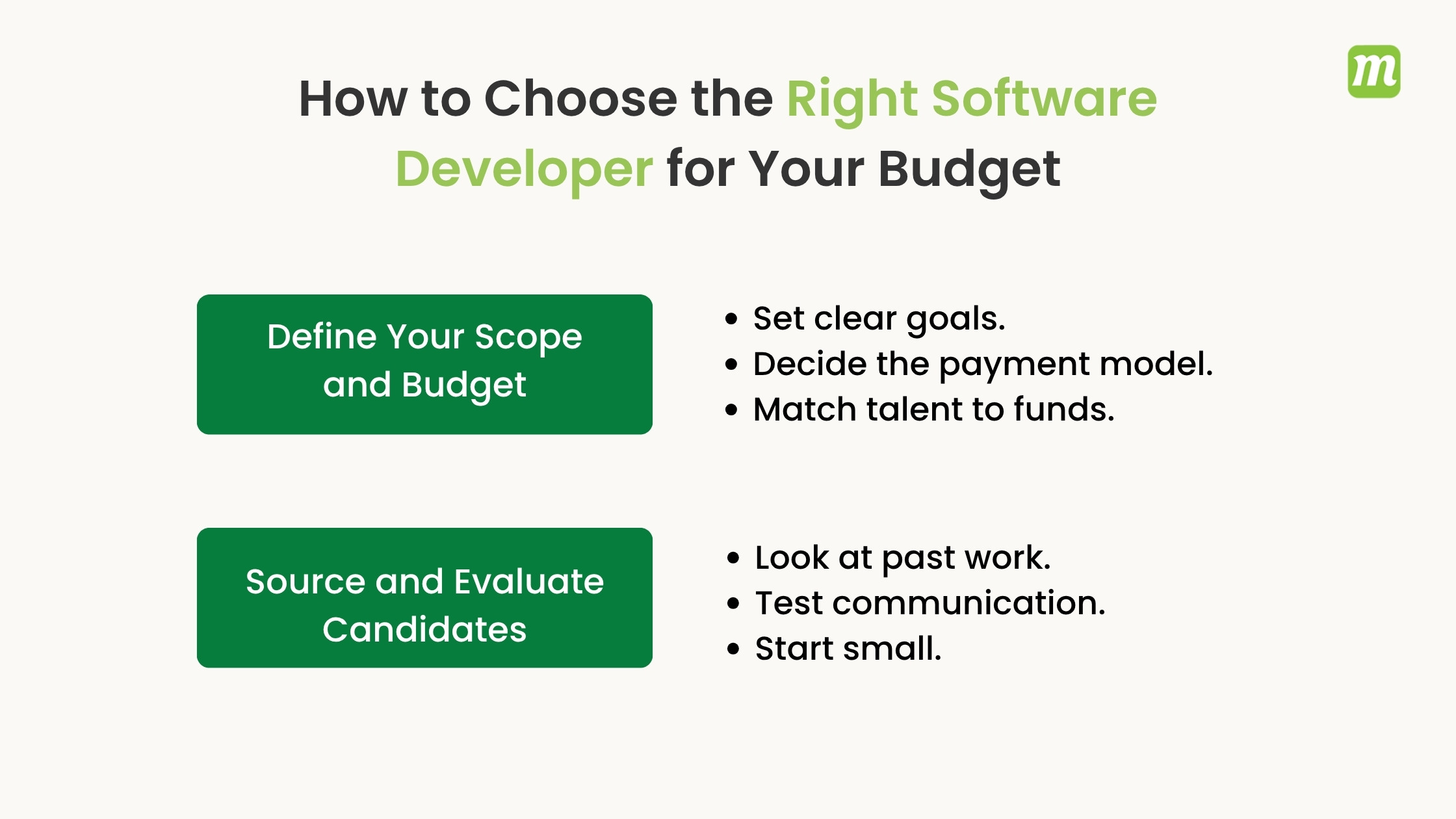
Define Your Scope and Budget
- Set clear goals: List the exact features or a minimum viable product (MVP) you need before talking to anyone.
- Decide the payment model: Use fixed-price contracts for strict, small scopes, or hourly rates if the project needs flexibility as it grows.
- Match talent to funds: Adjust expectations based on developer rates, which range from affordable independent freelancers to higher-cost specialized agencies.
Source and Evaluate Candidates
- Look at past work: Check portfolios and review past client feedback to verify the developer handles budgets and timelines well.
- Test communication: Ask candidates how they handle changes in project scope and unexpected roadblocks.
- Start small: Hire the developer for a small, paid trial task or pilot phase before committing your full budget to the main build.
Frequently Asked Questions
How much does it cost to hire a software developer per hour?
The global average cost to hire a software developer generally ranges from $15 to $200+ per hour, though highly specialized roles like AI/ML engineers or cloud architects can easily command $150 to $200+ per hour. The actual price varies heavily depending on geographic location, experience level, tech stack, and the hiring model you choose.
Is it cheaper to hire offshore software developers?
Yes, hiring offshore software developers is generally cheaper, reducing direct development labor costs by 40% to 70% compared to local in-house hiring in Western markets. However, hidden expenses like management overhead, communication gaps, and code rework can impact overall financial savings.
Should I hire a freelancer or a software development company?
Hire a freelancer for small, low-risk, and budget-friendly tasks. Hire a company for large, complex projects that need a full team, ongoing support, and strict deadlines.
What is the average monthly cost of a dedicated software developer?
The average monthly cost of a dedicated software developer ranges from $1,500 to $9,000+ USD (approx. ₹1.25 Lakh to ₹7.5 Lakh+ INR) for offshore hubs like India, and $6,000 to $16,000+ USD for regions like the US or Western Europe. Prices depend heavily on skill level, location, and tech stack.
How long does it take to hire a software developer?
Hiring a software developer typically takes 35 to 60 days from posting a job to an accepted offer. Junior roles average 30 to 45 days, mid-level roles take 45 to 60 days, and senior or specialized roles often stretch to 60 to 90+ days. Actual onboarding or joining can take an additional 2 to 4 weeks (or up to 2–3 months for standard notice periods in regions like India).
What factors have the biggest impact on software development costs?
The biggest factors that impact software development costs are project scope and features, choice of technology stack, UI/UX design complexity, development team location and structure, and ongoing maintenance requirements. Together, these elements determine the total time and labor needed to build and support the product.
Why Businesses Choose InnovationM to hire Software Development team
Businesses choose InnovationM to hire software development teams because of their 14+ years of industry experience, deep expertise in emerging technologies like AI/ML and cloud, and flexible engagement models including IT staff augmentation and dedicated remote engineering squads.
Core Strengths
- Specialized Talent: Access to pre-vetted full-stack developers, UI/UX designers, and QA engineers.
- AI-First Capabilities: Proficiency in integrating Generative AI, conversational tools, and machine learning models.
- End-to-End Execution: Seamless project handling from initial MVP strategy to full enterprise-scale deployment and support.
Delivery & Engagement Benefits
- Agile Scaling: Ability to ramp up or scale down team sizes quickly based on project demands.
- Cost Efficiency: Significant reduction in hiring overhead and recruitment time compared to building local internal teams.
- Proven Track Record: Extensive experience delivering secure, scalable digital products for global startups and enterprises.
So, if you are planning a project, you can connect with InnovationM to hire dedicated developers in India and build an ideal team for your required technology stack or project scope.
Conclusion
There is no one-size-fits-all answer to how much it costs to hire a software developer. The right budget depends on your project’s complexity, the expertise you need, where you hire from, and whether you choose freelancers, in-house employees, dedicated developers, or a software development company.
Instead of focusing only on the lowest hourly rate, evaluate the overall value a developer or development partner brings. Technical expertise, communication, reliability, and the ability to deliver quality software on time often have a greater impact on your project’s success than upfront cost alone.
Thus, if you’re looking for a cost-effective way to build or scale your development team, InnovationM provides access to experienced software developers through flexible engagement models tailored to your business goals. Whether you need a single developer, a dedicated team, or end-to-end software development services, we can help you find the right balance between quality, speed, and budget.