
Building software today doesn’t always mean hiring a large in-house development team. As technology needs grow and skilled developers become harder to find, more businesses are turning to software development outsourcing to access the right expertise, control costs, and bring products to market faster.
The growing adoption of outsourcing reflects this shift. As per Statista, the global IT outsourcing market is projected to reach US$ 634.18 billion in 2026 and is expected to grow at a CAGR of 6.20%, reaching US 806.55 billion by 2030.
Software development outsourcing is the practice of engaging an external agency, dedicated engineering team, or independent contractors to design, build, test, or maintain software rather than running the entire process through an internal department. This software development outsourcing guide breaks down how it works, the engagement models available, what to budget for, and how to choose the right partner for a project.
Key Takeaways
- Software development outsourcing means hiring an external team through staff augmentation, a dedicated team, or project-based delivery instead of building every capability in-house.
- The three core engagement models are staff augmentation, dedicated teams, and project-based outsourcing, each suited to a different level of scope certainty and timeline.
- Outsourcing can also be grouped by location: onshore, nearshore, and offshore, with cost and talent-pool size increasing as time-zone overlap decreases.
- Successful outsourcing depends on three fundamentals, in order: clear scope, structured project management (Agile/Scrum), and consistent communication.
- Project costs typically range from roughly $20,000 for smaller builds to $250,000+ for enterprise platforms, depending on region, scope, and engineer seniority.
- Vetting a partner should cover technical fit, ISO 27001/SOC 2 security compliance, and explicit intellectual property (IP) ownership terms before any contract is signed.
- Outsourcing works best as a long-term capacity strategy, not a one-off transaction; the right partner should be evaluated the way you’d evaluate a co-founder, not a vendor.
What Is Software Development Outsourcing?
Software development outsourcing is the practice of engaging an external partner, a development agency, a freelance engineering team, or a specialized digital engineering company to handle part or all of a software project instead of relying solely on an internal team.
These arrangements are commonly known as software development outsourcing services, and they typically cover one or more of the following:
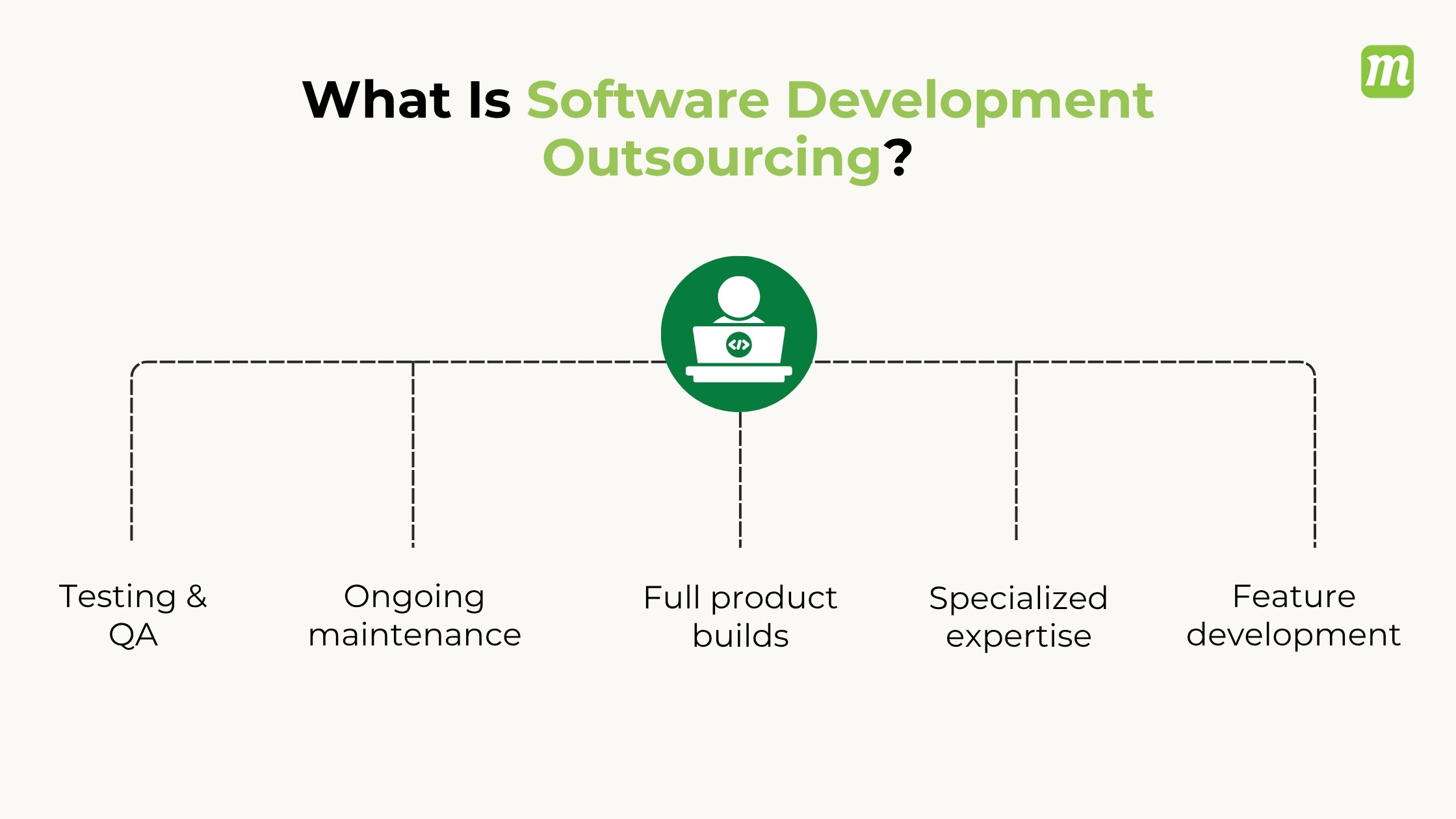
- Full product builds — taking a product from concept to launch
- Feature development — adding capability to an existing platform
- Testing and QA — validating software before or after release
- Ongoing maintenance — keeping a live product secure, stable, and updated
- Specialized expertise — bringing in skills (AI engineering, cloud architecture, DevOps) that don’t exist internally
Businesses of every size use it from early-stage startups outsourcing an MVP build to enterprises augmenting in-house teams with specialized engineers for a single initiative.
Why Are Businesses Outsourcing Software Development?
Outsourcing has shifted from a stopgap for understaffed teams to a deliberate capacity strategy that most modern businesses build into how they ship software. No single in-house team can reasonably hold every specialization it needs on payroll at all times. AI engineering, cloud-native architecture, and data platform skills are hard to hire for on a fixed internal budget, which is exactly why outsourcing has become standard practice rather than a fallback option.
Key Benefits
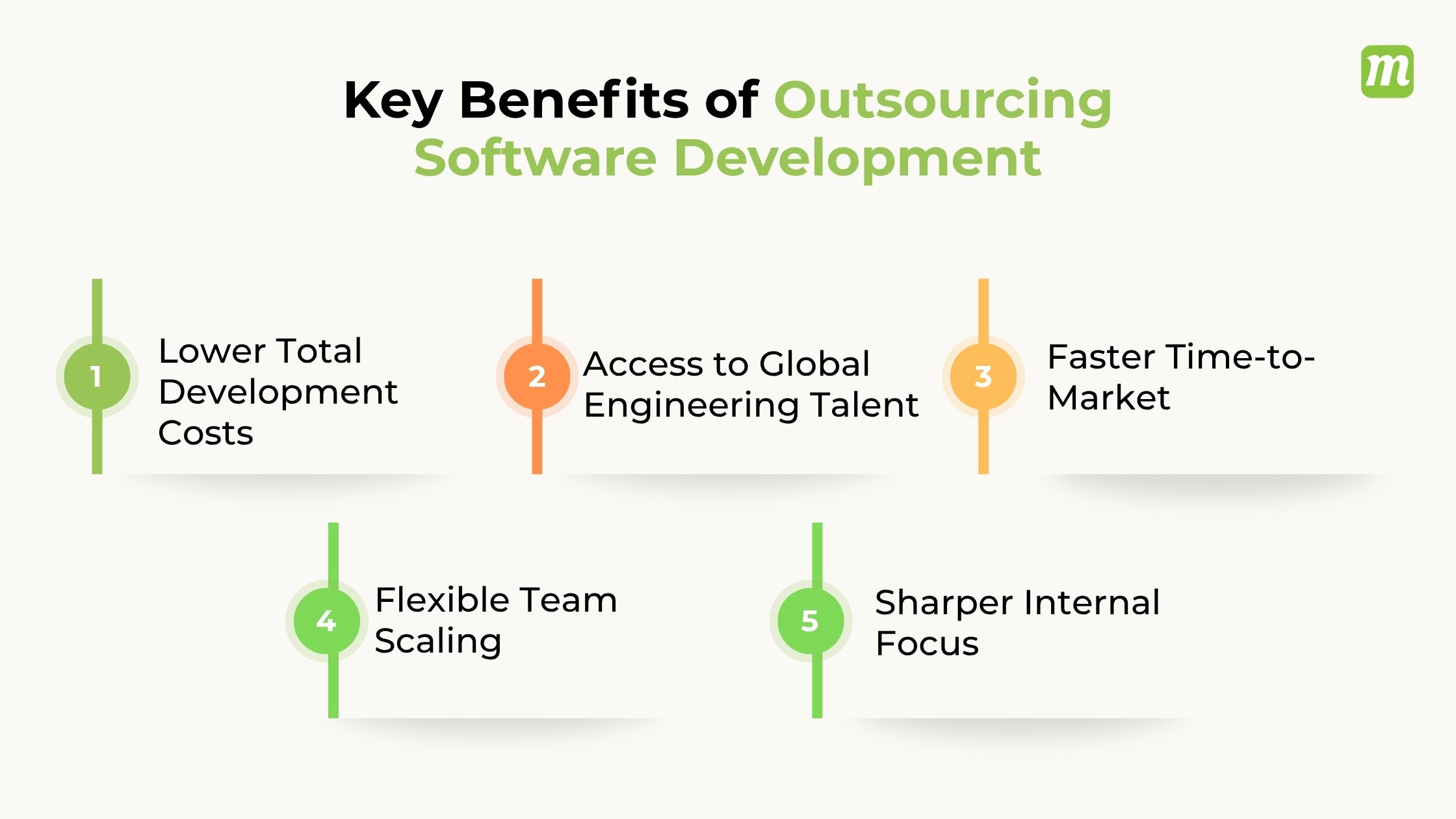
- Lower Total Development Costs: Outsourcing avoids the fixed overhead of local recruiting, onboarding, salaries, benefits, and office infrastructure, converting a large fixed cost into a flexible, project-based expense.
- Access to Global Engineering Talent: Businesses can tap specialized skills and emerging technologies immediately, rather than waiting months to find and hire that expertise locally.
- Faster Time-to-Market: Experienced outsourced teams have typically solved similar technical problems before, which shortens build cycles and gets products in front of users sooner.
- Flexible Team Scaling: Teams can grow during crunch periods and shrink between phases, without the long-term commitment of permanent headcount.
- Sharper Internal Focus: Offloading routine or specialized engineering work frees internal staff to concentrate on product strategy, customer relationships, and core business priorities.
The businesses that get the most value out of this treat their software development outsourcing company as a long-term technology partner, not a short-term vendor.
How Does Software Development Outsourcing Work?
Software development outsourcing moves through five predictable stages: defining requirements, selecting an engagement model, vetting and choosing a partner, aligning on tools and workflow, and building in iterative delivery cycles.
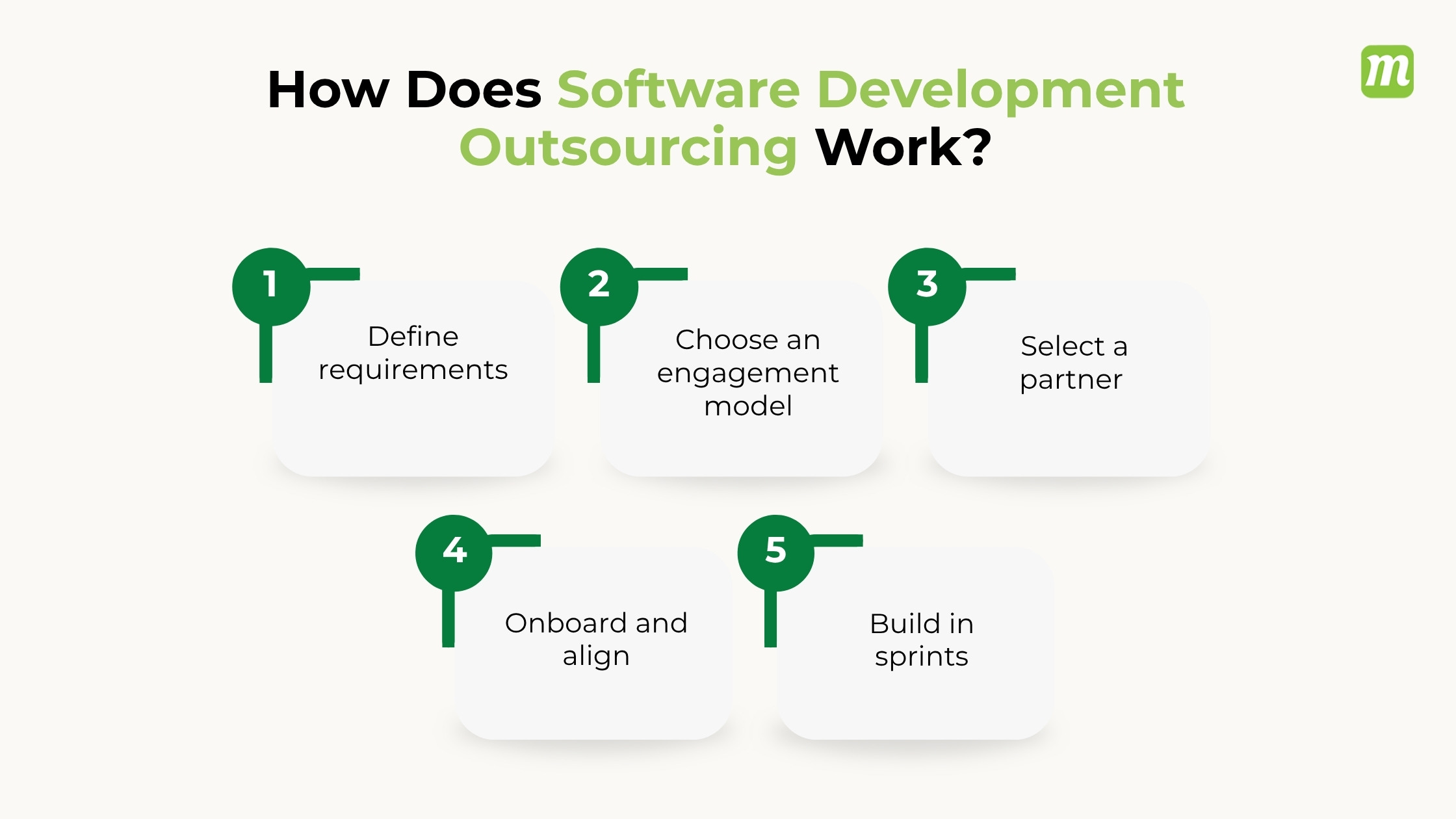
- Define requirements — scope, features, technical needs, and business goals are documented upfront.
- Choose an engagement model — staff augmentation, dedicated team, or project-based delivery, based on how defined the requirements already are.
- Select a partner — vet and hire an onshore, nearshore, or offshore team.
- Onboard and align — the external team adapts to internal workflows, communication tools, and coding standards.
- Build in sprints — development happens in iterative cycles with regular delivery checkpoints and tested code.
What Are the Engagement Models for Software Outsourcing?
The three standard engagement models for software outsourcing are project-based outsourcing, dedicated teams, and staff augmentation, and the right one depends on how defined the project scope already is.
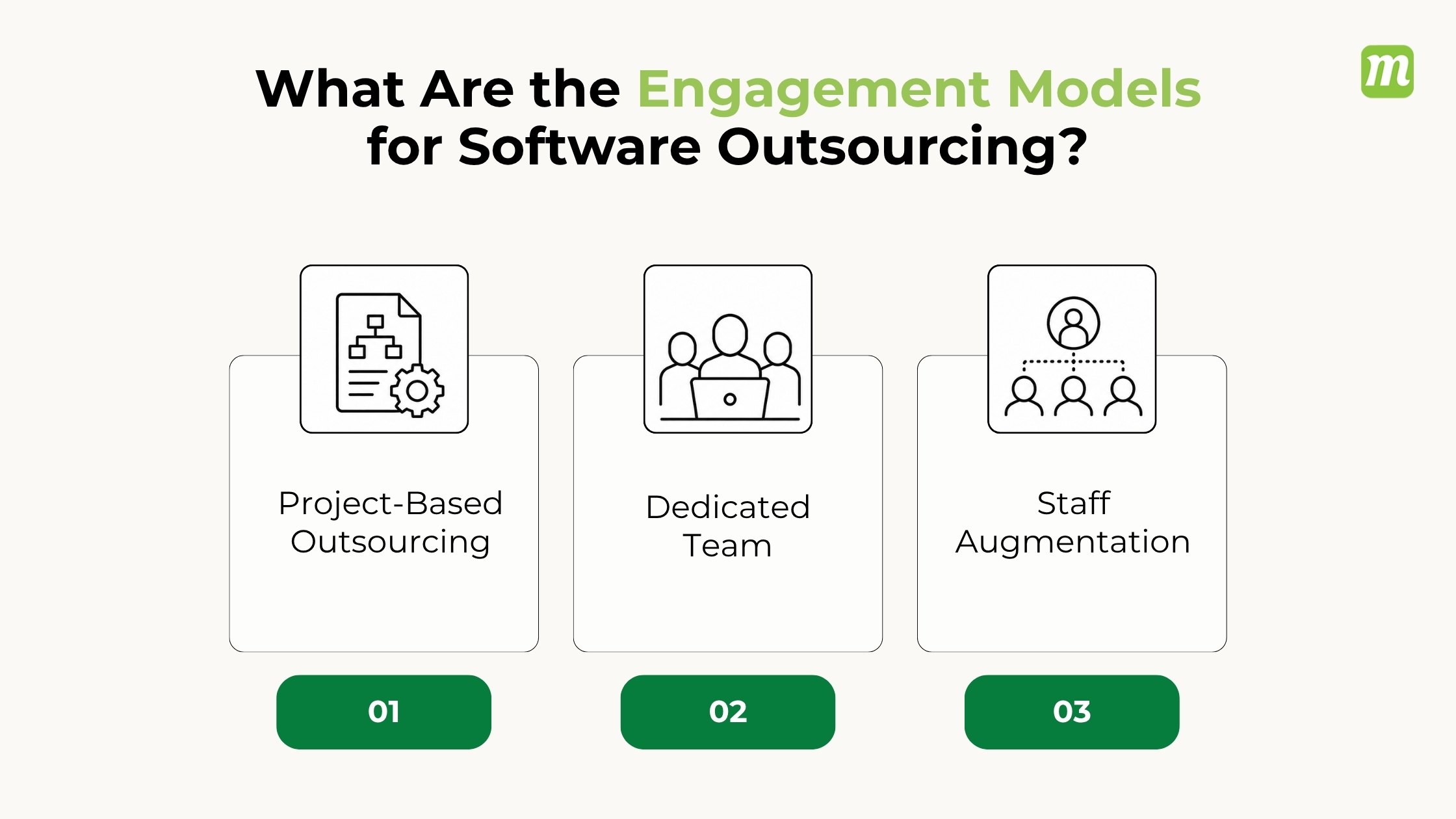
- Project-Based Outsourcing — A defined project with a fixed scope, deliverables, and timeline. Best when requirements are already locked and there’s limited need for ongoing iteration after launch.
- Dedicated Team — An external team that works exclusively on a company’s roadmap over the long term, functioning as an extension of the internal team. Suited to products that will keep evolving well past initial launch. Businesses that go this route often start by learning how to hire a dedicated development team before locking in scope.
- Staff Augmentation — Individual specialists who slot directly into an existing team temporarily, filling specific skill gaps (a senior DevOps engineer, an AI specialist, a QA lead) without a full hiring cycle.
None of these models is inherently better; the right choice depends on requirement clarity, expected engagement length, and how much internal technical leadership is available to direct the work.
What Makes a Software Outsourcing Engagement Successful?
A software outsourcing engagement succeeds when three fundamentals are treated seriously, in this order: scope, structure, and communication.
- Scope — a clearly defined project, with objectives, deliverables, and technical requirements spelled out before a single line of code is written. Vague briefs produce vague results, and “we’ll figure it out as we go” is how outsourcing budgets quietly balloon.
- Structure — real project management discipline, usually built around Agile or Scrum, that keeps the engagement organized across the full software development lifecycle instead of relying on ad hoc check-ins.
- Communication — regular updates, structured sprint reviews, and shared tracking tools (Jira, ClickUp, Linear) that keep the relationship transparent instead of turning into a black box checked once a sprint.
Underneath all three sits cultural alignment: how a team handles disagreement, how it defines “done,” and how it escalates problems. That’s what determines whether a partnership holds together once the initial excitement of kickoff wears off, and it’s the same reason internal team-building fundamentals matter just as much on the outsourced side of the relationship as they do in-house.
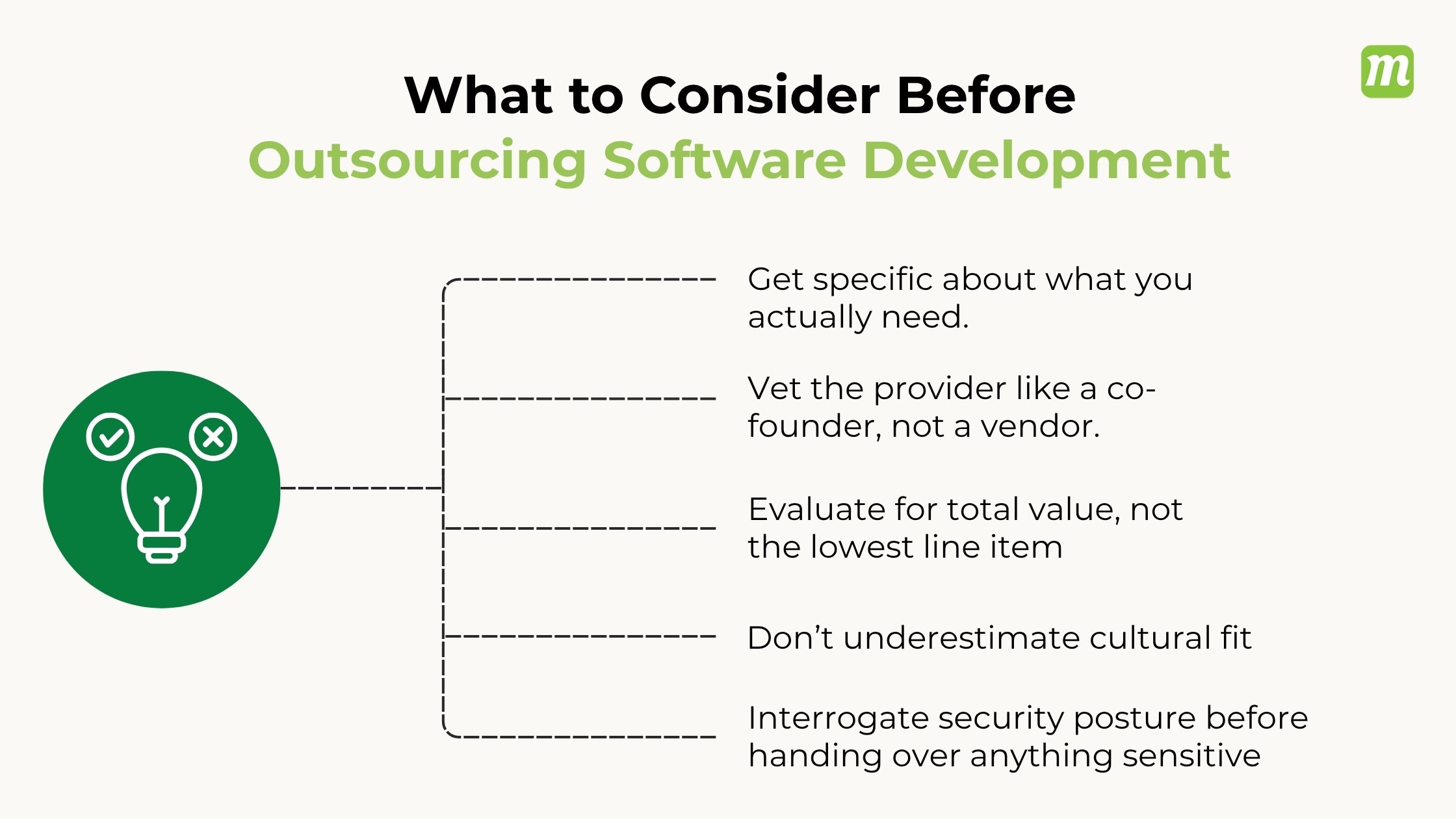
The five factors that matter most before outsourcing are requirement clarity, provider vetting, total value (not just price), cultural fit, and security posture.
- Get specific about what you actually need. “We need a developer” is a wish, not a requirement. Define the tech stack, project scope, and business goals in enough detail that a stranger could read the brief and understand what success looks like.
- Vet the provider like a co-founder, not a vendor. A proven track record and a portfolio that resembles your project matter more than a polished pitch deck. How a provider communicates during the sales process usually previews how they’ll communicate six weeks into a tight deadline.
- Evaluate for total value, not the lowest line item. The cheapest bid is rarely the cheapest outcome once rework, missed deadlines, and management overhead are factored in. Every outsourced software development cost estimate should account for region, project size, and engineer seniority, not just the headline hourly rate. Reviewing current software developer hiring costs is a useful starting point before comparing quotes.
- Don’t underestimate cultural fit. Work ethic, communication style, and how a team handles ambiguity aren’t soft factors; they directly shape how smoothly day-to-day collaboration feels.
- Interrogate security posture before handing over anything sensitive. Ask specifically what controls, access policies, and certifications (ISO 27001, SOC 2) are in place, not whether a vendor “takes security seriously.”
What Kind of Work Can Actually Be Outsourced?
Software teams commonly outsource MVP development, custom software builds, mobile and web development, UI/UX design, and QA testing, each suited to a different stage of the product lifecycle.
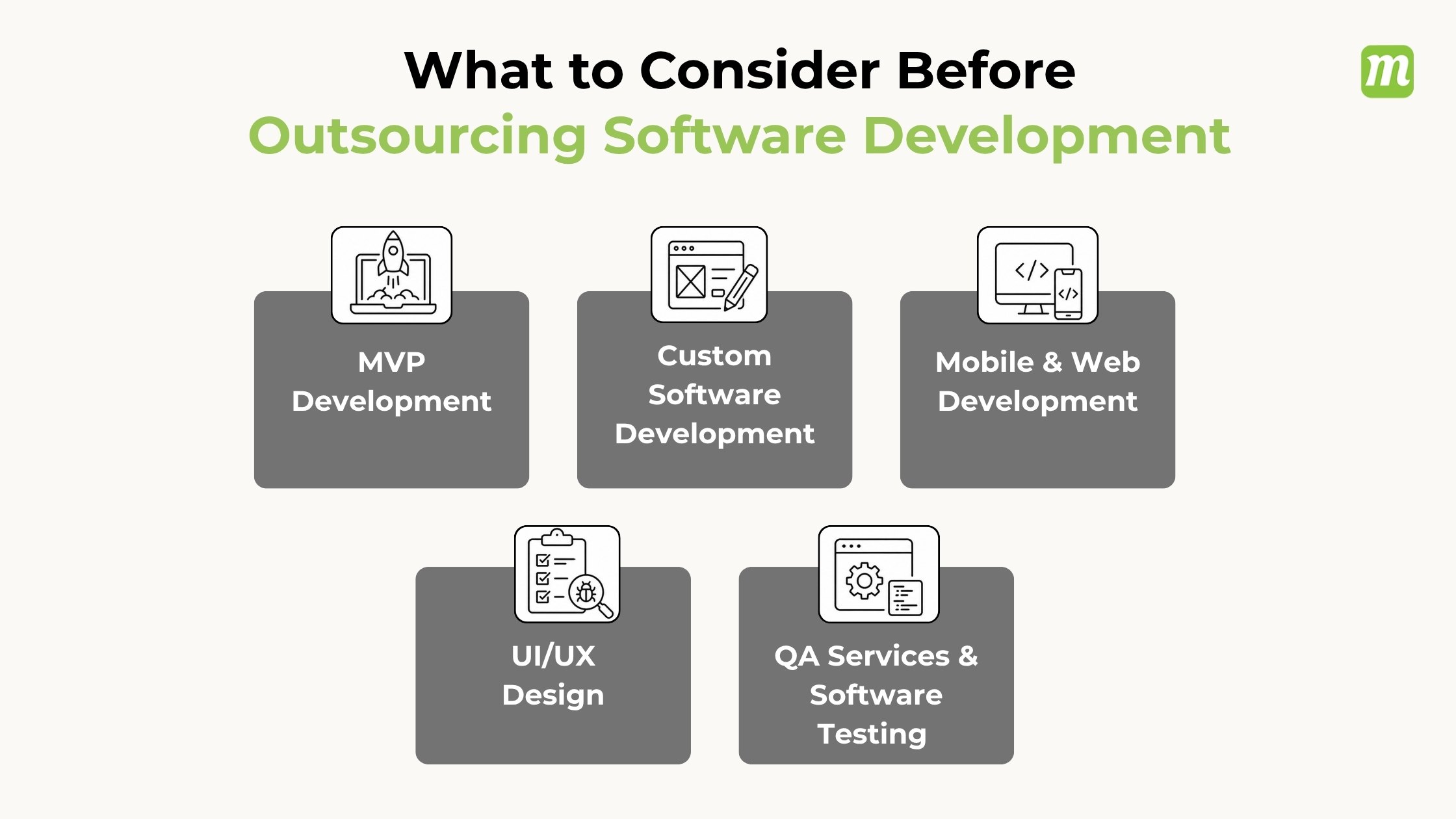
- MVP Development — building just enough product to validate an idea with real users before committing to full-scale development.
- Custom Software Development — applications designed around a specific business workflow rather than forcing that workflow into off-the-shelf software.
- Mobile & Web Development — websites and applications that work cleanly across devices and use cases.
- UI/UX Design — interfaces that are genuinely usable, not just visually polished.
- QA Services & Software Testing — systematically validating that software meets requirements and ships free of defects, often with support from specialized, AI-driven software testing companies for complex or high-compliance products.
The common thread: outsourcing isn’t only about offloading work; it’s a shortcut to specialized talent a business doesn’t need to own permanently, letting internal teams build and scale without stretching past their limits.
Why Choose to Outsource Software Development for Startups?
Startups rarely have the runway to build a full in-house engineering org before validating product-market fit, and every early hire adds fixed burn that’s hard to walk back if priorities shift. Outsourcing turns that fixed cost into a flexible one, without slowing down the build.
- Reach a working MVP faster, without running a full hiring cycle first
- Bring in senior engineering talent immediately, at a fraction of a full-time salary
- Scale the team up during crunch periods and back down between funding rounds
- Test different technical directions without long-term hiring risk
- Free founders to focus on fundraising and go-to-market instead of recruiting
The Three Types of Software Outsourcing
Software outsourcing splits into three types based on where the external team is physically located: onshore, nearshore, and offshore, and each trades time-zone overlap for cost savings and talent-pool size differently.
| Type | Where the Team Sits | Typical Time-Zone Gap | Relative Cost |
| Onshore | Same country as the business | 0–3 hours | Highest |
| Nearshore | A neighboring country or region | 1–4 hours | Mid-range |
| Offshore | A distant country | 5+ hours | Lowest |
Onshore outsourcing keeps working hours aligned but costs the most. Nearshore sits in between, often used by North American businesses working with Latin American teams. Offshore outsourcing software development delivers the widest talent pool and the largest potential savings, at the cost of daily overlap, which is why strong async communication habits matter more the farther offshore a team sits.
How to Choose the Right Software Outsourcing Partner
Choosing the right software development outsourcing company comes down to five checks: project scope and engagement model, location strategy, technical fit, security compliance, and IP ownership terms.
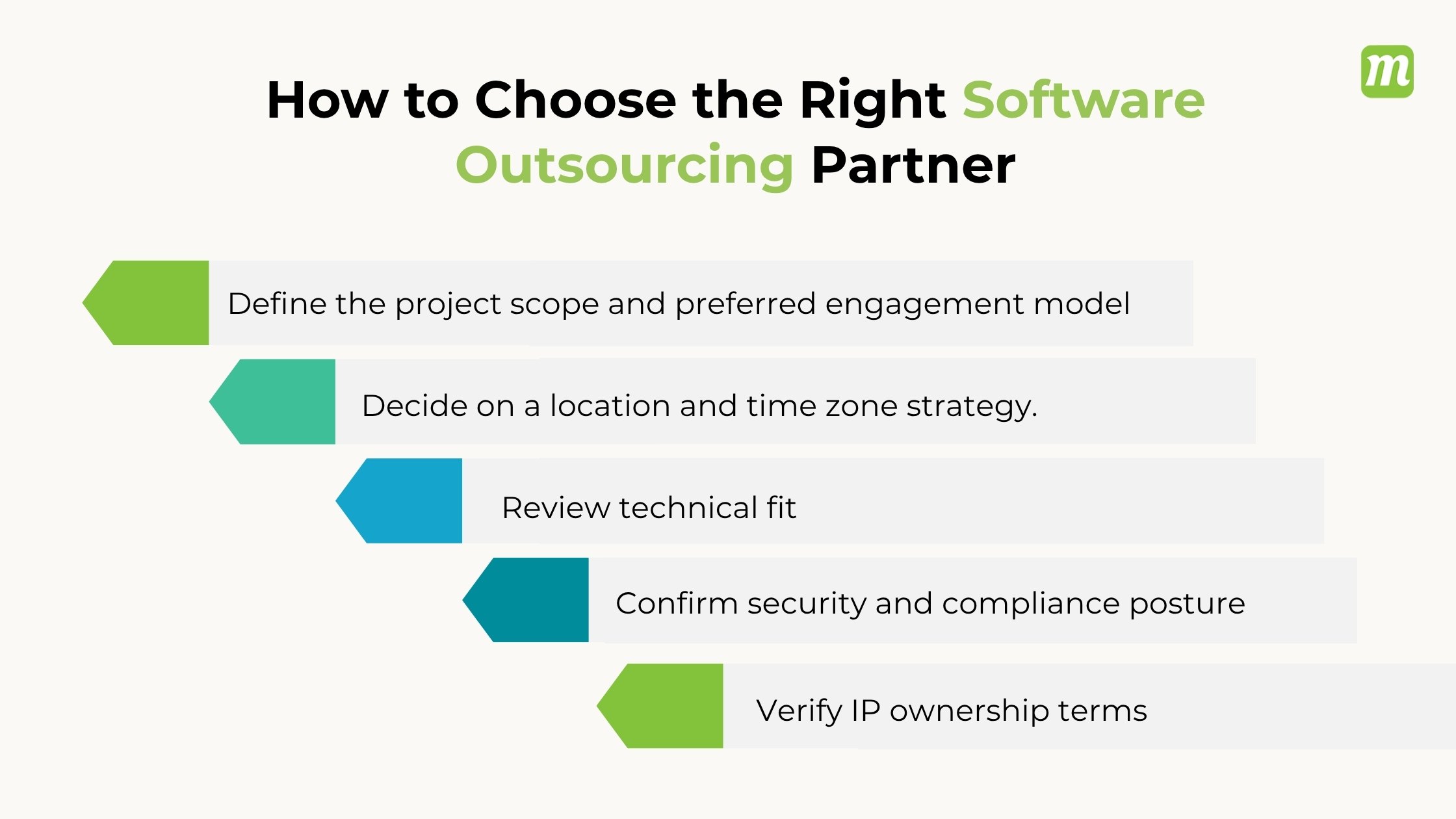
- Define the project scope and preferred engagement model: staff augmentation, dedicated team, or project-based delivery.
- Decide on a location and time zone strategy. Businesses weighing onshore versus offshore software development should base the decision on how much real-time collaboration the work actually requires, not just on hourly rate.
- Review technical fit. Check past case studies and verified experience with the exact tech stack the project needs. India remains one of the largest hubs for this, and reviewing a list of established software development companies in India is a reasonable starting point for comparison.
- Confirm security and compliance posture: ISO 27001, SOC 2, and any industry-specific regulation (HIPAA, BFSI-specific standards) that applies to the project.
- Verify IP ownership terms. The contract should explicitly assign full intellectual property rights to the hiring business, with no ambiguity.
A partner that resists specificity on any of these five points, especially IP ownership and security, is worth a second look before signing.
What Are the Common Challenges of Software Outsourcing?
The most common outsourcing challenges are communication gaps, reduced technical visibility, and financial or legal exposure, most of which trace back to contract clarity rather than a vendor’s technical ability.
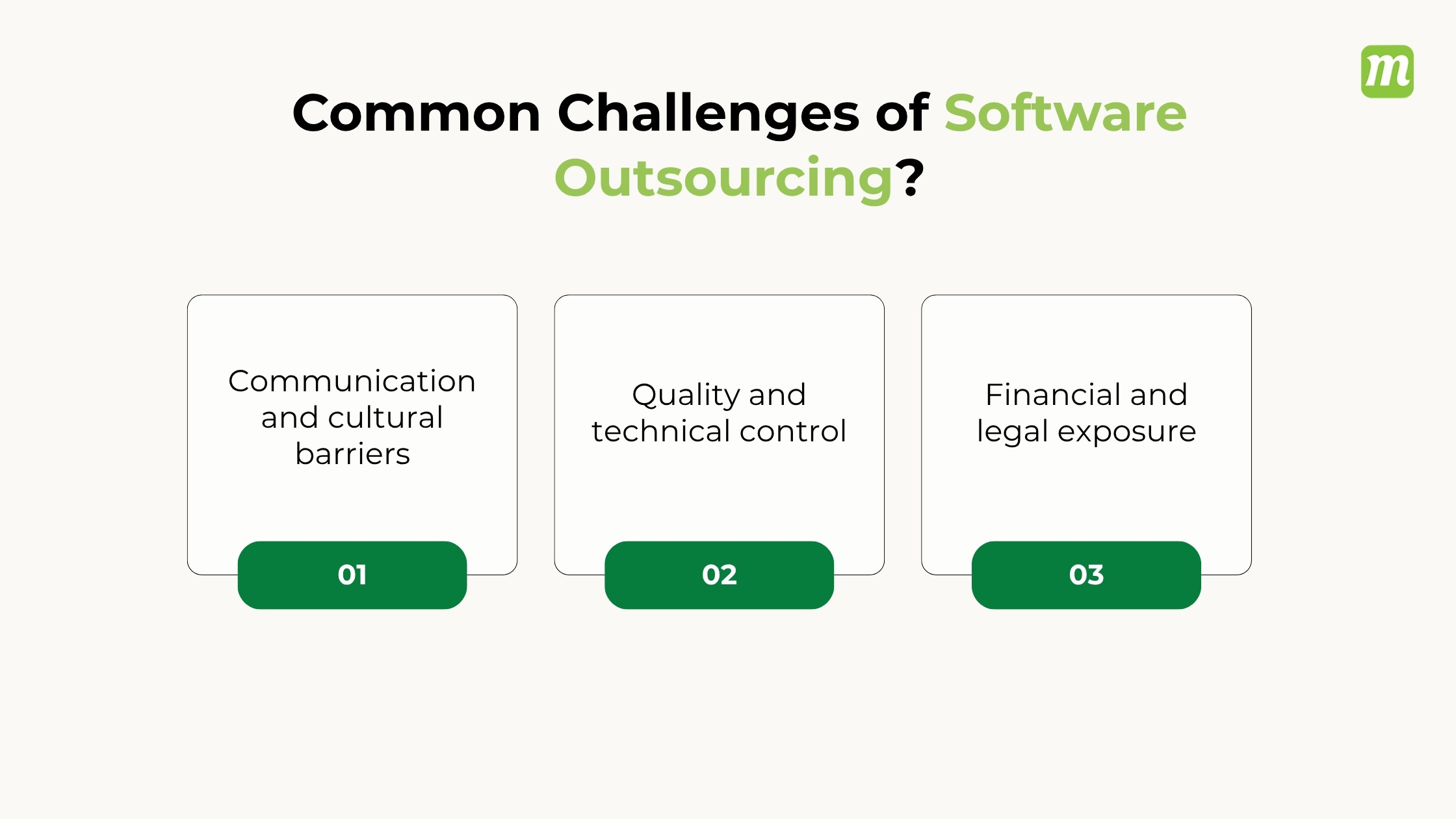
- Communication and cultural barriers — language differences leading to misread specs, differing work-ethic norms, and time-zone delays that slow feedback loops.
- Quality and technical control — inconsistent code review discipline, reduced visibility into day-to-day progress, and mismatched tech stacks.
- Financial and legal exposure — unclear initial requirements leading to scope creep, and weak contracts that leave proprietary data under-protected.
Each of these is manageable with the right structure in place, which is exactly why scope, structure, and communication were called out earlier as the fundamentals worth getting right first.
What Are the Best Practices for Successful Software Outsourcing?
The businesses that get the most out of outsourcing treat it as a structured, ongoing partnership rather than a one-time transaction.
- Define clear, measurable goals and user stories upfront to avoid expensive rework cycles later.
- Choose an engagement model that matches internal technical leadership capacity; a team with no in-house technical lead needs a more hands-on partner than one with a strong internal PM.
- Set up daily stand-ups and weekly sprint reviews using shared tracking tools.
- Establish overlapping working hours for real-time collaboration across time zones.
- Enforce code reviews, automated testing, and CI/CD pipelines as non-negotiables, not nice-to-haves.
- Put NDAs and IP-ownership contracts in place before any work begins, not after.
Frequently Asked Questions
What is software development outsourcing?
It’s the practice of hiring an external vendor, agency, or specialized engineers to design, build, test, or maintain software instead of relying solely on an in-house team.
What are software development outsourcing services?
Software development outsourcing services refer to hiring an external team, through staff augmentation, a dedicated team, or project-based delivery, to design, build, test, or maintain software on a company’s behalf.
What is the outsourcing software development process?
The process generally moves through discovery, requirement gathering, planning, design, development, testing, deployment, and ongoing maintenance, taking a project from an initial idea to a live, supported product.
What is the cost of outsourcing software development?
Outsourcing costs typically range from $20,000 to over $250,000 per project, with global blended developer rates spanning roughly $20 to $180+ per hour depending on region, project scope, and engineer seniority. Entry-level prototypes can start around $5,000, while multi-platform enterprise systems often exceed $500,000.
Is it worth outsourcing software development to India?
India remains a leading offshore outsourcing hub thanks to its large English-speaking talent pool, competitive hourly rates, and mature IT ecosystem, though time-zone gaps and security vetting still require careful planning before signing on.
Is software development outsourcing worth it for a small business?
Generally, yes, particularly for MVPs or projects needing specialized skills a small internal team doesn’t have. The right fit depends more on how clearly the project scope is defined than on company size.
What’s the difference between staff augmentation and a dedicated team?
Staff augmentation adds individual specialists into an existing internal team temporarily. A dedicated team is a standalone external team working exclusively on a company’s roadmap over the long term, with less day-to-day internal oversight required.
What are the biggest risks of outsourcing software development?
Poor code quality, communication breakdowns, loss of project visibility, and intellectual property exposure, most of which stem from weak upfront scoping and contracts rather than a partner’s technical ability.
How do I know if a vendor is a good fit before signing a contract?
Review their track record on projects that resemble yours, check how they communicated during the sales process, confirm their security certifications, and make sure IP ownership terms are explicit in the contract.
Software Development Outsourcing: InnovationM’s Approach
As a digital engineering partner working across AI, cloud, and enterprise platforms, InnovationM applies the same delivery discipline to outsourced engagements that it applies to its own product builds. Every engagement is treated as a technical partnership rather than a transactional hand-off, matched to a client’s actual maturity, timeline, and internal team structure. That shows up in three ways:
- Comprehensive Software Development Outsourcing Services: InnovationM’s engineers and project leads work directly with client stakeholders to shape a build strategy around actual business outcomes rather than a fixed feature list, covering everything from early MVP builds to enterprise-grade platforms.
- Enterprise-Grade Delivery Standards: InnovationM’s teams follow the same security, compliance, and code-review discipline expected by regulated US and UK enterprises, so outsourced work holds up to the same bar as an internal engineering org.
- Tailored Custom Software Development: Rather than fitting a client’s workflow into a fixed process, InnovationM builds around the client’s existing systems and constraints, delivering software shaped to the business, not the other way around.
Businesses evaluating InnovationM as an outsourcing partner can expect transparent, sprint-based reporting, security and IP terms confirmed before kickoff, and the flexibility to scale a team up or down as the project evolves.
Final Thoughts
Outsourcing software development isn’t about handing a project to an external team and waiting for a finished product. It’s a structured decision, one where the engagement model, the partner’s technical fit, and the clarity of the contract matter more than the size of the vendor’s pitch deck.
Get scope, structure, and communication right from day one, and outsourcing becomes what it’s meant to be: a way to extend engineering capacity, access specialized expertise, and move products from idea to market without stretching an internal team past its limits.
Get in touch with InnovationM to talk through what the right engagement model looks like for a specific project.